WASHINGTON — The Supreme Court on Tuesday struck down Watergate-era limits on how much political parties can spend in a coordinated campaign with their candidates.
By a 6-3 vote, the court said the restrictions on parties and their campaign ads violate the 1st Amendment.
Justice Brett M. Kavanaugh said the court was restoring broad free speech protections for parties and their candidates.
“For nearly 200 years after the ratification of the 1st Amendment, parties could spend freely to support their candidates during campaigns and could do so in coordination with the candidates,” he wrote. “Notably, no one suggests ‘that these elections were not functional or that they were marred by corruption’.”
The decision is a victory for the National Republican Senatorial Committee and is likely to give a boost to Republicans this year in their bid to maintain control of Congress.
That’s because the national Republican committees that support their Congressional candidates have $230 million available to spend this year, while the struggling Democratic committees have less than $120 million.
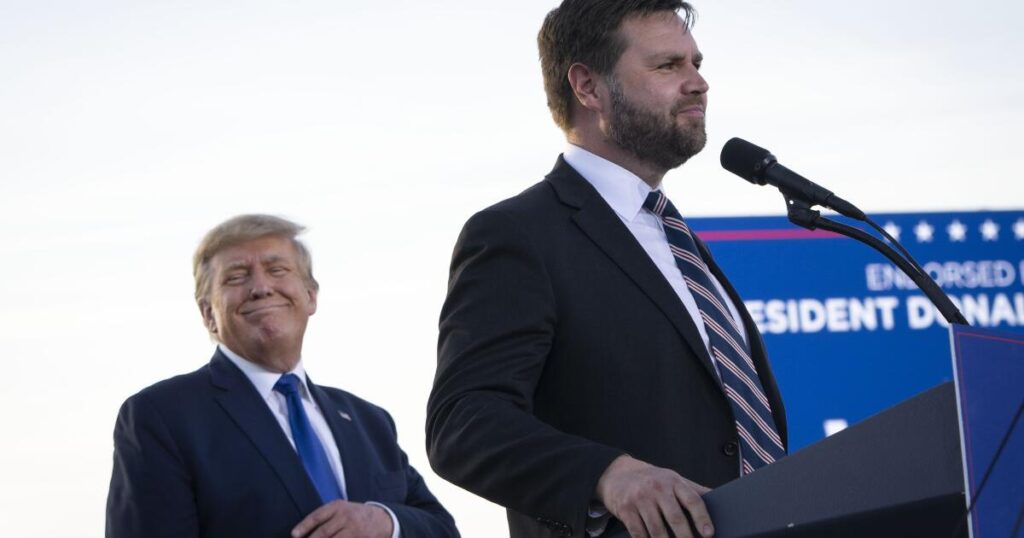
The party funding limits were challenged in 2022 in a lawsuit filed by JD Vance, who was then running in Ohio for a Senate seat, along with the Republican party committees.
Republicans argued these restrictions on parties were outdated and unwise in an era when “SuperPACs” can raise and spend huge amounts of money to promote candidates because they are independent.
If so, they asked, why shouldn’t the parties be free to raise money and coordinate their campaign ads with the candidates?
Under the current limits, the Federal Election Commission says an individual donor may give only $3,500 to a candidate seeking a federal office, but $132,900 to the national party committees.
Since the 1970s, however, federal election law has limited the parties from funding the campaigns of their candidates on the grounds that it could allow wealthy donors to buy influence.
But the court’s conservatives have repeatedly ruled that campaign money is protected as free speech under the 1st Amendment.
In the Citizens United case of 2010, they struck down the laws that restricted election spending by individuals, companies, unions and other groups.
Left standing were the rather low limits on direct contributions to candidates as well as the limits on how much parties could contribute to directly support candidates.
The limitations on parties and how they support their candidates have been disputed for decades.
The Supreme Court upheld the limits by a 5-4 vote in 2001 and said these “coordinated expenditures” were more like contributions than independent spending, and therefore, could be limited to protect against corruption.
Two years ago, the Biden administration defended the law, and an appeals court upheld it based on the court’s 2001 decision.
But last year, the Supreme Court agreed to hear the new challenge in National Republican Senatorial Committee vs. FEC.
Rather than defend the law, the Trump administration sided with the GOP and said the party limits should be struck down.
In dissent, Justice Elena Kagan looked back to the history of the Watergate era.
“For over half a century, a federal statute has guarded against actual and apparent quid pro quo corruption in our political system by limiting the amount of money a donor can contribute to a candidate,” she said. “The law’s theory is simple: A candidate may be induced to trade official acts for campaign contributions—and the bigger the contribution, the stronger both the candidate’s temptation and the public’s suspicion.
“But today, the court rewrites the rules, to allow circumvention of the contribution limits … and ushers back in the same opportunities for quid pro quo corruption that the contribution limits were meant to check.”
Justices Sonia Sotomayor and Ketanji Brown Jackson agreed.
The Democratic National Committee and attorney Marc Elias had stepped in to defend the limits.
He said the parties are free to speak in favor of their candidates but he argued that allowing them to “subsidize the campaign expenses of their candidates” is a contribution that can be regulated.
Otherwise, the “potential for actual or apparent corruption is is obvious,” he said.
The ruling is another election-year boost for the GOP.
Last month, the court’s conservatives ruled the Voting Rights Act did not prevent Republican-controlled states in the South from redrawing congressional districts that favored Black Democrats.
New maps in Louisiana, Alabama, Tennessee and Florida are expected to flip several seats in favor of the GOP.
The post Supreme Court strikes down Watergate-era limits on campaign funds for political parties appeared first on Los Angeles Times.