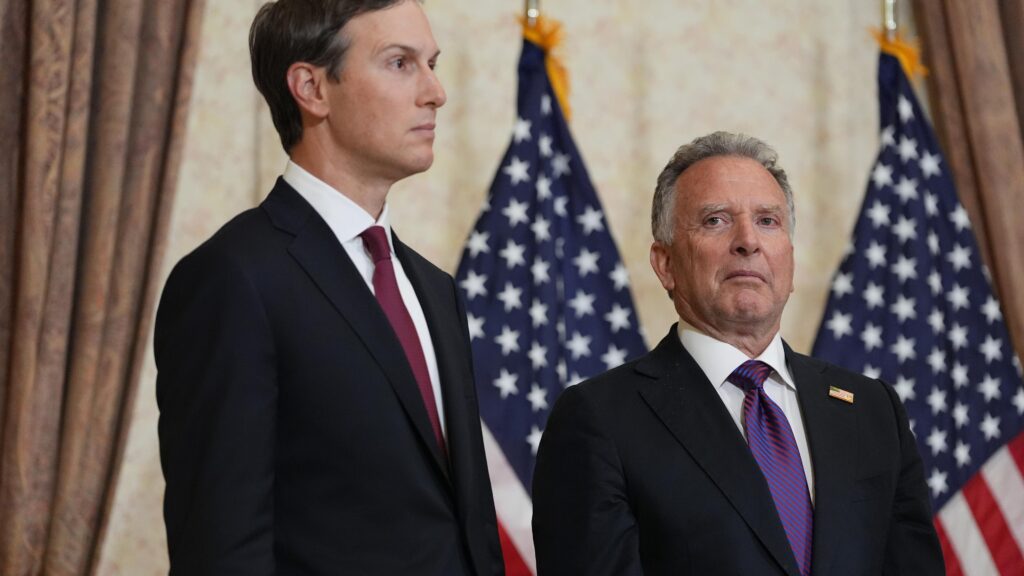
U.S. envoy Steve Witkoff and President Donald Trump’s son-in-law Jared Kushner are set to meet with mediators in Doha to discuss the Iran deal, but there are no planned high-level talks with Iranian officials, according to Qatar’s Foreign Ministry spokesperson.
During a media briefing Tuesday, Majed Al-Ansari said talks between the U.S. officials and Qatari mediators will focus on regional issues, including ongoing negotiations with Iran, but also the conflict in Lebanon.
Witkoff and Kushner are also set to meet with Qatari Prime Minister Sheikh Mohammed bin Abdulrahman bin Jassim Al Thani, a senior admin official told TIME.
There have been conflicting reports over the past 24 hours regarding the status of U.S.-Iran talks, after tit-for-tat strikes throughout the weekend threatened to derail the fragile interim peace agreement.
Trump on Monday declared that Iran had “requested” a meeting and said it would be taking place in Doha the next day, but Iranian officials swiftly rejected the idea that any direct talks had been arranged.
Iranian Foreign Ministry spokesperson Esmaeil Baghaei said Tuesday that an Iranian official will be in Doha, but only to engage in talks with Qatari mediators regarding the interim peace agreement and details surrounding the potential release of frozen Iranian assets.
“No meeting at any level with the American side has been scheduled for the coming days,” he said.
Trump and Iranian officials signed a Memorandum of Understanding on June 17, agreeing to an extended 60-day cease-fire to allow time for further negotiations to take place. That deadline is set to expire around mid-August, yet there appears to have been little progress on technical talks.
A flare-up of violence in and around the Strait of Hormuz has cast doubt over efforts to secure a full reopening of the vital waterway.
Over the weekend, the U.S. and Iran traded strikes after a Singaporean-flagged cargo ship in the Strait was struck on Thursday.
Trump said Iran was responsible for the attack, and the U.S. soon launched retaliatory strikes. Iran responded by targeting U.S. military sites in Kuwait and Bahrain, bringing further instability to the Gulf region.
The U.S. and Iran accused each other of violating the interim agreement. Although both sides have since agreed to stand down, tensions remain high.
Baghaei on Tuesday said the recent strikes undoubtedly had a “negative impact on the ongoing process.”
The ongoing dispute over the Strait of Hormuz
The Memorandum of Understanding states that “the Islamic Republic of Iran will make arrangements using its best efforts for the safe passage of commercial vessels with no charge for 60 days only from the Persian Gulf to the Sea of Oman and vice versa.”
But disagreements remain regarding shipping routes via the crucial Strait, through which around a fifth of global oil production flows.
The traditional route, used before the Iran war, takes vessels on a central voyage down the Strait. However, there are concerns about mines and other high-risk factors. Despite some progress, two merchant vessels were struck last week.
Washington has promoted a southern lane along the coast of Oman, which could enable evasion from Iranian officials.
Last week, Oman announced a temporary maritime corridor in coordination with the International Maritime Organization as commercial traffic gradually resumed after weeks of disruption.
But the Islamic Revolutionary Guard Corps (IRGC) had warned ships to coordinate with its navy and use designated Iranian-controlled routes.
Iran’s Foreign Minister Abbas Araghchi maintains “any interference or attempt to create parallel arrangements will only complicate the situation, increase tensions and delay the reopening of this vital waterway.”
International leaders are in support of a full, toll-free reopening of the Strait.
French President Emmanuel Macron met with Omani leader Haitham bin Tarik on Monday and expressed the two are “working together for de-escalation” in the Middle East.
“We have decided to collaborate jointly, in coordination with our partners, on demining the Strait to secure maritime routes and ensure free and unconditional passage through the Strait of Hormuz,” he said.
However, the move has not been welcomed by Iranian officials, with Baghaei insisting “there is no need for others to intervene” in the management of the Strait.
The post Witkoff and Kushner in Doha to Meet Mediators, But No High-Level Talks Set With Iran, Says Qatar appeared first on TIME.