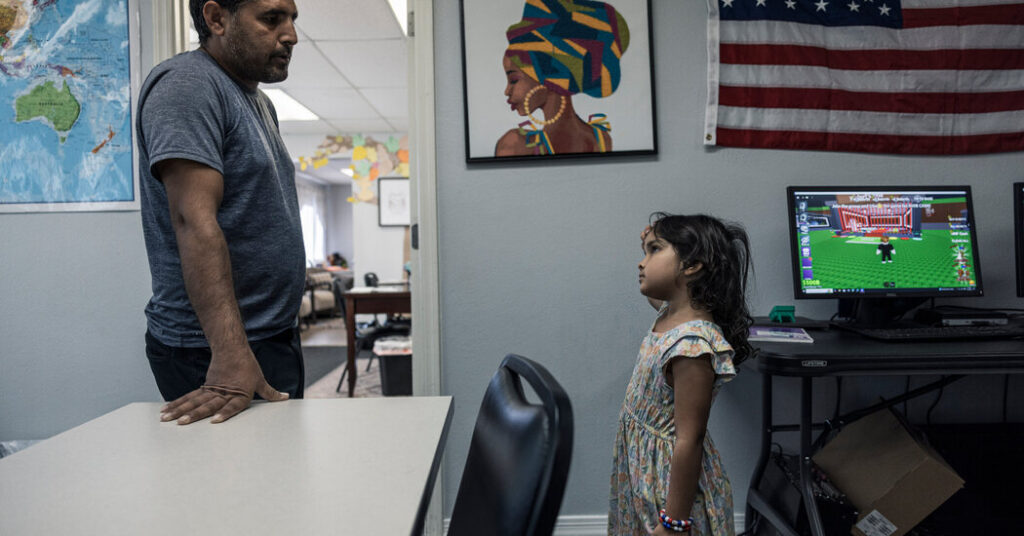
In the frenzied American exit from Afghanistan, Obaidullah Durani, a fighter pilot who had been trained by U.S. forces, was scrambling to get his family out, too. His daughter, Hela, was hoisted over the fence by a Marine at the Kabul airport as the family rushed to make a departing plane. But Mr. Durani’s wife, Shafaro, was separated from him and their two children and never made it onto an evacuation flight.
Allowed to enter the United States through a special program for people who worked with American forces, Mr. Durani settled in Arizona, with his infant daughter and toddler son. He had never changed a diaper in his life, he said, but he was now a single father juggling parenting with delivery jobs. Yet he felt safe in the United States and hopeful that the family would eventually be reunited.
That all changed with the deadly attack on National Guard members last week in Washington, D.C., which authorities say was carried out by a 29-year-old Afghan man.
Following the attack, President Trump directed his administration to suspend all Afghan immigration cases and immigration agents have been ordered to track down nearly 2,000 Afghans who have what are known as final deportation orders but are not in detention.
That threatens the lives built by the Duranis and thousands of other Afghan families in the United States.
Mr. Trump has seized on the shooting to intensify his broader anti-immigration campaign, and he has sought to depict the attack and the man charged, Rahmanullah Lakanwal, as evidence of a dangerously broken system he inherited from President Biden.
“We must now re-examine every single alien who has entered our country from Afghanistan under Biden, and we must take all necessary measures to ensure the removal of any alien from any country who does not belong here or add benefit to our country,” the president said on Truth Social. “If they can’t love our country, we don’t want them.”
All told, about 200,000 Afghans who were considered wartime allies of the United States have been admitted to the United States since the chaotic pullout that concluded the 20-year occupation. Many had worked alongside U.S. troops in combat or on bases; others were employed by organizations — including The Times and other media outlets — as well as institutions that supported U.S. operations or interests.
The rhetoric and the threats from President Trump have stirred panic in communities that are home to many Afghan arrivals, including the Phoenix area where about 4,000 have settled since 2021.
On Monday, after school pickup, Mr. Durani was among dozens of Afghans who crowded the Arizona Refugee Center, a nonprofit in Mesa, outside Phoenix, seeking answers.
He and his children have a green card interview scheduled for Dec. 17. He had many questions: Would the interview still take place. And, if it did, could his family end up being detained? Deported? What about his wife, whose process to enter the United States was now at a standstill?
“Every Afghan is worried,” said Mr. Durani, who delivers Amazon packages. “They shouldn’t punish all of us because of one person.”
“I’m here contributing, working, paying my taxes,” he said. “This is a country of laws and democracy; the man has been arrested.”
The center’s co-founders, Julianna Larsen and Robin Peterson, fielded a barrage of calls even as they coped with the people walking in for help.
“Right now, if you leave the country, you might not be allowed back,” Ms. Peterson told one caller, who had plans to visit family members in Pakistan. “It’s too risky, even if you have a green card.”
Mirwais Daudzai, who also visited the center, works at the Phoenix airport assisting passengers who require wheelchairs. He greets them with a smile, asks about their journeys and eases them into the chairs. When travelers learn that he fled to the United States from his native Afghanistan, he said many tell him they are glad he is safe in America. Some slip him a generous tip.
That kindness seemed to vanish last week, Mr. Daudzai said, after the deadly attack in Washington D.C. and the anti-immigrant measures announced by the government.
On Thanksgiving, the day after the shooting, a traveler was about to hand Mr. Daudzai a $20 bill, but shoved it into her pocket instead after hearing he was from Afghanistan.
It happened againover the long holiday weekend, Mr. Daudzai said. It was a hostility he had not previously encountered since arriving in the United States.
“Before this problem, I’m so happy and relaxed in this country,” said Mr. Daoudzai, 31, . “I have a job, I’m safe, I have no enemies.”
Now, “people are looking at all Afghans as terrorists,” said Mr. Daudzai, who was a police officer in his homeland and is in the United States with his wife. Both have active green card applications.
In the days since the shooting, U.S. officials have disclosed that Mr. Lakanwal was part of a paramilitary force that worked with the C.I.A. and was admitted to the United States as part of the effort to protect Afghan allies after the Taliban returned to power. Earlier this year, Mr. Lakanwal was granted asylum, which allowed him to remain in the United States and to seek a green card and citizenship.
For years, the admission into the United States of Afghans who supported the U.S. military mission in Afghanistan has enjoyed bipartisan support.
After the fall of Kabul in 2021, Americans across the political spectrum mobilized to welcome Afghans in one of the largest volunteer efforts since the end of the Vietnam War. Churches and synagogues in communities from Arizona to Virginia collected donations, furnished homes and taught newcomers how to navigate bus lines.
Before being allowed into the United States, the evacuees underwent extensive vetting. Many spent weeks or months in overseas way stations, such as Qatar, where they had to complete security checks, medical screenings and immigration paperwork. Once in the United States, they typically spent weeks on military bases before being resettled in communities across the country.
Most of them entered the United States with a special status called humanitarian parole under a program called Operation Allies Welcome. They then applied for asylum, which put them on the path to permanent residency in the country that gave them safe haven.
“They have worked for the last four years to achieve stability and integrate into American life,’’ said Ms. Larsen, co-founder of the refugee center in Mesa.
Thousands of Afghans awaiting approval have been stranded in third countries, including Pakistan, which has stepped up its own expulsion of Afghans who have settled there.
The Trump administration had already sharply restricted Afghan immigration as part of a travel ban announced in June, dashing hopes of many separated families that they would be reunited any time soon.
But the future of many Afghans, both those already in the United States and those hoping to immigrate, has been clouded by the Nov. 26 shooting, which killed one Guard member, Army Specialist Sarah Beckstrom, 20, and wounded another, Andrew Wolfe, 24.
President Trump has announced additional measures that could jeopardize the ability of Afghans in the United States to remain permanently. Among them is a plan to conduct new security checks of people already granted green cards, or lawful permanent residency.
As of Tuesday, the Trump administration has suspended the processing of all immigration applications filed by nationals of 19 countries, including Afghanistan, who had been barred from entering the United States under an executive order Mr. Trump issued in June. It is unclear when, or if, the suspension might be lifted.
Hekmatullah, 38, who said he was a former spokesman for the Ministry of Transport in Afghanistan, visited the center to seek camaraderie with fellow Afghans. His immigration status is especially precarious.
He, his wife and their three young daughters fled first to Iran, then to South America, where they joined the wave of humanity trudging through the perilous Darien Gap to make their way to North America.
They crossed the U.S. border with Mexicoearly last year and headed to Phoenix, where a brother-in-law, a former cargo plane pilot, had been resettled in 2021.
Hekmatullah, who spoke on condition that he be identified only by his first name to protect relatives in Afghanistan, applied for asylum, got a work permit and found a job at the airport.
His daughters, 11, 9, and 7 are thriving in school and already speak flawless English. In Afghanistan, they would be deprived of educational opportunities because they are girls.
“My kids are the most precious thing I have,” he said, as his daughters played on computers.
“If there was no Taliban and the country had stability,” he said, “I would not have left my country.”
Now Hekmatullah fears their asylum case, and their future in the United States, could be in jeopardy.
“We left because of fear,” he said. “Now fear is following us.”
On Tuesday, rumors that federal agents were spotted near an Amazon warehouse prompted many Afghans to skip work delivering packages.
Several men gathered at the Arizona Refugee Center to compare notes. Whether they had asylum or permanent residency, they were unwilling to risk an encounter with U.S. Immigration and Customs Enforcement, they said.
“I have a green card in my pocket,” said Khalil Sarwari, 48 producing it as proof. “But this crazy person caused big problems for everyone.”
Before starting his afternoon shift pushing wheelchairs, Mr. Daudzai stopped by the center, where he has been taking English classes. He also had a previously scheduled appointment there with a real estate agent.
His eyes were bloodshot from a sleepless night. Out of the blue, it seemed, the subcontractor that employs him at the airport had asked him to bring in his documents for review for the first time in more than two years.
“I’m so confused,” he said. “Do I buy a home? Or am I going to be deported?”
Miriam Jordan reports from a grass roots perspective on immigrants and their impact on the demographics, society and economy of the United States.
The post From Welcome to Worry: Afghans in the U.S. Face Uncertainty, Backlash appeared first on New York Times.