THE MIDNIGHT SPECIAL: The Secret Prison History of American Music, by Colin Asher
Colin Asher’s new book takes its title from the traditional folk song “The Midnight Special,” recorded most famously by the singer Lead Belly at Angola prison in 1934 and by Creedence Clearwater Revival more than three decades later. The song refers to a passenger train whose headlight is thought to be a beam of salvation for anyone behind bars. If the train’s “ever loving light” shines upon you, you may be released.
Asher’s book is a Midnight Special of its own. It’s a fog-piercing down-bound train of a book, better than it had to be. Subtitled “The Secret Prison History of American Music,” it examines how the police, courts and penitentiaries have shaped the nation’s musical culture through profiles of five artists: Lead Belly, Elmo Hope, Johnny Cash, Ike White and Tupac Shakur.
If these profiles had been straightforward, that might’ve been enough. But Asher is a calm and sophisticated storyteller who picks you up and sets you back down in places you didn’t anticipate. Like a good film director, he knows how to stagger his material. Minor characters rise, become major ones, then fall back.
“The Midnight Special” reminded me of the best episodes in Season 1 of Tyler Mahan Coe’s exceptional country music podcast, “Cocaine and Rhinestones,” and not just because both take an interest in Spade Cooley, the Western swing musician who went to prison for murder in 1961 and then became a mentor to many locked-up performers. Both Asher and Coe have a knack for the ideal detour.
Johnny Cash (1932-2003), the only white performer discussed here, occupies a central place. He doesn’t get more room than anyone else. But because he caught vastly more breaks than the Black musicians did, his career is a useful point of comparison.
Cash sang about shooting a man in Reno just to watch him die, recorded landmark albums while performing in California’s Folsom and San Quentin prisons, and cultivated an outlaw, hardened persona. But though he was repeatedly arrested for mayhem related to drugs and alcohol, he never spent more than a night in jail. Instead, he repeatedly received slaps on the wrist. His habit (amphetamines) wasn’t criminalized the way other narcotics were.
Asher respects Cash, who recognized the humanity of incarcerated men and became a spokesman for them. Cash counseled musically gifted prisoners and took some to play alongside him on tour. He spoke to Congress about prison reform and pushed for rehabilitation programs.
But Asher considers the levels of achievement Black artists might have reached if society had granted them the level of compassion and forgiveness Cash received. “The obverse is worth considering, too — the great cultural loss the world would have suffered if Johnny had been treated the way his Black peers were,” he writes.
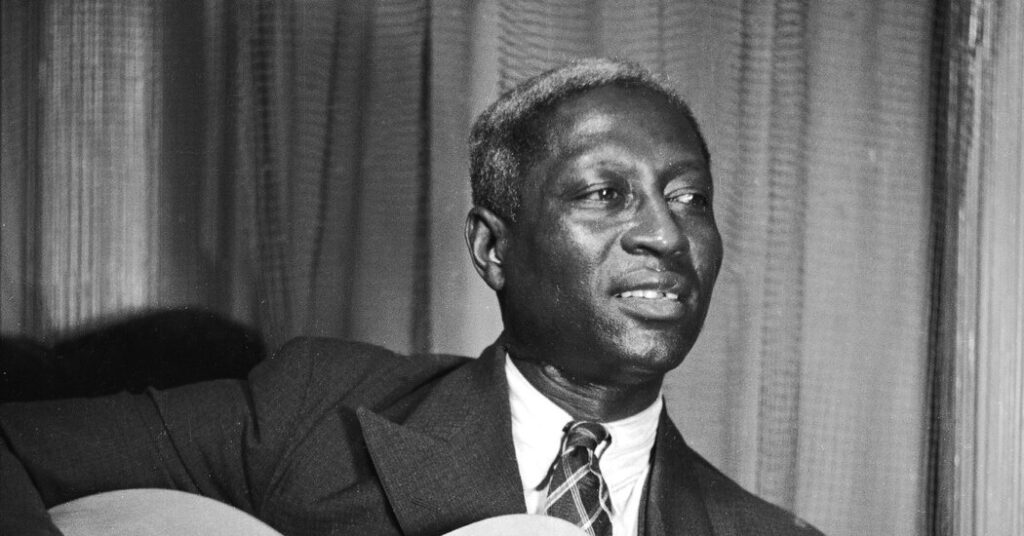
The chapter on Lead Belly, or Huddie (pronounced HEW-dee) Ledbetter, tells a tangled story that is not easily summarized. Born in 1888 or ’89, Ledbetter was incarcerated multiple times throughout his life. Asher has a lot to say about how criminality became shorthand for Black authenticity. He describes how the musicologist John Lomax, who first recorded Ledbetter, shaped his “primitive” image and made him perform in prison garb.
Lomax, though hardly a pure villain, often treated Ledbetter shabbily. He employed the musician as his valet, took an outsize chunk of his earnings and confiscated his tips. He was controlling. He wouldn’t allow Ledbetter to sing the songs he longed to sing, ones that had no connection to prison.
The chapter on Elmo Hope (1923-67) is a heartbreaker. A pianist, composer and arranger, Hope was a bebop pioneer who grew up in the Bronx. Among his closest friends were the pianists Bud Powell and Thelonious Monk. He was upbeat; people liked and admired him.
Hope was put away on Rikers Island after a string of arrests stemming from his heroin habit. He was allowed to join the jail’s band, a virtual who’s who of New York jazz greats, and played alongside Sonny Rollins, who was sent to Rikers after a foiled robbery. This book lingers on how Hope and so many other musicians, including Billie Holiday and Charlie Parker, were denied cabaret licenses because of their convictions, deforming their careers by rendering them unable to perform in New York City clubs that served alcohol.
Hope was forced to retreat to California and later fell again into drug use. The chapter about him ends with an account of the recording sessions for his classic 1963 album “Sounds From Rikers Island.” “The Midnight Special” will frequently send you to your turntable.
Ike White (1945-2014) was a soul and funk prodigy who was sent to prison at 19 for the killing of a convenience store owner during a botched holdup. White attempted suicide but came to find meaning in music, thanks to a warden at San Quentin who encouraged inmates’ creativity.
White was discovered after he backed Eric Burdon, then with the band War, and the soul shouter Jimmy Witherspoon, during their appearance at San Quentin. White’s guitar work on the blues standard “Goin’ Down Slow” was so psychedelic and soulful that Burdon and Witherspoon, who recorded the show, included the live version on their 1971 album “Guilty!” (That album has been rereleased as “Black and White Blues.”)
White went on to record an ambitious album, “Changin’ Times,” in 1974 at San Quentin. Stevie Wonder provided a blurb for the cover. But by the time it was finally released, in 1977, its psychedelia seemed dated and it didn’t take off. It deserves rediscovery.
Asher enters the story of the rapper Tupac Shakur (1971-96) via his mother, Afeni Shakur, the political activist and Black Panther who spent two years in prison before her acquittal as part of the Panther 21. While locked up, she was pregnant with Tupac.
She was not always an ideal mother, but she had her moments. When Tupac acted up, she made him read that day’s New York Times aloud from the first word to the last.
He inherited his mother’s ideas, and her distrust of authority. Asher considers how much of Tupac’s “Thug Life” persona was real and how much was put on. (In high school he loved “Les Misérables.”) Asher links the themes in Shakur’s songs to those in Lead Belly’s and notes that, unlike Lead Belly’s characters, Shakur’s fought back.
Here, too, Asher cites the perceived connection between criminality and authentic Black expression. He suggests that Shakur, who served time for a sexual-assault conviction, wanted to escape his gangsta-rap image before Suge Knight, the head of Death Row Records, forced him back into it.
Taken together, the profiles in “The Midnight Special” amount to a multilayered indictment of America’s prison system, the largest in the world. None of these men were blameless, but the injustice on display will frequently make you sick to your stomach. The book also underlines sheer human resiliency.
When White was put in solitary confinement for months at San Quentin, he passed the time by singing. “As far as I was concerned,” he said, “I was at Carnegie Hall … close my eyes and that’s where I was, man.”
THE MIDNIGHT SPECIAL: The Secret Prison History of American Music | By Colin Asher | Norton | 308 pp. | $29.99
The post American Music and American Prisons Overlap More Than You Know appeared first on New York Times.