China is intensifying a campaign of pressure on Japan. In recent days, China has banned more Japanese companies from receiving Chinese exports. It and Russia flew bombers near southwest Japan. It has confirmed that two Japanese businessmen in northeastern China were detained.
The campaign started in November, when Prime Minister Sanae Takaichi of Japan said her country could help defend Taiwan — which China considers part of its territory — in the event of a Chinese invasion. China has since reduced flights and academic exchanges, and continued to ban imports of Japanese seafood.
Now China is using its most powerful weapon: its control over rare earths, which are essential for manufacturing. Analysts say the scale and diversity of the measures is the worst in many years.
“The approach China is taking is truly comprehensive, and each tactic is interconnected,” said Shin Kawashima, a professor at the department of international relations at the University of Tokyo.
De Facto Ban on Rare Earths Exports
China’s commerce ministry announced new controls on Monday that banned dozens of Japanese entities from importing any Chinese items that could have military applications. The entities included the state-run National Institute for Defense Studies and military affiliates of Mitsubishi Electric.
The measure expanded a blacklist, first announced in February, that had targeted 20 Japanese entities. The ministry also added another 20 Japanese companies to an export watch list, subjecting them to more scrutiny.
For the Japanese companies on China’s export control list, the move amounts to a de facto ban on Chinese rare earths, according to Yoshikiyo Shimamine, a senior fellow at the Dai-ichi Life Research Institute.
The Chinese authorities, he said, “will likely spend a considerable amount of time reviewing whether it’s for military use, effectively reducing rare earth exports to almost zero.”
Beijing has used this playbook before, in its trade war with the United States. By threatening to throttle the world’s supply of rare earths, Beijing was eventually able to strike a trade deal with Washington to avoid the worst of President Trump’s tariffs.
“The Chinese government perhaps believes that through continuous pressure, Japan may yield. Because China is a major country and with the U.S.-China trade war, Trump has continued to back down,” said Xing Yuqing, an economics professor at the National Graduate Institute for Policy Studies in Tokyo.
Warnings of ‘New Militarism’
China’s government said it had imposed its latest sanctions in response to Tokyo’s “new militarism.” Beijing has criticized Japan’s decision to revise its laws to allow the export of lethal weapons.
Ms. Takaichi is an outspoken critic of China and has promised to raise Japan’s military spending to 2 percent of gross domestic product. Japan believes that it must modernize its forces to keep up with China’s rising military clout in the region.
Also provocative to Beijing is Japan’s recent military cooperation with the Philippines, including Tokyo’s decision to send decommissioned warships to the Southeast Asian country and participate in joint parachute exercises this month.
Ships and Jets
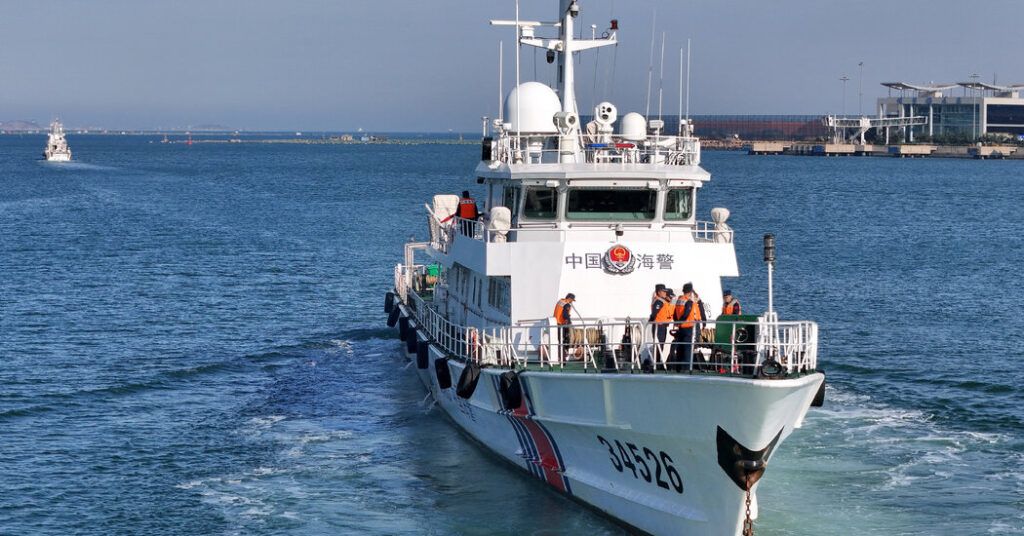
Earlier this month, China’s coast guard patrolled the waters east of Taiwan, where China, Japan and Taiwan all have competing maritime claims. Beijing called it a ”maritime traffic enforcement operation,” in which it inspected vessels in the area.
Chinese state media suggested that the presence of Chinese vessels there could become routine. China’s foreign ministry said the operation was in response to an announcement by Japan and the Philippines that the two countries would hold talks on their maritime boundaries, which would likely involve the waters near Taiwan.
“China views each of these steps as a provocation to the reddest of red lines, which is Taiwan,” said William Yang, senior analyst for Northeast Asia at International Crisis Group. “So that’s why we are seeing this series of escalations.”
On Saturday, a joint Chinese-Russian bomber patrol of 15 planes passed over the Sea of Japan, prompting Tokyo to scramble fighter jets to meet them.
Historical Enmity
Relations between China and Japan have for decades been prone to flare-ups over territorial disputes and Japan’s brutal World War II occupation, for which Beijing believes Tokyo has never sufficiently apologized.
The last time in recent history that relations between the two countries reached such a low point was in 2010, when two Japanese naval vessels collided with a Chinese trawler near uninhabited islands — known as Diaoyu in China and Senkaku in Japan — that Japan controls but China also claims. At the time, Beijing halted rare-earth exports to Japan for only two months.
In the years since, China surpassed Japan to become the world’s second-largest economy and invested heavily to modernize its military.
While Tokyo has not retaliated against China’s measures, Ms. Takaichi has also not recanted her comment from November, and is unlikely to do so. The incident may be cover for Beijing to pressure Japan at a time when Tokyo’s most important ally, the United States, is distracted in the Middle East.
“It would seem Beijing prefers antagonizing Tokyo. To what purpose? Perhaps simply to show that it can,” said Sheila A. Smith, a senior fellow at the Council on Foreign Relations.
The post China Tightens the Screws on Japan appeared first on New York Times.