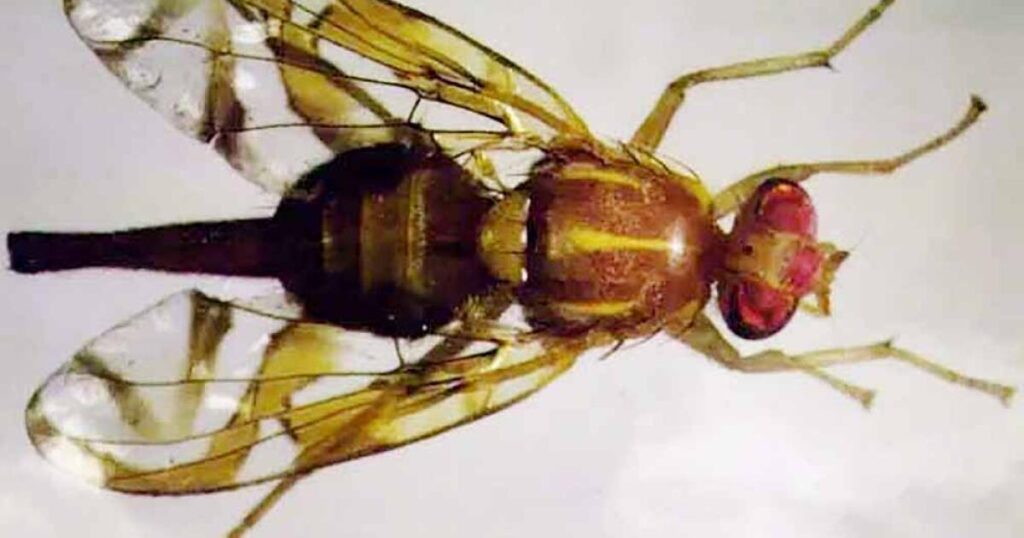
Millions of sterile male Mexican fruit flies will be released over parts of San Diego County, after one mated female fruit fly was detected around Spring Valley, according to food and agriculture regulators.
In an effort to dramatically reduce the population of the harmful fruit fly, authorities will launch a “sterile insect technique,” which means the sterile male flies will be dispersed either from the air or the ground to mate with wild female flies, resulting in an end to the fly’s reproduction process.
Sterile insect technique has been used for years to decrease and control pests. A news release from the California Department of Food and Agriculture did not say when the fly release would begin or end.
Mexican fruit flies are one of the world’s most destructive pests when laying their eggs, destroying or damaging fruit such as apples, grapefruits, avocados, peaches and pears, according to the California Department of Food and Agriculture.
In March, a quarantine was placed over La Mesa after multiple Mexican fruit flies were found. In a news release last week from the department, a new quarantine area in San Diego County was expanded by 19 square miles.
The quarantine now boarders El Cajon, Proctor Valley, Lemon Grove and McGinty Mountain— with a total of 76 square miles of San Diego County under quarantine.
In affected areas of San Diego County, the fly release rate will be about 250,000 male Mexican fruit flies per square mile per week. The male fruit fly release will take place in an area “50 square miles around the infestation,” the food and agriculture agency said.
The Mexican fruit fly enters California when travelers bring fruits or vegetables back from regions that are infested, according to the department. .
An adult Mexican fruit fly is larger than the average housefly, with a 1.0-cm-long body. Originally native to Mexico, the insect has been detected in Belize, Costa Rica, South Texas’ lower Rio Grande Valley, El Salvador and Guatamala.
Female Mexican fruit flies lay thousands of eggs in their lifetime. Once the eggs hatch into larvae inside the fruit, the rotting process begins.
Mexican fruit flies are also known to host inside nuts and vegetables, according to the USDA’s Animal and Plant Health Inspection Service.
Ongoing quarantines can affect locals who grow and sell fruits and also residents of the affected areas. Agriculture regulators advise home gardeners to either consume homegrown produce on site or not move it at all from the property to prevent the spread of the fly to nearby regions.
The post Millions of sterile male Mexican fruit flies to be released in San Diego County appeared first on Los Angeles Times.