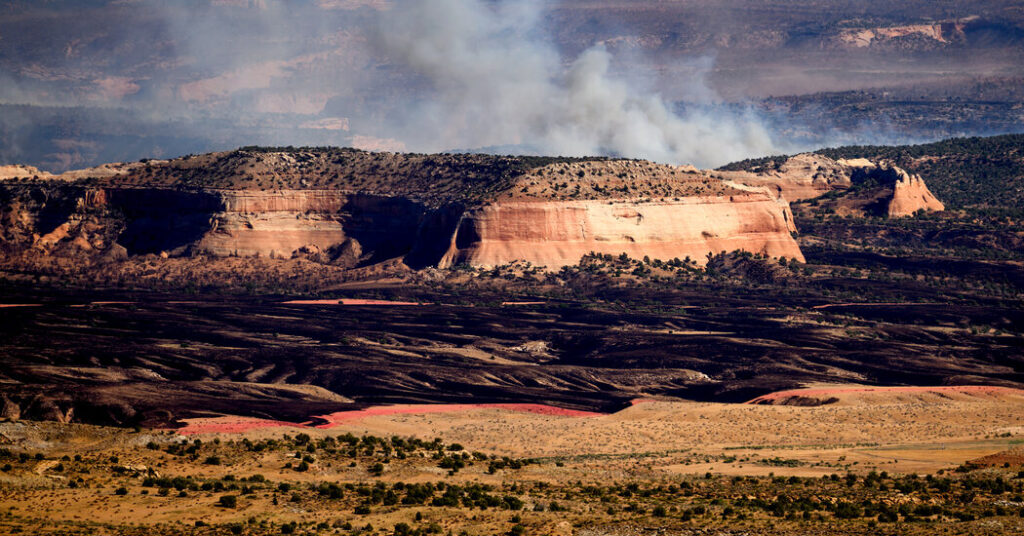
In the days before wildfires raced up and down mountain slopes in the Southwest this past weekend, National Weather Service forecasters issued rare red flag warnings and said the weather conditions would be “extremely critical” across several states.
“We knew this event was coming. We saw it at least a week or so in advance,” said Brooke Scholtens, a meteorologist with the Weather Service in Grand Junction, Colo.
Most of the Western United States recorded historically low amounts of snow this past winter, resulting in drier conditions this spring and summer that have left the landscape parched and highly flammable. More than 75 percent of the West is in at least a moderate drought, according to the U.S. Drought Monitor, and some of the most severe conditions are near where these fires are sparking.
Early last week, an elite group of fire forecasters began highlighting portions of Arizona, Utah and Colorado for critical fire conditions. By Thursday, they started upgrading the forecast to the highest risk level: an “extremely critical” designation.
The designation, issued by a part of the Weather Service called the Storm Prediction Center, means that fires are more likely to spark and are harder to contain if they do.
At that point, some fires were already burning, including one of the most destructive in Utah’s history, the Cottonwood fire. And more were expected.
“When we issue extremely critical, we don’t pull that lever very often,” Nick Nauslar, the fire science and operations officer for the Prediction Center, said on Thursday, just after the designation was put in place for Friday’s conditions. He said that forecasters were trained to reserve the category for “an exceptional situation,” noting the usage only a handful of times a year.
Forecasters then extended the designation into Saturday. While a single “extremely critical” warning is rare, having them on multiple, consecutive days is not entirely unheard-of, according to Bill Bunting, an expert with the Weather Service. It’s more likely to occur when a large-scale weather pattern is persistent or changes slowly, he added.
By Saturday, Ms. Scholtens said, forecasters considered issuing an even more dire warning for wildfire conditions in the area, a “particularly dangerous situation” designation, but they refrained because not many fires had sparked, despite the conditions.
But as dry lightning swept across the region and new fires ignited, the forecasters wanted the warnings to stand out to a population accustomed to fire conditions this time of year.
“With these fire starts, it was kind of necessary for the public to kind of lock in and understand” the risk, Ms. Scholtens said.
By Sunday morning — with brutally arid conditions and 50 mile-per-hour winds — forecasters became convinced that lives were in danger. The Grand Junction office of the Weather Service issued a red flag warning with the “particularly dangerous situation,” a first for that office.
“Typically, red flag warnings are pretty common for us in the summer here,” Ms. Scholtens said. “The P.D.S. flag really declares it as what it is. We believe that this is a particularly dangerous situation. We’re worried about structures. We’re worried about the people.”
On Sunday, three firefighters working to contain a fire near the Colorado-Utah border died.
The Grand Junction office was not alone in escalating its warnings as the week unfolded. Forecasters with the Salt Lake City weather office also issued a red flag warning with the particularly dangerous situation language last Thursday afternoon and continued to use it through the weekend.
While the warning has existed within the Weather Service decades — the phrase “particularly dangerous situation” was first used during a tornado outbreak in April 1982 — it’s only recently that meteorologists, searching for ways to communicate increasing levels of urgency, have begun to apply it to other types of weather events, including wildfires.
It was first written into a fire weather warning in Nevada in 2017, and the Salt Lake City office used it unofficially for two wildfire events in 2019 and 2020.
Though critical fire weather outlooks and red flag warnings do not always result in disaster, forecasters’ warnings of uncontrollable fires typically manifest on these more strongly worded days.
While it is often not difficult to predict the worst weather conditions, it remains nearly impossible to predict the actual ignition of a wildfire.
The post How the Deadly Southwest Wildfires Were Poised to Spark appeared first on New York Times.