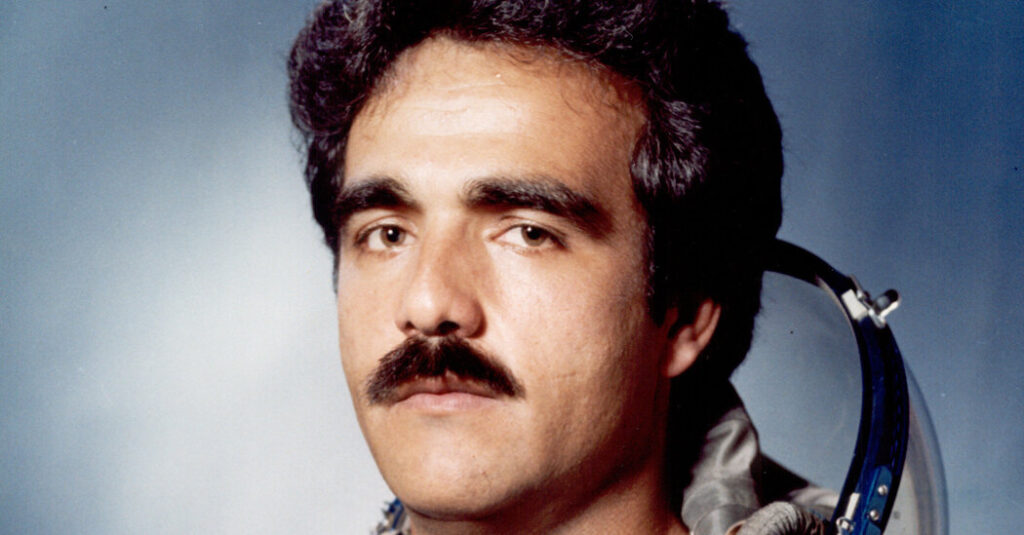
Abdul Ahad Momand, Afghanistan’s only cosmonaut, who flew on a Soviet mission to the Mir space station during the waning days of the Soviet Union’s war in Afghanistan, died on June 21 in Germany. He is believed to have been born in 1959, though the exact date is uncertain.
His family said on social media that the cause was cancer, but did not provide any other details. He had lived in Stuttgart, Germany, since 1992.
Captain Momand’s spaceflight “inscribed the name of Afghanistan in the realm of global space exploration,” his family wrote on Instagram, “and became a source of pride and inspiration for generations of his fellow countrymen.”
A pilot in the Afghan Air Force, Captain Momand blasted off from Kazakhstan on Aug. 29, 1988, with two other cosmonauts, Col. Vladimir Lyakhov, the commander, and Valeri Polyakov, a doctor, aboard a Soyuz TM-6 spacecraft.
The flight was part of Intercosmos, a Soviet program that sent the country’s cosmonauts into space alongside those from allied nations — including Poland, Romania, Czechoslovakia, Bulgaria, Cuba, Vietnam and Afghanistan — as well as astronauts from Britain, France and Japan.
During the voyage, Captain Momand worked on various experiments and used sophisticated cameras to photograph Afghanistan from space to determine which regions were arable or rich with minerals.
His mission also involved an effort “to accurately map the country,” Asif Siddiqi, a history professor at Fordham University who has written about the Soviet space program, said in an interview. “Momand talked about growing up without accurate maps of his country and how this spaceflight might help get them.”
In 2017, Captain Momand told Sputnik, a Russian state-owned news agency, “The view of Earth from Mir’s porthole brought me enjoyment incomparable to any other.”
With his country at war with the Soviet Union, Captain Momand made a plea for peace during a phone call from space with President Mohammed Najibullah of Afghanistan. “Take your neighbor by the hand, lay down your arms,” he said. “Let’s solve our problems through dialogue.”
Capt. Momand said on state-run Soviet TV that from space, the violence in his homeland was invisible. “I would like to believe,” he said, “that such will be the situation on the land inhabited by my brothers and sisters, on the land of our fathers and mothers who have suffered so much during the years of war.”
At the Afghan government’s request, he also read a prayer from the Quran, the holy book of Islam, broadcast on Soviet TV. “Ahad put on a skullcap to do it,” Colonel Lyakhov told the BBC in 2014. “He was being filmed from below, and I was just out of the shot, hanging on to his legs to stop him floating off.”
Abdul Ahad Momand was born in Sardeh Band, a town in Afghanistan’s Ghazni province. As a boy, he dreamed about the possibilities of flight.
“Sometimes,” he told the BBC, “planes would appear overhead and I would think how great it would be if I could fly.”
Eventually, he got the chance. After graduating from Kabul Polytechnic University, he was drafted into the Afghan Air Force in 1978 and trained at two military academies, including the Gagarin Air Force Academy near Moscow. By the time he joined Intercosmos, he had risen to become the chief navigator at Bagram Air Base in Afghanistan. After an Afghan colleague got appendicitis, Captain Momand took his place on the 1988 mission.
The mission was originally supposed to take place the next year, Dr. Siddiqi said, but “the whole idea of launching an Afghan into space was entangled with the Soviet invasion and the war in Afghanistan. The Soviets wanted to get Momand off the ground before they withdrew, which meant bringing the mission forward by about a year.”
By the time Captain Momand and his crewmates flew to the Mir, Soviet troops had already begun to withdraw.
The voyage out went smoothly, but the return flight was a near disaster. Captain Momand and Colonel Lyakhov had to abort their first attempt at re-entry when rays from the sun caused the malfunction of an infrared sensor in the guidance system. (Dr. Polyakov had remained on the space station.) A second attempt failed when the engine fired for six seconds rather than the necessary four minutes.
The failures forced the cosmonauts to orbit Earth for another 25 hours, with limited oxygen and food. They finally landed on Sept. 7, although the onboard computer had begun the same re-entry sequence that had failed after the remote sensor malfunctioned.
Captain Momand told the German broadcaster DW in 2021 that he and Colonel Lyakhov were, at one point, “exactly two seconds away” from never returning to Earth. “If we hadn’t deactivated the autopilot,” he said, “the engines would have come off on schedule and we wouldn’t have ever reached the atmosphere.”
Back in Afghanistan, he was greeted with a reception in his honor in Kabul. But a storm of artillery fire erupted nearby, a sign of the ongoing war.
Captain Momand did not remain in Afghanistan for long. He served briefly as the deputy minister of civil aviation. But in 1992, as the Soviet-backed government collapsed and civil war erupted among the Islamic mujahedeen groups and militias, he fled to Germany, where he requested political asylum.
“The country was divided: a province for each warlord, all fighting each other, following the orders from their respective foreign backers who, like today, interfered in the affairs of Afghanistan,” he told DW. “They ruined the country, and many people died.”
In Germany, he worked in the printing business and later as an accountant. His survivors include his wife, Zulfara, two daughters and a son.
In 2013, when Captain Momand returned to Afghanistan to celebrate the 25th anniversary of his spaceflight, he met with President Hamid Karzai and went stargazing with a group of young astronomers and their teachers. As they parted, one of the teachers recalled watching, with hope for the future, as Captain Momand spoke from space to President Najibullah.
“You told him that Afghanistan was very beautiful from space,” the teacher said, as Captain Momand recalled in the BBC interview. “And that it looked so peaceful.”
The post Abdul Ahad Momand, Only Afghan to Fly in Space, Is Dead appeared first on New York Times.