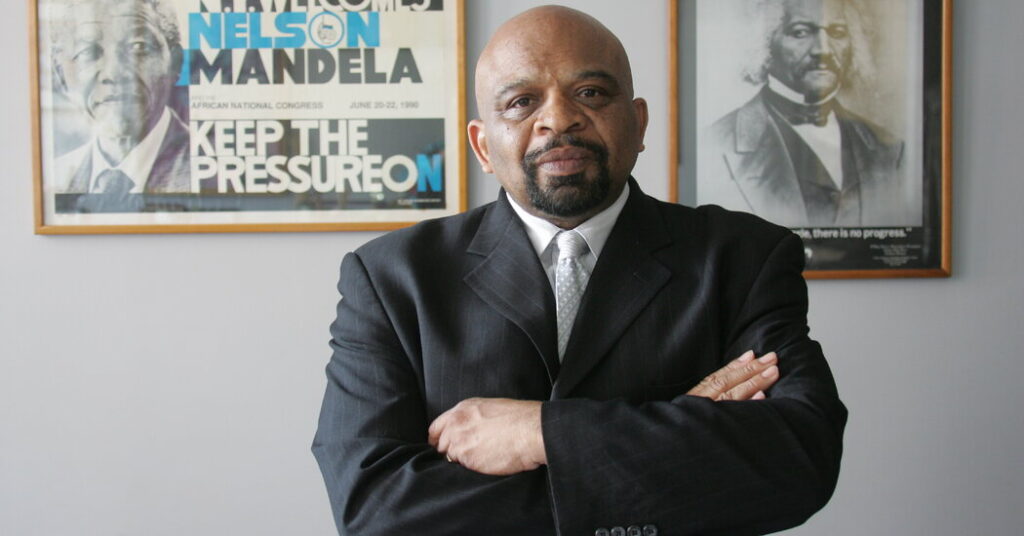
George Gresham, a hospital custodian who became a significant political force as the longtime president of the largest health care workers union in the United States before being ousted in an election last year amid accusations of self-enrichment, died on May 8 in the Bronx. He was 71.
His death, at a hospital, was confirmed by his sister, Davelin Gresham. She did not provide a cause.
Local 1199 of the Service Employees International Union United Healthcare Workers East, which Mr. Gresham led from 2007 to 2025, said his death followed “a long illness.”
During Mr. Gresham’s six terms as president of Local 1199, its membership expanded to 450,000 from 300,000 health care workers along the East Coast. He held particular sway in Democratic Party politics in New York City and statewide, endorsing candidates and deploying a powerful get-out-the-vote operation.
After his death, Gov. Kathy Hochul of New York directed flags across the state to be flown at half-staff in his honor. In a statement, she called Mr. Gresham a “legendary labor leader who never stopped fighting for working people, communities of color and the dignity every New Yorker deserves.”
Local 1199 established itself as a political force in the late 1980s, helping elect David N. Dinkins as New York City’s first Black mayor. The union offered key early support to Democratic officials like Representative Nydia M. Velazquez, Senator Chuck Schumer and Mayor Bill de Blasio, but maintained good relationships with important Republicans, too. In 2007, when he took over as president from Dennis Rivera, Mr. Gresham cited the maxim, “We have no permanent friends; we have permanent interests.”
In 2016, Andrew M. Cuomo, then the governor of New York and a close ally of Mr. Gresham’s, listed him among the leaders who had helped win the battle to increase New York’s minimum wage to $15 an hour from $9. That year, City & State New York, a news organization, named Mr. Gresham the most influential person in the Bronx, his longtime home, noting that there “is no union in New York City or the state as powerful as 1199 SEIU.”
As he rose through the ranks, Mr. Gresham held every elected position in the union; stood at the forefront of a campaign to increase Medicaid funding for New York hospitals and nursing homes; improved staffing levels at health care facilities; and secured wage and benefit gains for workers, along with upgraded funding for continuing education, child care and retirement.
But he failed in his bid for a seventh term in May 2025, a month after a Politico investigation found that he had used union funds to benefit himself, his family and political allies.
Among the payments he authorized, according to Politico, were a $50,000 “legacy award” for the Rev. Jesse Jackson, a longtime ally who faced mounting medical bills; $60,000 to cover Mr. Gresham’s daughter Siana’s costs to serve as his caregiver on business trips; hundreds of thousands of dollars spent on events and concerts, ostensibly for get-out-the-vote purposes, that coincided with Gresham family reunions in a small town in Virginia; and hundreds of thousands paid yearly to the production company of a former union driver who held lavish rallies and parties for the union, and who several times hired Mr. Gresham’s son, James, as a D.J.
Mr. Gresham, whose annual salary as president was $300,000, denied any wrongdoing, and a union spokesman said in a statement to Politico that the allegations of financial impropriety were “categorically false.” An independent review of the union’s finances has not been made public.
He was soundly defeated by a top lieutenant, Yvonne Armstrong, whose spokeswoman accused Mr. Gresham of a “pattern of financial misappropriation and lack of transparency.” After becoming president, Ms. Armstrong vowed to lead with “openness, urgency and purpose.”
George Kermit Gresham was born on Feb. 8, 1955, in Richmond, Va. A year later, his parents moved north, and George remained in Virginia with his grandparents, who were sharecroppers. His parents eventually found work with a family in Great Neck, N.Y., on Long Island — his father, David Gresham, as a butler and chauffeur, and his mother, Lucy (Whiting) Gresham, as a maid.
Later, his mother spent two decades as a home care aide, an issue that resonated with her son.
“People don’t understand the importance of home care work and how hard a job it is,” Mr. Gresham told The New York Times when he became president of Local 1199. “After you spend your whole day taking care of someone in the last legs of life, how do you come home and take care of your own family and divorce yourself from that?”
When he was 8, he joined his parents in New York. At DeWitt Clinton High School in the Bronx, he was a star fullback; he was recruited to play football at Michigan State University, but gave up the sport after developing a tumor on his left arm during his senior year in high school.
In 1975, Mr. Gresham took a custodial job at what was then Presbyterian Hospital in Manhattan and is now NewYork-Presbyterian/Columbia University Irving Medical Center. He mopped floors, emptied trash and worked in the hospital laundry.
“I didn’t like the job,” he told The Times, “but I liked the paycheck.”
The union’s benefits fund paid his tuition and $150 a week in living expenses so he could attend college for two and a half years, training to become a radiology technologist, which doubled his salary. “That really allowed me to appreciate the union,” he told The Times.
As he rose, he caught the eye of Mr. Rivera, who spent 18 years as the union’s president and was widely viewed as New York’s most powerful labor leader.
“It was in open forums, when he would speak,” Mr. Rivera said in 2007, “that I would find out how wise and knowledgeable he was.”
In addition to his sister, Mr. Gresham is survived by his daughter, Siana Gresham; his son, James; another daughter, Brittny Bekoe-Tabiri; another sister, Crystal Gresham-Johnson; a brother, Scott Gresham; and five grandchildren. His wife of 38 years, Sandra (Beckford) Gresham, a teacher and civil rights activist, died in 2017.
When he spoke to The Times in 2007, Mr. Gresham had posters of Nelson Mandela, Malcolm X and the New York Knicks star Patrick Ewing hanging on the walls of his office.
Another poster, with an image of the abolitionist Frederick Douglass, bore one of Mr. Gresham’s favorite sayings: “If there is no struggle, there is no progress.”
The post George Gresham, Health Care Union Powerhouse, Dies at 71 appeared first on New York Times.