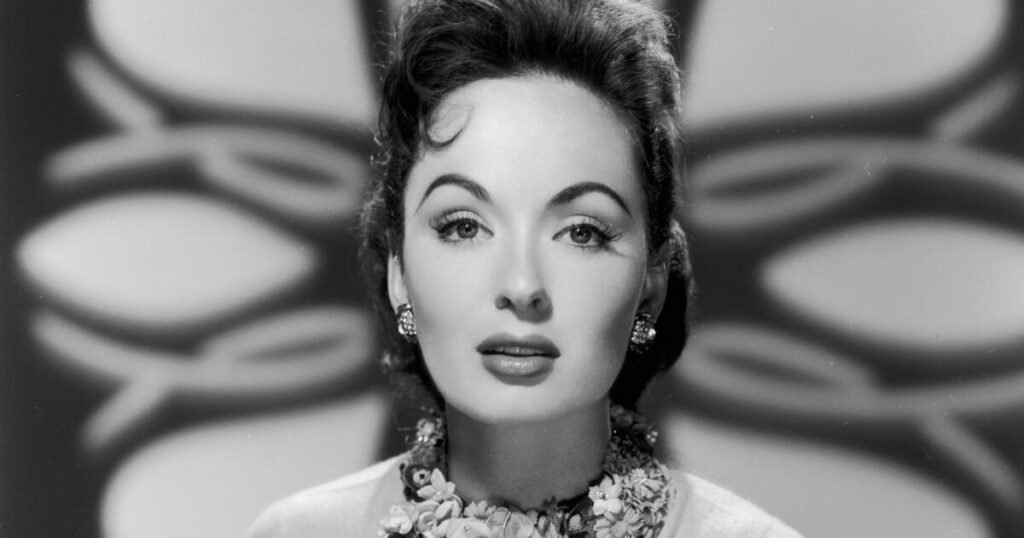
From the beginning, Mildred vowed that her daughter Veda would have all the things this newly blossoming post-war suburban paradise could offer.
They lived in a charming Spanish Colonial house in Glendale, the kind of place where there were more kids than cars on the street. Veda’s days were filled with stickball, piano lessons and ballet. If she fancied a dress in the display window at the Broadway or Bullocks, it would appear in a fancy box on her bed a few days later.
But this pampered childhood was not enough for Veda. She had her eye on the bigger house, the fancier car, the wealthier man — a drive for riches that would destroy her life and make her one of the greatest L.A. movie villains of all time.
Veda died last week.
Well, the actress who played her, Ann Blyth, passed away at 98. But this L.A. monster is so etched into my mind that I long ago stopped being able to differentiate between the actress and the character.
Veda’s story unfolds in “Mildred Pierce,” the classic James M. Cain novel and 1945 Joan Crawford film.
The movie is an apex of film noir, filled with dark shadows, moody lighting and ominous swaying palm trees. But it is also a memorable — and much analyzed — meditation on class in the American century.
We meet the Pierces as Mildred is struggling to make ends meet. Her husband can’t hold a job, so she starts baking cakes. She eventually gets a job as a waitress at a downtown L.A. coffee shop, but keeps it a secret for fear Veda will judge her. She eventually scores her own American dream, opening a chain of restaurants with locations in Beverly Hills, Laguna Beach, Glendale and beyond.
But Veda has zero admiration for Mildred’s rapid upward mobility, striking the pose of a blue blood who looks down on hard work. Veda loves to torture Mildred about being a middle-class striver, denigrating her mother’s work ethic: “I’m really not surprised. You’ve never spoken of your people — who you came from.”
Veda’s behavior worsens, including a fake pregnancy with a son of L.A. old money, until the epic showdown. Her monologue manages to be both a diss to her mother and to the city that gifted her so much success.
She tells Mildred she can’t wait to get away “from you and your chickens and your pies and your kitchens and everything that smells of grease. I can get away from this shack with its cheap furniture — and this town and its dollar days, and its women that wear uniforms and its men that wear overalls.”
Veda’s conflicts with Mildred feel like the beginning of what would become the generation gap between the kids born into the plenty of American post-war life and their hardworking parents. At one point, Veda rejects Mildred’s overtures with a line that could be dialogue from a 1960s melodrama about teenage rebellion: “You still don’t understand, do you? You think new curtains are enough to make me happy. No, I want more than that.”
But Veda is no idealist out to end wars or reject her parents’ materialism.
“Mildred Pierce,” the movie, was released just after the end of World War II, so it’s easy to see it as an early commentary on post-war life. But Cain published his book in 1941. Critic David L. Ulinwrote Mildred’s struggles and sacrifices feel more anchored in the boom-bust L.A. between the wars.
Veda’s evil can also feel anachronistic, especially in today’s world of nepo-baby jokes, “immigrants get it done!” and reverence of rags-to-riches stories. But it remains a relevant morality tale — of the rot that comes with coveting all of L.A.’s beautiful things and the pitfalls of parenting by giving your children all the material things you lacked.
I challenge you to watch the movie today and not place her up there with all-time L.A. movie villains, sharing the stage with Noah Cross, Keyser Söze, Hans Gruberand … Joan Crawford.
Blyth lived a long life, working as an actress for decades and raising a family. But she knew she would always be known as that spoiled brat she played at age 17. My colleague Susan King wrote a profile of Blythin 2013, taking pains to separate the woman from the character.
The headline: “NOT LIKE VEDA.”
The post Veda Pierce, L.A.’s most odious monster, dead at 98 appeared first on Los Angeles Times.