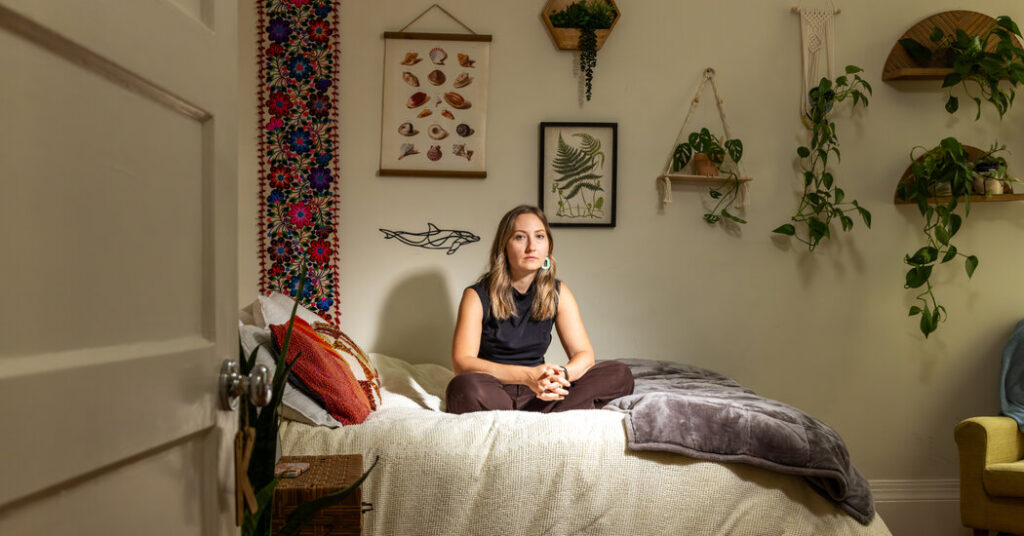
Katrine Razniak, 27, arrived in San Francisco in 2022 as a recruiter at LinkedIn, earning $70,000 a year. Her annual salary soared to $180,000 when she joined the software company Rippling to lead a team of account managers. Her partner, Adam Woodbury, 39, moved to the city in 2021 and earns $185,000 as a software engineer.
These days, even those six-figure salaries are no longer enough in San Francisco.
When Ms. Razniak and Mr. Woodbury tried to find a one-bedroom apartment for under $5,000 a month this spring, they struck out. They looked at around 30 properties over three months, but all were too expensive and too in demand. At one listing for $5,200 a month, they found 30 people had added their names to a sign-up sheet within an hour of the open house.
They ended the search. But even if they had found a place, a question lingered: whether a city where groceries and dinner with friends had become sources of financial concern was somewhere they could build a future.
“I don’t feel completely hopeless, but I don’t think I can stay in S.F.,” Ms. Razniak said. Mr. Woodbury added, “At some point, there was a slow transition where we both realized it just didn’t make any sense.”
Ms. Razniak and Mr. Woodbury are not struggling by any conventional measure. But as a wave of artificial intelligence wealth is set to deluge San Francisco, even young tech workers who came to the city chasing the Silicon Valley dream have started to say an affordable future feels increasingly out of reach.
That’s because as the A.I. companies OpenAI and Anthropic — both with headquarters in San Francisco and valued at nearly $1 trillion — prepare to go public, an A.I. elite has emerged that can outspend other tech workers. The two companies, along with Elon Musk’s newly public SpaceX, could mint more than 20 new billionaires among current and former employees, according to an analysis by Sacra, a private markets research firm.
“I feel a little bit like I’m not good enough to live here anymore because I don’t work at an A.I. company,” Mr. Woodbury said, even though his salary puts him roughly in the top 20 percent of American households, according to Census Bureau data.
Mr. Woodbury recently moved to Carnelian Bay, on Lake Tahoe, Calif., which is less expensive. Ms. Razniak remains in an apartment in San Francisco’s Haight-Ashbury neighborhood, which she shares with two roommates and for which she pays $1,650 a month. They’re making the long-distance relationship work.
San Francisco has long wrestled with affordability, but the issue has been magnified as OpenAI, Anthropic and other start-ups have attracted a flood of A.I. workers. The overall cost of living in the city sits 65.6 percent higher than the national average, according to the latest data from the Cost of Living Index by the Council for Community and Economic Research.
Housing leads the markup. San Francisco’s median home price topped $1.7 million in April, according to a report by Redfin, far above the national median of around $450,000. And in the last few months, the city’s average apartment rent surpassed New York City’s to be the nation’s most expensive, reaching $3,827 a month, according to the real estate data firm CoStar.
“It’s a pressure cooker, and it’s heated up really fast,” said Nigel Hughes, a senior researcher at CoStar. The apartment vacancy rate in some of the city’s most sought-after neighborhoods — including the Marina District, Pacific Heights and South of Market — has fallen to roughly 3 percent, down from about 13 percent in 2020, according to CoStar data. New construction has stalled.
Rising property prices are compounded by other factors. Utilities cost about 41 percent more in San Francisco than the national base line, transportation runs roughly 43 percent higher and groceries cost about 19 percent more than in the rest of the country, according to the Cost of Living Index.
And it is increasingly hard to keep up with the Joneses — or in this case, Sam Altman, the chief executive of OpenAI, and Dario Amodei, the chief executive of Anthropic. The mean annual pay in San Francisco was $196,365 last year, up from $153,359 in 2020, according to the Bureau of Labor Statistics.
Ted Egan, the City of San Francisco’s chief economist, said high earners had always weighed whether to accept the city’s trade-offs or leave for somewhere with a yard and garage. What’s new is the scale, he said. When Uber went public in 2019, its valuation was about $82 billion.
“OpenAI and Anthropic are estimated to be more than 10 times that,” Mr. Egan said.
Daniel Lurie, the mayor, said in a statement that his administration was working to reduce costs through access to child care, a new family housing zoning plan and transit improvements. He did not specifically address the concerns of six-figure earners.
(The New York Times has sued OpenAI and Microsoft, claiming copyright infringement of news content related to A.I. systems. The companies have denied the claims.)
For Ms. Razniak, the cost of existing in San Francisco has become its own drain. Her monthly budget has increased by about $1,000 more than previous years for what she describes as roughly the same life.
Despite more than doubling her salary since she arrived, Ms. Razniak said she felt neither wealthy nor that she was living paycheck to paycheck. Instead, it’s something in between: a low-level vigilance about money that she had expected, by now, to have left behind.
“I thought when I’d make $200k I would be able to basically not worry about money at all,” she said, adding that she and her friends stopped going out to restaurants last year and shifted to potlucks and reality-TV nights.
Demand from professionals for affordable housing has exploded. This month, Varsha Madapoosi, 25, who lives in the Lower Pacific Heights neighborhood and works in financial technology, posted two open rooms in the four-bedroom, one-bathroom home she rents — going for around $1,200 and $1,500 a month — to a private Facebook group, attaching a Google form and leaving it open for 24 hours.
She received 88 responses immediately. In contrast, a single open room for about $1,400 drew 28 messages over four days last July.
“I have never seen this kind of response,” Ms. Madapoosi said.
Jolie Gan, 23, moved to San Francisco in January after completing a Fulbright fellowship at the Massachusetts Institute of Technology. She now has two jobs: working at the venture capital firm Andreessen Horowitz and writing for Core Memory, a technology and science publication, earning about $250,000 a year. She and her roommate have already moved three times in two months — in one case, they left an apartment that was misrepresented as a two-bedroom; another time, they departed a building that had black mold and rats.
At $250,000 a year, and with no student loan debt, Ms. Gan said she felt she could manage, even saving for retirement. But she said she saw the strain on friends who were earning below $200,000, for whom rent, utilities and groceries consume nearly everything that comes in.
Ms. Gan said she was determined to stay in San Francisco for the next several years because of the career opportunities, the energy of the city and the community she had built.
“As silly as this housing situation is, and as expensive as it gets, I think that all these intangibles are still worth it for me,” she said.
Ms. Razniak and Mr. Woodbury have started thinking about Seattle. The life Ms. Razniak imagines there is one she cannot picture affording in San Francisco, even on a combined income that would be remarkable almost anywhere else in the country.
“We want a house, we want a garage, we want storage,” she said. “And that just doesn’t feel attainable here.”
The post In San Francisco, Even $180,000 Tech Salaries Are No Longer Enough appeared first on New York Times.