Subscribe here: Apple Podcasts | Spotify | YouTube | Overcast | Pocket Casts
President Trump wanted to paint the Reflecting Pool that sits between the Washington Monument and the Lincoln Memorial a deep shade of blue; he wanted it to be resplendent for the nation’s big anniversary. The pool itself is a sight to behold. “Two thousand five hundred feet, the length of the tallest Building in the World,” Trump wrote in a Truth Social post in late April. The new paint job was supposed to be finished in a week at a fraction of the cost that had been expected, he boasted. It was a part of his broader effort to leave his mark on the nation’s capital—including the ballroom at the White House where the East Wing once stood and his proposed archway on the Virginia side of the Potomac River. As my colleague Michael Scherer recently wrote, Trump is “proud” of how he’s changed D.C.—often at the expense of national-park projects elsewhere across the country. But as April turned to May and May to June—and the pool turned from that deep, reflective blue to a gelatinous, algal green—it became an example of how the president’s tendency to move fast at the expense of procedure (and, at times, legality) can create new problems.
What can Trump’s effort to make the bottom of a seven-and-a-half-acre pool the same blue that the 50 stars of the American flag rest upon tell us about how he has tried to refashion the nation’s capital? On Radio Atlantic, my colleague David Graham joins me to discuss.
The following is a transcript of the episode:
David Graham: I’ve often treated that as a kind of skeleton key to understanding Trump’s approach to things. He sees the splashy announcement as what matters. So, it’s a splashy announcement to say you’re gonna fix the Reflecting Pool, and you’re gonna have it looking great by the Fourth of July for the 250th celebration. It’s great to say you’re gonna go into Iran, you’re gonna, you know, topple the regime and bring democracy. Those announcements are easy and fun, and they tend to have a political payoff. But the political payoff decays over time.
[Music]
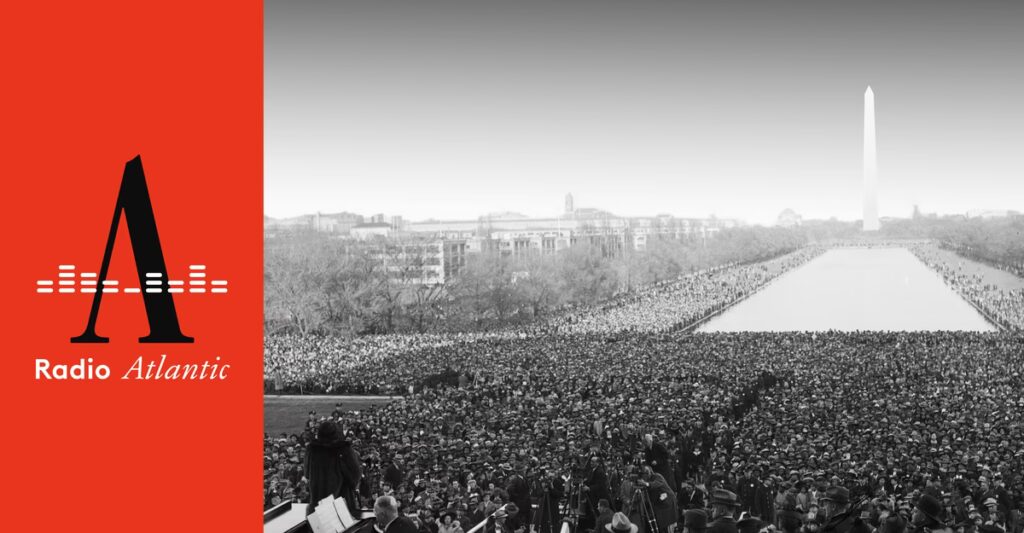
Adam Harris: The Reflecting Pool in front of the Lincoln Memorial in Washington, D.C., holds a special place in American history. It’s a symbol of national pride. It was built a century ago to connect the National Mall—the space between the Washington Monument and the Lincoln Memorial. It was dedicated in 1922.
It was where the crowds gathered as Martin Luther King delivered his “I Have a Dream” speech during the March on Washington for Jobs and Freedom in 1963.
Martin Luther King Jr.: I have a dream that my four little children will one day live in a nation where they will not be judged by the color of their skin but by the content of their character. I have a dream.
Harris: And it’s been in iconic films: It’s where Forrest Gump, wearing his dress uniform, reconnects with Jenny, depicting the day in October of 1967 when thousands of Vietnam War protesters gathered for the March on the Pentagon.
Tom Hanks (from Forrest Gump): Jenny!
Harris: But when the pool recently turned green as a result of algae blooms, and its just-finished paint job began to peel away, the Reflecting Pool became a symbol of something else.
I’m Adam Harris. This is Radio Atlantic. This week, we need to think about the president’s mission to leave his mark on the nation’s capital.
Now, the Reflecting Pool is just one of several projects President Trump has launched since returning to office. Some have been to beautify the city in the lead-up to the nation’s 250th anniversary. But others—including tearing down the East Wing to build a ballroom, or his plan to construct an arch at the city’s limits—are an attempt to cement his legacy long after his term in office is over.
What does the president gain by trying to remake Washington? And what, if anything, do we as Americans stand to gain, or to lose?
Joining me to discuss all of this is my colleague, Atlantic staff writer David Graham. Let’s get to questions.
So David, why are people so glued to this Reflecting Pool drama?
Graham: I mean, there’s a lot of factors, but I think there’s a couple, maybe three. One is a little bit like the East Wing demolition. It’s a really physical demonstration of something. So you can talk about corruption, you can talk about power grabs, you can talk about all these things and they’re kind of abstract, but the Reflecting Pool is there. Or conversely, the East Wing is not there anymore.
The second thing is that he just made this a story on his own. You know, this was not—no one was talking about the Reflecting Pool before he started making a big deal about it a few weeks ago.
And then the third thing: The Reflecting Pool really was green, although it seems like it may now be turning back blue, and experts are warning that it could vary some over time here.
Harris: At its root, though, the Reflecting Pool, the demolition of the East Wing to try to build a ballroom, all of these things are—if you allow Trump to tell it—attempts to beautify the city of D.C. But when you look at the polls, it shows that few Americans are supporting the changes that he’s making here. What is it about the specific changes? If the attempt is to beautify the city, what is it about the specific changes that people don’t seem to like?
Graham: You know, I want to believe that a lot of it is about process, and that’s hard to believe, because usually I don’t feel like Americans care a lot about process. Like, political reporters do, but it’s, you know, it’s sort of irrelevant. But I think the way that he does these things without permission, without seeking funding, and of course that’s true elsewhere—see the Iran war, for example—I think does grate on people. But the other problem is he does it poorly.
Like, if Trump were doing these things and it was working really well, I think maybe it would be a different story. But if you say you’re going to fix the Reflecting Pool and you spend $16 million on it and it immediately falls apart, that’s gonna blow back on you. If you say you’re gonna erect a giant arch, and it looks really bad, people are going to see it looks really bad. Whereas if you build something beautiful without asking permission, I think people are likely to be more forgiving.
Harris: Yeah, that’s fair. And, you know, you think about construction projects, they often fail, right? Or they’re gonna need repairs over time. It’s not that this is something where—thinking about it in the context of, like, your house. Somebody comes to repair your sump pump and two weeks later, your sump pump breaks. I’m not speaking from personal experience here, I promise.
Graham: (Laughs.)
Harris: But these construction projects—they are more than a dozen at this point—they’re gonna cost at least a billion dollars, according to a New York Times analysis that recently came out. And that’s like only accounting for the projections that we can track. What purpose does remaking D.C. serve for the president?
Graham: You know, he has such a self-image as a builder and a self-created image as a builder. And I think he wants to, you know, he wants to show that. He wants to be the builder that he claimed to be in real estate. I do buy into the idea that he’s more obsessed with legacy than he was in his first term. There’s all these things that are meant to be sort of big swings and are meant to leave—have a lasting legacy. But the problem is you have to do things well. And that has always been a challenge for Trump.
He has never lacked for ideas throughout his career in business, but he has not always followed through very effectively. And I think that’s part of the problem here. And, you know, he rages against process and he rages against procedures, but some of those things—and look, government has a lot of red tape; no one would disagree with that. But sometimes that red tape has a purpose and it is to make sure that you have the best contractor doing it and not some rando who might have donated to your campaign. And you have the right process and you’ve thought through it.
If you look at the Kennedy Center, it’s clear they just didn’t think about what they were doing. They wanted to take over the Kennedy Center. They didn’t like the way it was going, but they didn’t really think about, Okay, what’s the next step after we seize control? And so I think that causes problems too, just sort of the lack of planning. And, you know, that’s very much the case with the Reflecting Pool. You can say the Reflecting Pool was full of algae and could have looked better. Fair enough. But like, do you actually have a plan to fix that or you just have a plan to say you’re going to fix it?
Harris: Yeah. The idea that that planning—I’ve been thinking about that a lot as well too. If you think about the fact that it’s summer, when algae blooms start up. One of our colleagues talked to ecologists who were like, Well, if you have a dark background to a pool (this is a darker color, shade of blue), and you do it in the spring (you should be doing it in the fall or winter), you’re going to get these algae blooms; this is something you could have foreseen. I also think of that in the context of war-gaming Iran. Saying that, Well, they have the opportunity to close the Strait of Hormuz, and now that is a permanent option that’s on the table for Iran.
So, I guess, what does this say about the president’s MO? His way of doing things?
Graham: I go back a lot to the first impeachment, in the first term. Trump was withholding money from Ukraine that Congress had appropriated, and that was the basis for the impeachment. But what he wanted from Ukraine was that they would announce an investigation into Hunter Biden. And, crucially, it was not—it became very clear in the impeachment hearings and the hearings in Congress and in testimony that Trump didn’t actually care about how the investigation was executed; he wanted an announcement, because he saw that as the politically useful thing.
And that, to me—I’ve often treated that as a kind of skeleton key to understanding Trump’s approach to things. He sees the splashy announcement as what matters. So it’s a splashy announcement to say you’re gonna fix the Reflecting Pool and you’re gonna have it looking great by the Fourth of July for the 250th celebration. It’s great to say you’re gonna go into Iran, you’re gonna, you know, topple the regime and bring democracy. Those announcements are easy and fun, and they tend to have a political payoff. But the political payoff decays over time.
And in the case of the Reflecting Pool, or Iran, I think the decay has been faster than Trump is prepared for or expects or sort of has a plan to deal with.
Harris: I’m thinking about the construction projects and I’m also thinking about the things that aren’t as physical in D.C., right? You talked about his legacy, trying to quite literally cement his legacy, build an arch and things of the sort. But how should we be thinking about the ways that he has also changed our political institutions in ways that may be intractable at this point.
Graham: Yeah, I mean, when you talk about his MO, and we’re talking about it with these physical things, it’s not like the MO is significantly different in other places. And so when you see Trump, for example, sidelining Congress, taking control of the independent regulatory agencies—so the sort of alphabet soup, FEC, FCC, NLRB kind of stuff—I think it’s working in much the same way. It’s just not as visible.
But Trump has upended 90 years of precedent about these independent agencies. Maybe people will like the way that they’re operating in the new system, but I don’t think so. And I would look at the FCC as an example, where you have Ted Cruz being one of the most prominent critics of the way Brendan Carr, Trump’s handpicked FCC chairman, is running things. If you don’t like Brendan Carr and his approach, you’re not gonna like the way that looks when the president controls all of those agencies, which is what seems likely.
But putting them back is gonna be really hard to do. And there’s not a lot of thought about how to do that, and I think the repair is going to take a long time. I don’t know how long it will take to fix the Reflecting Pool. It sounds like, from contractors, we’re talking about, you know, well past July 4.
I don’t know how long it will take to fix the Kennedy Center, which is a sort of less-mechanical fix, but it’s kind—they’ve taken it over; they’ve broken it; now the audiences have been driven away; the artists have been driven away. A judge says they have to remain open, but it’s not clear what they’ll actually do if they remain open, like what the shows are going to be. And so I think there’s a lot of these issues that—a lot of this MO creates issues that are deeper, harder to see, and harder and longer to fix than, you know, an eyesore on the Mall.
Harris: So every administration spins things, but this administration seems to try to spend things that we can see are untrue with our own eyes. Things from winning the war with Iran—“winning” the war with Iran—to the green water in the Reflecting Pool. So are Americans, Republicans in particular, and congressional Republicans if I’m being really specific, turning a corner and starting to call Trump on these instances?
Graham: First I’d say your point about spin is interesting. I think that’s useful and it made me think, like, one of the differences with other administrations—every administration spins, but Trump seems to treat it as the spin is the endpoint rather than a way to sell something. There often isn’t anything under it. It’s all on the surface.
Is Congress turning a corner? It’s so hard to know. It kind of goes in fits and starts. It does seem like having somebody like Bill Cassidy, who got into a shouting match with Trump behind closed doors on Wednesday, apparently; or Tom Tillis, who is spitting great quote left and right to reporters on the Hill; or even John Cornyn, nobody’s idea of a rogue actor. You see people pushing back on these things. I want to see how far that goes.
Trump is making another push for the SAVE America Act. It doesn’t seem like that’s going to work.
Harris: Can you actually just remind people what the SAVE America Act is?
Graham: Yeah. This is the big bill that Trump and a few Republican allies have been pushing. And it would do a bunch of things to change election administration. But the biggest and most famous one is it would require proof of citizenship in order to register to vote.
But what we’ve seen in the past is that when Trump tries enough times, eventually the Senate gives in. It would be remarkable for senators this time to hold the line. And it seems possible, but I wouldn’t rely on it given the history.
Harris: Yeah, actually can you talk a little bit about that history of, like, places where Republicans have pushed back and then it’s sustaining that pushback, sustaining that diligence that sort of decides whether or not the president is able to do the things that he would like to do.
Graham: Yeah, I mean you can go back to the primary in 2016 where nobody in the party wanted Trump to be the nominee, and then they acquiesced, and then they seemed like they were gonna push him out after the Access Hollywood tape, and then they came back. And that pattern has just gone back and forth. I mean, you see it to some extent on the Epstein files, where a couple of Republicans broke ranks, but not many. You see it on some of these votes on the Iran war. There’s just a, you know—I think what happens is these members of Congress see something happen and they realize that it is bad. They are personally offended by it or they personally think it’s bad. But then, over time, Trump is able to kind of marshal his media machine and his megaphone, and they get a little bit nervous and they back off.
There are signs that that is splintering. When you see somebody like Tucker Carlson breaking with the president so fiercely, and I don’t think Carson deserves any credit, but I think it’s notable to see that. Maybe Trump has a little bit less power. And also maybe with the midterms coming, Republicans are thinking, Well, I don’t want the president yelling at me. But on the other hand, I’ve already gotten through my primary, and what I really don’t want to do is lose my seat. This guy’s unpopular, doing unpopular things. Maybe this is the time to break from him, at least for a little bit.
Harris: So we’re coming up on the 250th anniversary; we’re coming up on July fFourth. What are you going to be watching for as we move through this week of 250 celebrations, events, leading up to the Fourth of July?
Graham: It feels like—to choose a kind of World Cup metaphor—Trump is in a real own-goal space right now. There’s a housing bill that Republicans think will be useful for Republicans in the midterms. He announces he’s not going to sign it. He tries to jawbone them again on the SAVE America Act.
And I think some of this is: He’s really angry that they voted on the Iran war to limit his powers. I think some of this is: Trump realizes that Congress is very unpopular and he’s sort of trying to push back against them as a way of bolstering his own popularity.
But I think a lot of it is just, he’s kind of—he’s in a mood. And he keeps doing things that seem to me to be self-defeating. And so I want to see where that goes, whether he continues that or if they’re kind of compartmentalized.
In his rally on Wednesday night, he didn’t really talk about those things. That’s maybe unusual message-discipline from him, but I wouldn’t say that there’s a plan, because there’s often not a plan, but I’m curious to see how he kind of gets out of this.
Harris: Yeah. You know, it’s actually interesting too that it’s—as we’re moving towards this national anniversary, we’re thinking so much about this one man, right? As opposed to the ideals that are underpinning it, which seems to also be a sort of feature of the Trump era.
Graham: Yeah, he loves that. He must be very pleased about that. (Laughs.)
Harris: David, thank you so much for joining me.
Graham: My pleasure.
Harris:
That’s all for today’s episode. If you like what you saw here, new episodes of Radio Atlantic drop every Monday and Thursday.
You can subscribe on The Atlantic’s YouTube page, on Apple or Spotify, or wherever it is you get your podcasts.
And if you want to support this work and the work of my colleagues, you can subscribe to the publication at TheAtlantic.com/Listener.
Until next time, I’m Adam Harris.
The post Trump’s Battle for Washington appeared first on The Atlantic.