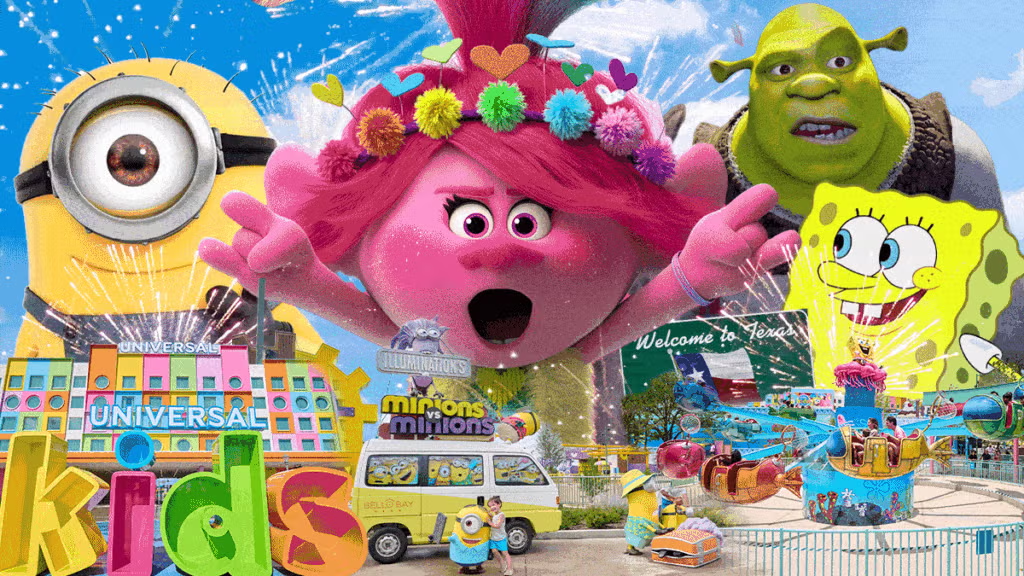
FRISCO, Texas — It’s 93 degrees at 10am and I’m standing outside, only mildly baking in the hot Texas sun, at Universal Kids Resort, Universal’s first theme park made specifically for small children. There are roller coasters and water rides and Minions and SpongeBob Squarepants, but when I ask my four-year-old son where he wants to go first, he takes a hard left and walks straight into a small wooden caterpillar playground made to look like it belongs in the “Trolls” franchise.
An entire theme park at his disposal, brand new rides with no lines, and he runs to the thing he could play on any day back home.
But the fact that this kind of playground even exists in Universal Kids Resort, let alone that it’s the first thing that catches my son’s attention, speaks to why this park is different from anything Universal has made before.
Missing are the experiences where guests can step completely inside the worlds of “E.T.,” “Jurassic World” and the Harry Potter universe. There are no massive “Fast and the Furious”-style roller coasters and 3D motion simulators. Instead of glamorous Hollywood or the theme park capital of Orlando, Fla., it’s located in a medium-sized Texas city about 30 miles north of Dallas.
But, as executives told TheWrap, its purpose in the larger Universal portfolio is also different. Universal Kids Resort is much smaller — both in scale and budget — than the coastal parks, and is designed to be a gateway to those bigger summer destinations down the line. Market research showed the booming population and economy in North Texas offered an opportunity to build a park that could operate at a profit with mainly regional visitors, while also hooking kids and families on IP that feeds directly into the larger Comcast flywheel.
It represents an entirely new strategy for a company that has been ramping up heavily in the battle with Disney over theme park domination, and which has become an increasingly critical stream of revenue — the division generated nearly $10 billion in 2025 — that’s a hedge against its more volatile movie and TV businesses. The approach also echoes Disney’s “cradle-to-the-grave” approach to getting people embracing its properties as a young age, with that lifelong fandom paying dividends down the line.
“This is where young kids will go on their first roller coaster, where they’ll meet the characters for the first time, and hopefully they form a love of those characters and those stories and they want to see the movies, they want to watch the TV shows, and then when they get older, they come to the big park. It’s sort of a rite of passage,” Page Thompson, the president of UDX New Ventures who oversees development of new resorts and parks, told TheWrap. “I think that the success of this park will open up a lot of opportunities for us.”
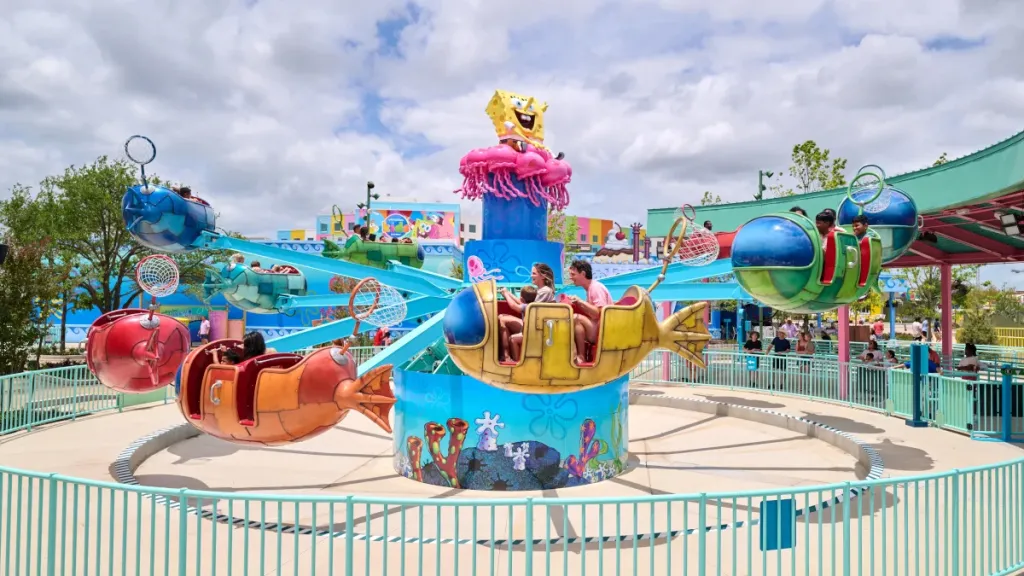
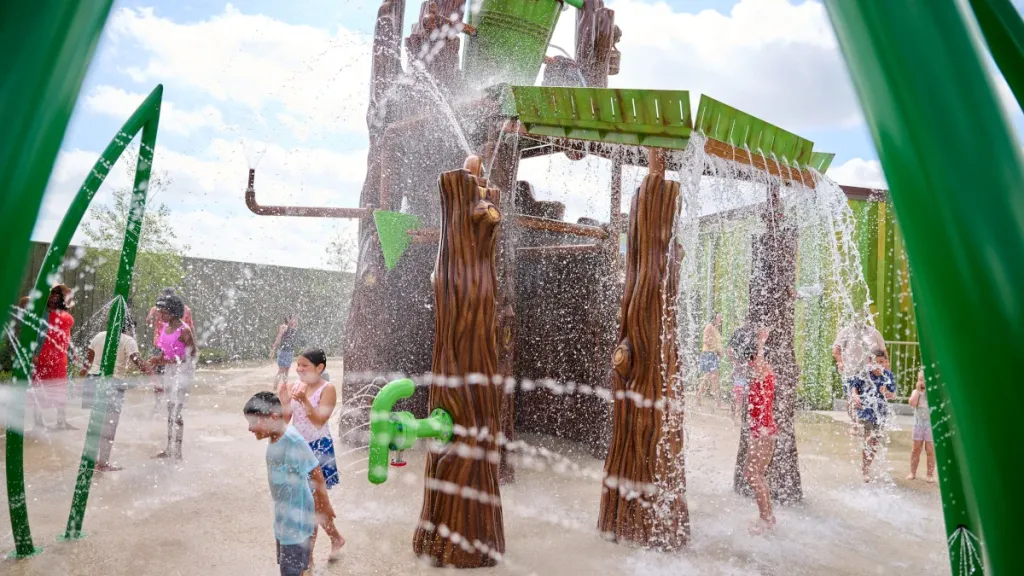
Universal Kids Resort caters specifically to those between the ages of three and eight, with lands dedicated to kid-friendly IP like Minions, Trolls, Shrek, Jurassic World and SpongeBob Squarepants, which Universal licensed from Paramount. It’s not nearly as ride-heavy as the other parks, with splash pads and playgrounds offering more tangible activities than standing in line, although it does offer two kid-friendly roller coasters (one is “Trolls”-themed, the other inspired by “Jurassic World”) and a rip-roaring “Minions” water ride.
My son had a blast throughout the park as we attended a media preview event in mid-June. Devoid of the height restrictions that narrow the audience for Universal’s bigger parks to pre-teens and above, he could ride almost everything — and did. The roller coasters were a big hit, but so were the splash parks and playgrounds, something you don’t find as much of at the big theme parks (I had to physically carry him out of a sprawling “Jurassic World”-themed climbing area. My back will never be the same).
The opening of Universal Kids Resort on July 1 comes on the heels of Universal’s fourth gate in Orlando, the sprawling Epic Universe, which opened in 2025 and helped drive a 14% parks revenue increase last year with its lands dedicated to “How to Train Your Dragon” and “Super Mario.” (It was the first major theme park to open in the United States in a quarter of a century.) In the first quarter, Universal Parks revenue increased 24% over a year ago to $2.4 billion.
NBCUniversal, which announced a corporate split Monday that will see the parks/movie/TV side of the company separate from the connectivity side, is thinking outside of the typical theme park box. Construction is underway on Universal’s first-ever U.K. theme park, a $6.7 billion investment in a massive 540-acre plot of land just outside London. It’s s rumored to include lands dedicated to James Bond and Peter Jackson’s “Lord of the Rings” films.
In addition, Universal recently brought its Halloween Horror Nights concept to Las Vegas in the form of a year-round horror attraction called Universal Horror Unleashed, in which guests walk through a spooky venue with rotating themes. The Las Vegas experience is located in AREA51, a kind of shopping center/theme park concept designed by Gensler, that also includes Meow Wolf’s Omega Mart attraction.
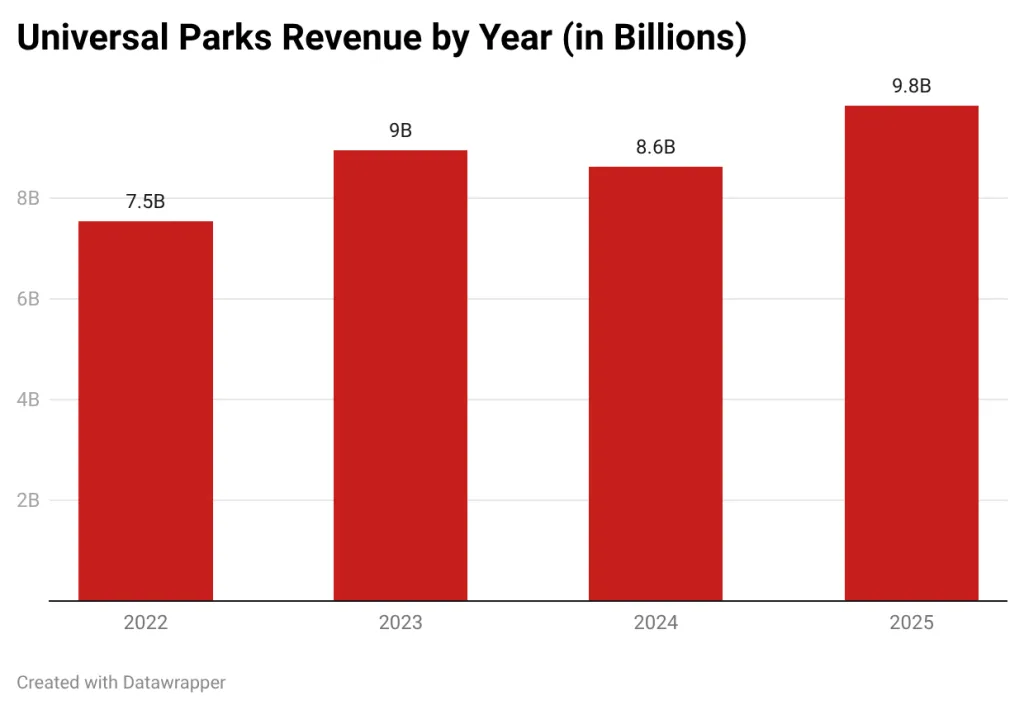
This investment comes as linear TV advertising craters and the streaming wars continue — with NBCUniversal’s Peacock still losing money. As a result, these theme parks have become a vital source of capital that can be funneled into other divisions.
“We really had three areas to grow our business,” Thompson explained of the Parks strategy. “The first is to continue to build in our existing parks and expand those, and we built Epic Universe in Orlando and we have the ‘Fast and Furious’ coaster coming. And then the second thing is to continue to expand internationally with resorts, we have our London-area resort opening in 2031. And then the third thing was, come up with new concepts to bring to new audiences in new locations. That’s where this fits in.”
Fun in the Texas sun
The middle of the country is not entirely devoid of theme parks. There are two Six Flags locations in Texas alone, one in San Antonio and other in Dallas, and an even smaller Peppa Pig theme park in Dallas. There’s also the 1800s-themed Silver Dollar City in Branson, Mo., Dolly Parton’s Dollywood in Pigeon Forge, Tenn., and, of course, roller coaster haven Cedar Point in Ohio.
But there’s nothing as prestigious or IP-filled as what Universal has cooked up, which beats Disney to the punch with the first regional theme park from the Big Two.
Location is everything, but the Universal team zeroed in on the Dallas area — a location Disney actually eyed for a since-scrapped expansion of its own — as the ideal spot for Universal Kids Resort for several reasons.
For one, Dallas is big. It’s one of the top five markets in the U.S. and one of the fastest-growing, with counties in the surrounding area also expanding rapidly — the area’s population has ballooned by 11% to over 8.4 million since 2020, according to latest U.S. census data.
“We picked Frisco because there are already millions of people coming to Frisco for the FC Dallas and the PGA and the Dallas Stars and all of the other things that they have here,” Thompson added, shouting out the oversized sports presence in the area, in addition to the easy access provided by the neighboring highway.
Thompson said the goal is to primarily draw visitors from Texas and neighboring states like Oklahoma, Arkansas and Louisiana, and with annual passes already sold out, that’s bearing fruit. With a 300-room hotel also connected to the theme park, owned and operated by Universal, Thompson said it’s seeing bookings for multi-day vacations or “staycations” from Texas residents.
“That’s exactly what we hoped would happen, so we’re very pleased to see that happening,” he added.
A bet on Middle America is also smart considering most of the parkgoers are coming domestically anyway. Comcast co-CEO Mike Cavanagh noted in April that international travel to the U.S. parks continues to be depressed and below pre-COVID levels.
“Universal was not wrong to try their hand at delivering a small regional theme park,” said former Imagineer Jim Shull, who runs a theme park-centric YouTube channel called Disney Journey. He pointed out that there actually 12 parks across the U.S. on par with what Universal is attempting with Universal Kids Resort, including the aforementioned Peppa Pig in Dallas. “The template is a strong one, and a proven one.”
Price-wise, Universal Kids Resort is more expensive than other parks in the region. One day at the park costs $69.99, compared to $39 for a day at Six Flags Over Texas or $24 for the Peppa Pig park. But they’re far cheaper than Universal Studios Hollywood, which starts at $109, or the $140 standard ticket for Epic Universe. And a drive to Frisco is certainly cheaper than a flight to Orlando or California.
At a time when families are literally going into debt for Disney vacations, Universal Kids Resort is a budget alternative.
If Universal builds it, will they come?
At 32 acres, Universal Kids Resort is dwarfed by the company’s other theme parks — Orlando’s Epic Universe is 135 acres, while Islands of Adventure is 125 acres, both part of the complex currently referred to as Universal Orlando Resort. Universal Studios Hollywood is 415 acres but includes a working movie studio.
Universal Kids Resort’s breadth of rides is also scaled down. While there are themed lands, there are no dark rides or high-tech 3D marvels like the rides that populate the coastal parks. (A slow-moving dark ride themed to Illumination’s “The Secret Life of Pets” franchise, which opened at Universal Studios Hollywood in 2021, seems like a natural fit but is nowhere to be found.) Interspersed between the attractions are themed playgrounds and splash pads, the latter of which come in handy in the heat with the lack of indoor attractions.
But that modest scale is part and parcel of the entire idea of creating a theme park for small children.
“I’m a dad of nine-year-old twins, and the first thing I look for is where are they going to play, where are they going to just go and run?” said Brian Robinson, EVP and chief creative officer of Universal Creative Studio. He and Universal Creative President Molly Murphy helped spearhead the design of the park, and they said viewing the experience through the eyes of a child was always their north star.
That was the case with my kid — he hit up every playground and splash pad he could find, and was having just as much fun if not more in those areas than on the rides, which are shorter in duration here. To that point, the stripped-down nature of the park left something to be desired for two parents who are used to the unbridled immersion and imagination on display in the bigger parks — the lack of dark rides is particularly striking, especially when trying to escape the Texas heat.
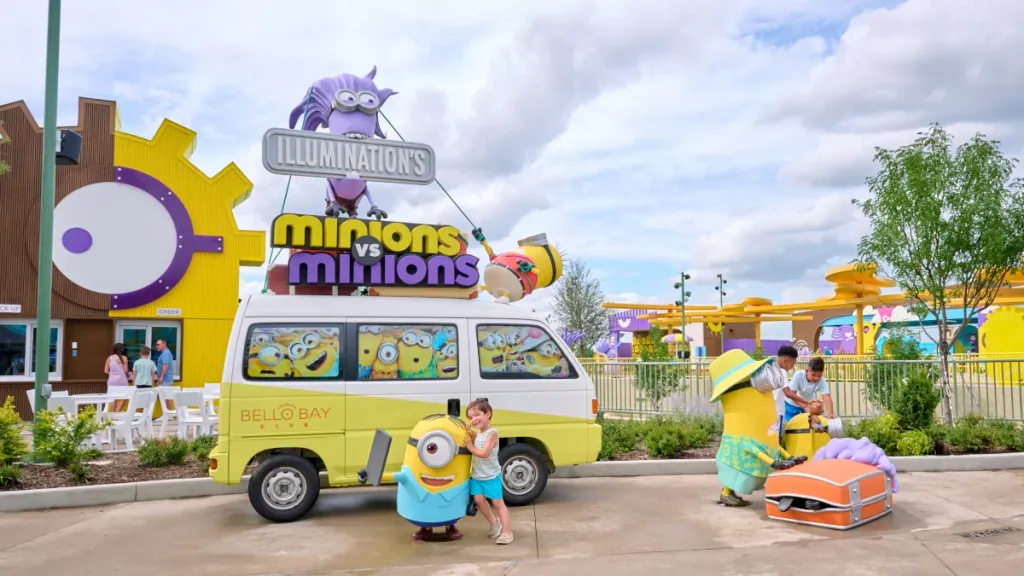
In the wake of the park’s first look hitting social media, skeptics questioned the lack of extravagant theming that’s prevalent throughout the Orlando and Hollywood parks. Even Shull was critical based on photos and video he saw: “It’s a good idea, poor execution. They need shade and they need three dark rides.” When the heat index is 103, it’s hard to disagree on those last points.
But for that 3-8 age range, it’s a sensory playland with no boundaries where, yes, the kids become even more endeared to some of Universal’s most successful IP. It’s not a coincidence that the park opens the same week that “Minions & Monsters,” the latest installment of the franchise that began nearly 15 years ago with “Despicable Me,” will hit theaters.
And, as if perhaps right on cue, when we got back to the hotel room after a day at the park, wouldn’t you know it, there were several Minions movies to watch on Netflix.
Plus, there’s always room for expansion. Universal’s toe-dip into regional parks is right-sized for a gamble — at an estimated $550 million it cost a fraction of the over $7 billion that the company spent on Epic Universe.
When asked where else Universal looked for the Universal Kids Resort location, Thompson declined to answer because “we might build there someday.”
Universal’s themed experiences are blossoming domestically and internationally, as Disney plans to invest $30 billion through 2033 in its own domestic theme parks and is expanding its international footprint with an Abu Dhabi park.
But for now, if you’ve got kids, well, Universal hopes to see you in Frisco. Just bring plenty of sunscreen.
The post Why Universal Built a Theme Park in Middle America appeared first on TheWrap.