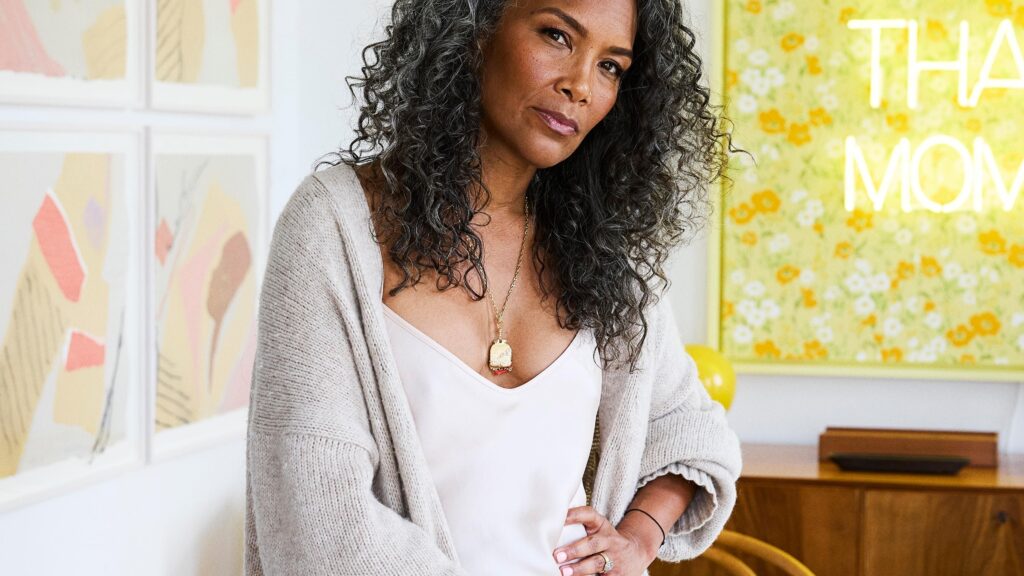
Mara Brock Akil knows how to savor a moment. You might presume that, for the creator behind a long list of TV hits beginning with the era-defining 2000s sitcom Girlfriends and culminating in the triumphant Judy Blume adaptation Forever, doing press would, by now, be an obligation endured on autopilot. But when I pull out my galley of her debut novel, The Revelation of Dionne Daphne, at the homey restaurant in Manhattan’s Chinatown where we’re having breakfast, she has to pause to drink in the scene.
“I don’t think I can get used to that,” she says, shaking her head. “Just seeing the book on the tabletop. Come on!” A week earlier, on the auspicious occasion of her 56th birthday, she had posted an Instagram video of herself unwrapping her first hardcover copy, overcome by emotion. “Look what God did!” she marveled.
Maybe staying awake to novel experiences is the key to vitality. Fresh-faced and energetic, with salt-and-pepper curls falling over the shoulders of her moss-green sweater and gold jewelry punctuating her gestures, Brock Akil is youthful in a way that defies Hollywood’s ever-more-plasticky imitation of youth. Along with the keen awareness so many of her characters display about how they are perceived as Black women in a world built for white men, her warmth and elegance suggest deliberateness but not artifice in her self-presentation. Charm can be a mask for shallowness, but in her case, it eases the way into deeper conversation. In work and life, what she seems to value most is forging genuine connections.
Now in the fourth decade of her career, she is connecting on both a grander and a more intimate scale than ever. When we meet, in early June, she’s a couple weeks into production on Season 2 of Forever, a romantic drama that is reaching a global audience on Netflix and a rare story about teens that speaks just as eloquently to parents. The shoot coincides with the publication of Dionne Daphne on June 30. A novel of crisis and self-discovery in 1990s New York, it uses first-person narration to go deeper than any TV show could into the perspective of the eponymous Essence beauty editor, whose outwardly glamorous life has come to a sudden crossroads. Drawing on some of Brock Akil’s toughest experiences, and coming at a time when she’s eager to speak with—not to—the next generation, it may be her most generous act of communication yet.
Among the creators who’ve thrived throughout TV’s unstable 21st century, Brock Akil is unique in her consistency. While David E. Kelley moved on from quirky ’90s lawyer shows to Big Little Lies and its clones, and Shonda Rhimes has applied her twisty style to doctor dramas, political thrillers, and Regency romances, Brock Akil tends to tell grounded stories about Black women. Girlfriends’ eight-season run followed Tracee Ellis Ross’s Joan, a young lawyer approaching age 30 with none of the romantic or professional security she craves but a close-knit group of women to navigate the uncertainty with her. In The Game, which ran in various forms on various platforms between 2006 and 2023, Joan’s cousin Melanie (Tia Mowry) juggles med school and a boyfriend in the NFL. Brock Akil gave BET its first drama with 2013’s Being Mary Jane; while Melanie initially sacrificed work for love, Gabrielle Union’s TV journalist has chosen her vocation and a caretaking role in her chaotic family over a fulfilling personal life.
Intelligent, driven, and beautiful, with elite educational backgrounds and impressive careers, these characters are not identical to Brock Akil. But each bears some resemblance to her at different stages of life. “Girlfriends was my singledom,” she reflects. “The Game is my coupledom. Mary Jane is about my success.” Yet she thinks of them not as conduits for her perspective, but ways of starting universal conversations: love, work, whether “having it all” is really possible.
Though its two leads are teenagers, Forever—a cinematic series that updates Blume’s 1970s novel of first love among white high schoolers in New Jersey to center two very different Black families in L.A.—is her meditation on parenthood. Can parents who fear for their kids’ safety among the threats of new technology and old-fashioned racism allow them the freedom to get their hearts broken? “Do we remember what it was like to fall in love?” Brock Akil asks. “Where is that connection we say we don’t have today?” She and her husband, director and showrunner Salim Akil, have two sons, 22-year-old Yasin and 17-year-old Nasir.
Brock Akil has been drawing insights from her experiences for as long as she has been a working writer. Raised in the L.A. area and, after her parents’ divorce, Kansas City, Mo., she studied journalism at Northwestern, then moved back to her hometown to pursue a career in TV. She arrived amid an explosion of Black sitcoms—The Fresh Prince of Bel-Air, Living Single, Martin, Family Matters—and rose through the writers’ room ranks on Fox’s South Central and UPN’s Moesha, both produced by Ralph Farquhar, a mentor. One early triumph was an award-winning 1998 Moesha episode in which the titular teen, played by America’s R&B sweetheart Brandy, is prescribed birth control. It was, Brock Akil recalls with a joy so immediate it’s like she’s suddenly back in that moment, the show’s first script to receive no network notes.
Still, she knew not everything she wanted to express could be conveyed in a teen sitcom. “If I’m writing for a comedy like Moesha, I enjoy the interiority of this young girl,” she says. “But there’s a deeper interiority of us”—that is, Black women. “Moesha wrote in her diary, and my diary was quite different.” It was, in fact, a “lifeline” as she processed some of the most difficult moments of her past. Once she realized she might have a long screenwriting career ahead of her, she imagined her ideal project, a movie born out of these reflections. That is when she started making the notes that would become Dionne Daphne.
The book has many origin stories. One takes place during COVID lockdown, when an editor’s inquiry motivated Brock Akil to find a new format for the project she’d put aside because, she says, “nobody’s investing in the interiority of a Black woman in film—not then, not now.” Another is the first HIV test she took, as a young woman in L.A. The wait for her results felt like “the longest two weeks of my life.” When the test came back negative, “it gave me a renewal at a perfect time to focus on my life and my career and what I wanted.”
This experience gives the title The Revelation of Dionne Daphne its dual meanings. In a literal sense, the book unfolds during the two weeks that the 33-year-old protagonist spends waiting for the potentially life-changing revelation of HIV test results, after the ex-boyfriend she’d hoped to marry tells her he has the virus. On a more profound level, it chronicles the revelation of Dionne Daphne to Dionne Daphne through her quest to heal the wounds she hides beneath perfect makeup. The persona of a glamorous, successful, sexually liberated young woman has obscured the loneliness of someone who struggles with not just physical intimacy, but also trust and vulnerability after suffering years of child sexual abuse—an experience with parallels to Brock Akil’s own history as a survivor. Keeping this secret has distanced her from her parents; prevented her from confiding in her best friend, Farrah; and kept her from examining her unsatisfying sex life.
While Brock Akil’s experiences as a survivor of child molestation are not precisely mirrored in Dionne’s, her years of introspection have produced relationships and insights that feel authentic, including implicating oneself: “I have examined how I could get into a situation like that,” she says. Then she learned how infuriatingly common it is for people, especially but not exclusively women, to carry this invisible weight. She looks around the café where we’re sitting and estimates that, statistically, three or four of the put-together patrons sipping coffee share this dark element of her past. “We look like professionals, writers, actors, journalists—we look like all these things that we want to be. We don’t look like the things that have been done to us and that we have survived,” she says.“I’m fascinated by how long we carry them, how we move through them, through the other desires and goals of our life.”
That we must understand ourselves to authentically connect with others is a central theme of Dionne Daphne. Dionne’s path to self-knowledge is both an inward journey and a cross-country road trip to confront her abuser and parents—the mother whose illusion of respectability Dionne’s silence preserved and the father too absorbed in a new family and religious community to protect her. She is challenged, often by the unlikely love interest who escorts her on the trip, to put herself in the shoes of those who hurt her without intending to. Brock Akil did a similar exercise while writing, imagining the entire story through the eyes of flawed secondary characters. When Dionne returns to New York, late in the book, she’s still waiting on her results but already becoming more empathetic. “I walk down the crowded streets of midtown actively thinking that we really don’t know what others are going through, but we’re all still here,” she marvels. “Ants who want to matter in the world.”
During a safari in Kenya not long ago, Brock Akil was moved by the collective nature of animal groups. “It hit me profoundly, how nature can teach you,” she says. “The pride is safe when they roll as a protective village. Our system is built around the isolation of family.” In tumultuous times for humanity, as fear and isolation run rampant, she believes that instead of “the core family, we should be talking about the core village.”
One way of looking at the evolution of her storytelling is as a gradual shift, from the individualist ideals of the ’90s and aughts to a vision of mutual caretaking—from the loneliness of stubborn independence to a form of interdependence that makes her characters stronger than they were on their own. In Forever, Keisha and Justin find support in not just their immediate families, but also in cousins, grandparents, friends. When Dionne leans on Farrah, her best friend envelops her in the love Dionne’s mother is too hurt to give. Writing this relationship took Brock Akil back to Girlfriends, but with a new perspective: “I realized the importance of girlfriends is that they become a surrogate parent until you can stand on solid ground—so that you can stop the legacy of pain in your family.”
To forge such strong bonds requires open communication across differences, especially within a home or romance. Raising her sons expanded her empathy for Black men to an extent that is unmistakable in her recent work. “They’re caught in the patriarchal trap, too,” she says. Dionne Daphne shows us an ex-con struggling to get his life on track, a man who clings to his masculinity by denying his sexuality, a father emasculated by a society that expects him to be a breadwinner but limits his opportunities. Forever, whose first season won a Peabody Award and was, according to Netflix, viewed nearly 20 million times in its two months on the platform, introduces a privileged Black boy who falls for a working-class girl. Viewers get to know Justin as more than just a basketball star; he’s a sheltered rich kid, a student with ADHD, a developing person with softness and layers.
“Forever is my own catastrophic fears, not only for my children, but for this generation,” Brock Akil explains. In this, too, the show leads with empathy; instead of scolding teens for living through their phones, it registers the stress of constant, screen-mediated peer surveillance. This is why she’d rather look to the future by having two-way conversations with younger generations, which talk openly about concepts like trauma and sexual agency in a way hers did not, than try to secure a legacy by building monuments to her own achievements.
Her L.A.-based residency and mentorship project, Writers’ Colony, is one way of connecting with emerging talent, just as Brock Akil once did with guides like Farquhar. For a creator who was stretching budgets and cultivating audiences to weather Hollywood’s cyclical interest in diverse stories while millennial heirs like Issa Rae and Quinta Brunson were still in school, this time-tested apprenticeship approach is also a bulwark against the onslaught of technology. Maybe AI can spit out a novel or TV pilot with the superficial elements of a hit, but it can’t connect on a soul-deep level because it doesn’t have a soul. With that in mind, Brock Akil has been asking herself: “How are we not just entertaining, but being left more fulfilled?” It’s a question that could stump algorithms while fueling a lifetime of passionate, human conversation.
The post Mara Brock Akil Changed TV. But Her Most Urgent Story Demanded a New Medium appeared first on TIME.