Michael Toth is director of research at the Civitas Institute at the University of Texas at Austin.
The second Trump administration has pushed the boundaries of executive power. But on one of the most consequential fronts in federal policymaking, the opposite is true.
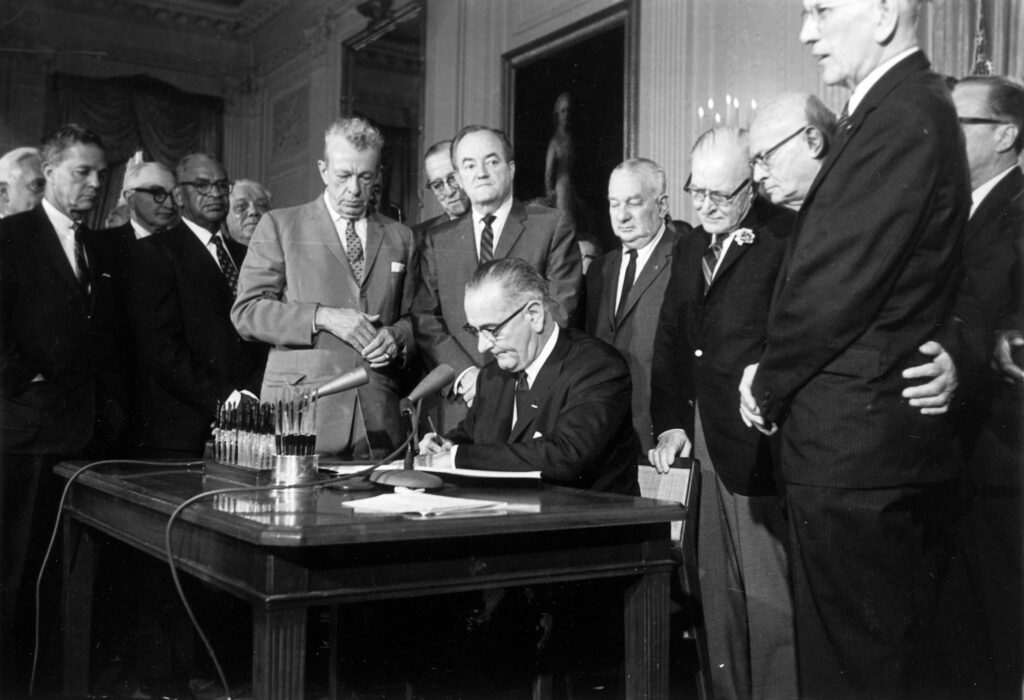
The administration is undertaking the most significant reset of civil rights policy in decades. Unlike its tariff programs, this one rests on solid legal ground. By returning to the text of the Civil Rights Act of 1964, which plainly prohibits discrimination “against any individual … because of such individual’s race, color, religion, sex, or national origin,” Trump 2.0 is reviving a basic principle: Government and employers should treat individuals as individuals, not as members of racial groups. Because that principle is rooted in the Constitution and federal law, this agenda is likely to outlast the administration.
The latest example is the recent Justice Department memo directing the Equal Employment Opportunity Commission to reconsider guidance built on the controversial “disparate impact” doctrine. Under that theory, employers can face liability for race-neutral hiring and promotion practices whenever those practices produce unequal statistical outcomes, regardless of discriminatory intent.
As the memo shows, the commission’s disparate impact framework injects race and sex into employment decisions through a maze of rules and evidentiary requirements. This labyrinth invites regulators, human resources departments and plaintiffs’ lawyers to second-guess legitimate job-related criteria whenever workforce demographics fail to match statistical expectations. The burden often pressures employers to adjust workforce composition until numerical targets are met — the very kind of quota-driven decision-making that the original supporters of the Civil Rights Act intended to prevent.
Democratic Sen. Hubert Humphrey of Minnesota, one of the law’s principal architects, explained that there was “nothing” in the Civil Rights Act that authorized the commission or courts “to require hiring, firing, or promotion of employees in order to meet a racial ‘quota’ or to achieve a certain racial balance.” Likewise, the bill’s floor managers, Sens. Joseph Clark (D-Pennsylvania) and Clifford Case (R-New Jersey), pledged that “any deliberate attempt to maintain a racial balance, whatever such a balance may be, would involve a violation” of the Civil Rights Act, “because maintaining such a balance would require an employer to hire or refuse to hire on the basis of race.” Reflecting the prevailing liberal consensus against racial preferences, the New York Times editorial board similarly emphasized that the law did not require employers “to drop any standard for hiring or promotion … except the discriminatory standard of race or religion.”
The Justice Department memo does not propose abolishing disparate impact analysis. The Supreme Court recognized the doctrine in 1971 in Griggs v. Duke Power Co., and Congress codified it in 1991 amendments to the Civil Rights Act. Instead, the memo calls for a narrower reading aligned with the law’s prohibition against discrimination on the basis of race. Under that approach, statistical disparities serve primarily as evidence of intentional discrimination. Consider, for example, the Ivy League’s use of geographic quotas to limit Jewish enrollment in the early 20th century. The problem with the selection process was not that a facially neutral policy produced a disparate outcome. It was that the policy, viewed in context, revealed an intent to discriminate, which the law prohibits.
The revision of the commission’s disparate impact guidelines is part of a broader campaign to dismantle federal “diversity, equity and inclusion” mandates. Across the executive branch, the Trump administration has ended racial preferences in federal contracting, eliminated demographic set-asides in small-business programs and required federal contractors to certify compliance with federal antidiscrimination laws.
Many of these now-retired affirmative action programs had been in place since President Richard M. Nixon’s Labor Department used its authority over federal contractors — which then employed one-third to one-half of the American workforce, as the historian Hugh Davis Graham writes in the 1990 book “The Civil Rights Era” — to push employers to mirror the racial and ethnic composition of their surrounding communities in their hiring. Like the commission’s disparate impact framework, the Nixon-era policies were built on the premise that proportional representation — not equal opportunity — is the proper measure of equality. This reinterpretation of the Civil Rights Act survived determined opposition from figures such as Attorney General Edwin Meese, who tried and failed to dismantle race-based contracting preferences during the Reagan administration.
Liberal commentators have decried the Trump administration for challenging legal doctrines such as disparate impact, which the Supreme Court endorsed more than 50 years ago in Griggs. Yet it is difficult to imagine the current court subordinating a color-blind Constitution to the pursuit of demographic parity.
Next to diversity, equity and inclusion advocates, the biggest losers from the Trump campaign may be “New Right” thinkers, who will no longer be able to blame the Civil Rights Act for ushering in an era of identity politics in which unelected bureaucrats and cultural elites gained authority to scrutinize any custom they deemed discriminatory, regardless of how traditionally accepted it was. As congressional supporters noted during the legislative debate, the act was drafted to leave businesses largely “undisturbed,” intervening only to prevent intentional discrimination on prohibited grounds.
The distinction between prohibiting discrimination and mandating demographic balance was well understood when the historic Civil Rights Act passed. By restoring it, the administration is acting in accordance with the rule of law.
The post This part of Trump’s agenda will outlive the administration appeared first on Washington Post.