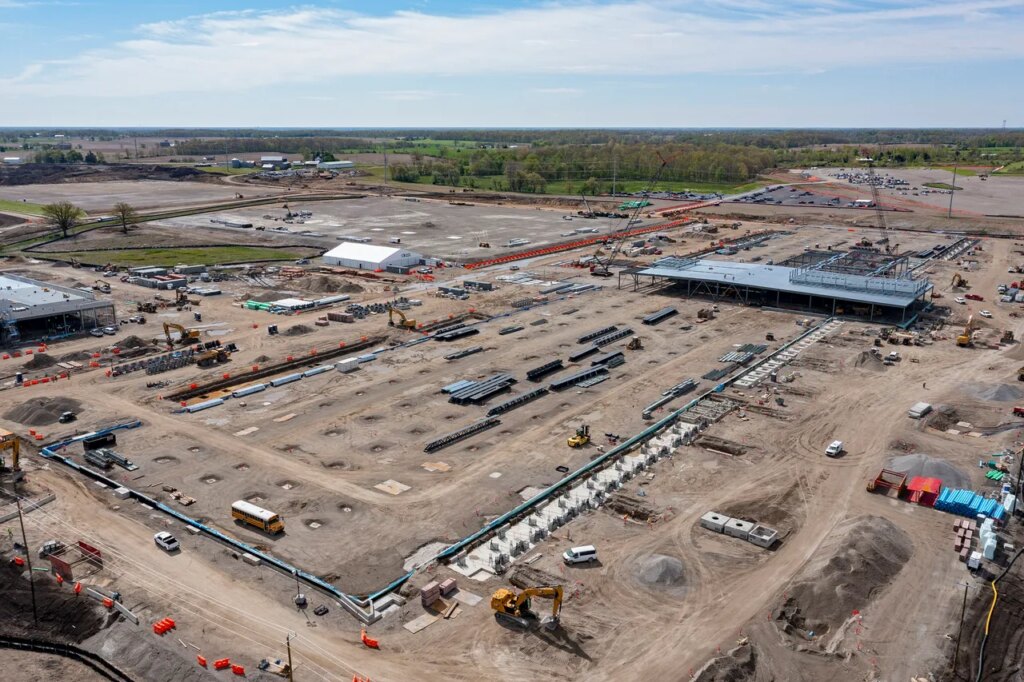
Will Lawrence is one of the founders of the Sunrise Movement, a grassroots climate activism group. Now, he’s running for Congress in a Michigan swing district, one of a growing handful of candidates around the country calling for a moratorium on data center development.
Senator Bernie Sanders has endorsed him, calling Lawrence a candidate who will “demand real accountability for big tech and AI companies.” And the backlash to data centers, Lawrence says, is helping him understand rural resistance to another kind of large-scale industrial project in the state: utility-scale renewable energy.
Lawrence’s campaign sees data centers as a potent topic to rally voters to his side in the Democratic primary in Michigan’s 7th district, to be held in August. Internal polling conducted by Data for Progress of likely Democratic primary voters in the district shared with WIRED shows that more than 40 percent of respondents were “much more likely” to vote for a candidate who opposed data centers. The message resonated even more with respondents under 45: Almost 80 percent of younger voters said they’d be much more likely or more likely to support an anti-data-center candidate. (The 7th district includes the college town of Ingham.)
Data centers “certainly [weren’t] the issue I expected to be talking about on the campaign,” Lawrence tells WIRED. Voters, he says, started organically approaching him at town halls and other meetings after he announced his candidacy last summer, asking for his advice as a longtime organizer about how to channel the anti-data-center energy among their neighbors into something productive.
“People feel like they’re being utterly disrespected by the companies and the local officials who are welcoming them into town,” he says.
The Data for Progress poll put Lawrence ahead of both his opponents in the primary. Another poll commissioned by one of his opponents and released in April shows Lawrence winning the primary, though it also shows the vast majority of voters remain undecided. Lawrence also remains a distant third in fundraising.
There are at least 11 data centers planned throughout Michigan, according to the clean-energy database Cleanview. Significant local pushback in two townships in the 7th district have stalled at least two planned projects over the past year. But data center developers have found ways around local opposition elsewhere in the state. After a township in the 6th district voted against an Oracle data center earlier this year, the company sued, and the town let development begin rather than engage in a costly court battle.
Earlier this month, Michigan governor Gretchen Whitmer appeared at the opening of the Oracle data center, where she was photographed smiling next to OpenAI’s Sam Altman and praised the $16 billion investment.
“Any candidate worth their weight knows that these data centers are toxic,” says Cooper Teboe, a Democratic strategist based in California. Candidates that don’t recognize this, Teboe says, “are not candidates that are going to win.”
Christy McGillivray, the executive director of Voters Not Politicians, a Michigan-based democracy reform organization, says that Whitmer’s appearance at the opening was a major misstep for the governor, who’s been floated as a 2028 presidential contender.
“It literally blew my mind,” she says. “I was like, ‘Are you trying to hurt the entire Democratic party?’”
While on the campaign trail, Lawrence says that he met with data center protesters who differed significantly with him politically. These included people opposed to data center construction who were also opposed to solar and wind projects being built on farmland.
Michigan is a hotbed of resistance to renewable energy projects. A 2025 review ranks it as the state with the largest number of local restrictions: More than 60 local governments in Michigan passed ordinances, moratoriums, or other restrictions on wind and solar development between 2011 and 2024. Local opposition, the report found, had stalled or blocked at least 28 projects across the state.
In 2023, Whitmer signed a law allowing renewable energy developers to more easily bypass local ordinances against wind and solar construction, making it much easier for big developers to site projects on rural land. It has since prompted backlash from many towns and counties that had passed ordinances, including a lawsuit filed by dozens of townships against the state, many in the 7th district. Two officials from townships in the district said in a statement in 2025 that renewable energy developments “threaten to turn our fertile soil into wastelands, putting at risk the livelihoods of those who have worked the land for decades.” (There is no evidence that renewables do long-term damage to soil.)
Lawrence maintains that he supports renewable energy, especially community-owned and -operated models. (In 2023, the same year the law to bypass ordinances was passed, the Michigan legislature did not pass initiatives that would have supported community solar.) But the response to data centers, he says, has helped him understand why Michiganders are also resistant to seeing big renewable energy projects come to town.
“The pattern that I see that is similar with the data center issue is people don’t feel that they have control over the future of their own community,” he says. “That is fostering backlash. Then they have people who mostly live in cities lecturing to them and saying, ‘Don’t you understand? This is the price of progress.’”
Teboe agrees with Lawrence that tech companies need to rethink how they’re approaching communities with proposals for projects.
“Ninety-nine percent of the tech executives think that of course people will love these things,” he says. “They cannot conceive of a world where the first thought someone has upon seeing a data center in their community isn’t ‘Wow, the future is amazing,’ but is ‘What the fuck are you doing in my backyard?’”
The post The Anti-Data-Center Movement Is Reshaping Michigan Politics appeared first on Wired.