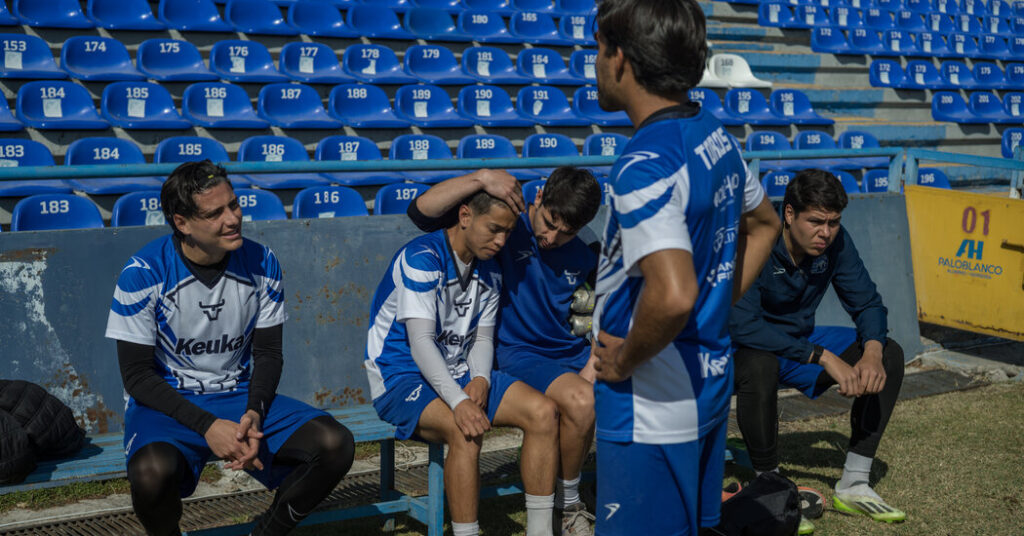
The soccer tournament gathered teenagers from around Celaya, an industrial city in central Mexico, offering a refuge from the death and violence that have become a way of life here.
As the Ravens waited for their next match, some players stretched between games, taking a moment of silence to focus. Others glared at the competition as they gathered around a boombox blasting narcocorridos, polka and waltz-based ballads extolling the lives of Mexican drug lords.
“I don’t like it, but I can’t tell them to turn it off,” said their coach, Sugey Milagros Salinas Grimaldi. “They are very loyal to their way of living, and I must respect that.”
Some of the songs were about their own loved ones, killed in gruesome ways while slinging drugs, a common path out of poverty in Celaya. Shutting off the music risked insulting the memory of their dead, Ms. Salinas explained.
She struggles to keep the children of Celaya, one of the world’s most dangerous cities, off the streets and away from the cartels. She has watched with alarm as her students join the criminals that have woven themselves into the city’s social fabric or fall off the grid, slipping into addiction.
Now, the cartels are moving to control the local soccer leagues by any means necessary, gunning down spectators and assassinating or kidnapping players.
They threaten one of the city’s last remaining joys and a rare, honest possible pathway out of poverty for local children. Who would recruit these teenagers first, Ms. Salinas or the cartels?
Far from the crowds of the World Cup games, many of the soccer fields have gone silent around the city. The crowds here have been replaced with crosses and monuments bearing the names of victims: players, referees and spectators who were gunned down.
When a cartel killed 11 people after a game in January, local governments suspended all soccer events for nearly a month. When they resumed, many players were too afraid to return.
Not the Ravens.
The boys played hungrily, weeks of cabin fever erupting onto the soccer field. Some of the players mocked their rivals, egging them on.
“You express what you need to express on the field!” Ms. Salinas yelled, urging the team to release their frustrations through the sport, not fistfights.
In moments like these, Ms. Salinas relied on Juan Pablo, 14, her star player and the team’s captain. Juan Pablo came from a farming family and was everything she wanted her other players to be: well-behaved and respectful, with a stellar school attendance.
He tried to rally his teammates, urging them to work together.
But another player, Manuel, 13, was picking fights with the referee and questioning his calls. He could be a star, but his emotions made him quick to anger and quick to get a yellow card.
Manuel was out of practice. He had missed two months of school to get high, a brief reprieve from his difficult life: A brother had been killed by a cartel, his father had hanged himself, and his mother worked long hours yet could barely make ends meet.
Ms. Salinas had kicked him off the team until he cleaned up. The tournament was his first time playing in months.
Both Manuel and Juan Pablo were eager to show off their skills, hoping to be noticed by the scouts looking for young talent to feed into Mexico’s professional teams.
It is a race against time for both teenagers, in a sport where most retire at 35.
The Ravens are bound by poverty but little else — some come from humble farming families, others from households with criminal ties. On the field, Ms. Salinas tries to make them all equal. She funds the team herself since there is no public funding available.
From the sidelines, a Ravens mom cheered the team on. She had a pistol tattooed on one side of her neck with the year 1991 and an AK-47 with the name Alexis on the other.
“I love pistols and I was born in 1991,” explained the mother, Mirian Mendoza. “Alexis was my brother,” she said. “He died violently.”
The game ended. The Ravens had lost. Manuel fell to the ground, crying. Juan Pablo looked on as the winning team posed with their trophy, his eyes filled with hunger.
Juan Pablo headed home. A huge opportunity hung in the balance: an invitation for tryouts with Chivas, Guadalajara’s professional team. He just needed to raise $300 to go.
It could be the start of a new life.
Days later, a sign appeared on the soccer fields where the tournament had been held.
If you play here, you must pay, it said.
Mexico’s Bermuda Triangle
Celaya and the surrounding areas around are a kind of outpost for Mexico’s oil, piped in from faraway wells and refined in the area. While the state-owned refinery brought jobs, it also attracted the cartels, competing to siphon off the oil to sell on the black market. The illicit business has become a major cartel revenue stream, netting billions of dollars annually, according to the U.S. Treasury Department.
That has made the area one of Mexico’s most dangerous, ranked 13th in the world for homicides.
Locals say they live in the Bermuda Triangle. Commuters often disappear forever.
The community now fears it is losing itself. Children are shuttered in at night. Parties end early, if they happen at all. Several church festivals were canceled this year after cartel extortion threats.
It was only a matter of time until soccer became the next target.
“It hurts us a lot,” said Celaya’s mayor, Juan Miguel Ramírez Sánchez. “Sports is one of the only ways to save children from violence.”
The first episode happened in 2018, when a referee and a player were killed on the field. Last year, 13 players were killed across the metropolitan zone of Celaya. So far this year, 14 players and spectators have been killed.
The most bloody attack was the one in January, when 11 people were gunned down after a game in Salamanca, on Celaya’s outskirts. Local residents refer to that episode as “the massacre.”
In recent years, the cartels have established soccer teams to compete in minor league games to launder money and exert control over the communities they live and operate in, authorities say.
“They also make money off people’s betting,” said Salamanca’s police chief, Juan Pablo Ramírez Talavera, in an interview.
“This should be a healthy game bringing people together,” he said. “But instead these amateur leagues have turned into a production of money.”
Mr. Ramírez Talavera estimated that criminal groups spend tens of thousands of U.S. dollars a month on Salamanca’s games alone, a city of about a quarter million people. He said that up to 20 cartels and smaller gangs operate across Guanajuato state.
On a recent day, parents watched as their children, of elementary school age, kicked soccer balls around cones, did sprints and took shots at the goal.
Behind them, police pickup trucks were decked with flashing lights to telegraph their presence. Police officers on four-wheelers crisscrossed the field, patting down men hanging out on the sidelines, making sure they had no weapons, drugs or alcohol.
‘Maybe I could have done more.’
The decay of Celaya’s community has been personally painful for Ms. Salinas, the Ravens coach.
During her first year teaching in 2021, one of her students was gunned down at the age of 12, hooked on drugs and unable to pay his dealer. The mother of the student, Pedro, died when he was younger, and his father had abandoned him to migrate to the United States.
The boy was near-feral, stealing food and barely showering, Ms. Salinas said.
“I have always carried that with me,” Ms. Salinas said, crying as she recounted how her fellow teachers urged her not to get involved. “Maybe I could have done more for him.”
Ms. Salinas said she was called to the crime scene shortly after Pedro was killed — just another corpse in Celaya.
Unable to sleep for weeks, she was tormented by how she might have helped.
She decided to start a soccer team to give her students something to be excited about and committed to. To join, students must attend class regularly and behave on and off the field.
When asked why she named the team the Ravens, she replied without hesitation. “Because they are smart birds; they get what they want by looking carefully,” she said. “It’s like the children here, they are always looking for opportunities.”
Pedro’s story is why Ms. Salinas is so devoted to Manuel, the team member who lost his temper. Violence and poverty still stand between Manuel and the training he needs to reach his dreams.
Shortly after Manuel kicked his drug addiction and returned to school, all soccer games and practice were suspended for nearly a month. He has also had to decline invitations to join teams more professional than the Ravens because he lacks money to take the bus to training or to pay for the uniform.
Sitting in his mother’s room after school one day, Manuel exploded in tears.
“Football clears my mind of the problems in my house,” Manuel said, choking on every word as he sobbed. “What I have is hunger to win, to play well. But what I don’t have are opportunities.”
Manuel’s mother, María, watched in concerned silence. She knows soccer is a safeguard from the cartels seeking to recruit teenagers.
She knows the dangers firsthand, having spent a year digging around Celaya looking for the remains of her eldest son. He was found in a mass grave next to a grain mill.
“I always tell him, there is no such thing as friends. Go to school, play soccer, stay out of trouble,” she said.
But Manuel’s bedroom was a temple to the narco-culture that the older generations worry is infecting their community.
Manuel’s walls were covered with neon lights and a poster featuring Al Pacino as Scarface flanked by two of Mexico’s most notorious drug kingpins. Bulletproof vests and Kevlar helmets hung from the walls, which he swore were only decorations.
On his dresser were neatly arranged bullet casings. Some had been spent.
Across town, Juan Pablo received bad news from Ms. Salinas. His coaches had not been able to raise the $300 he needed to go to the Chivas soccer camp. His parents tried to put on a good face, but they were also devastated.
Juan Pablo could be the family’s ticket out of poverty, out of the cramped house they live in on the small farm they manage in their backyard.
“I cannot imagine not being a professional player,” he said. “But I guess I could be a car mechanic.”
The post For These Teens, Soccer Is Life. Now, the Cartels Want In. appeared first on New York Times.