Bitter foreign policy debates over Israel and Iran are fracturing the Democratic and Republican parties, creating powerful wedge issues that are reshaping the battle for control of Congress this year and could affect the 2028 presidential election.
The dispute among Democrats, in particular, has already left a lasting mark on the midterms. Israel’s growing unpopularity since the war in Gaza began nearly three years ago emerged as a dominant force last week, when two incumbent House Democrats in New York lost to primary challengers who had cast them as insufficiently critical of the U.S. ally.
And both U.S. support of Israel and the war with Iran continue to cause fissures inside the Republican Party, and particularly within President Trump’s Make America Great Again movement. Isolationists who hailed Mr. Trump’s campaign promise to avoid foreign wars say they feel betrayed by his intervention in Iran and the domestic consequence: spiking prices.
Recently, another front has emerged against the president. Now that he is negotiating with Iran, he faces backlash from hawks within the party who believe he did not achieve his goal of crippling the country’s military and nuclear capabilities, let alone end its hard-line regime.
The rifts are producing unsettling election outcomes in a critical midterm year in which control of Congress, and the fate of Mr. Trump’s agenda, are at stake. Some centrist Democrats are losing, with more at risk in upcoming races. Some Republican voters are staying home, a potential disaster for their party if the trend carries to November.
All of those dynamics are emboldening critics who want to permanently reshape their respective parties’ ideologies and policy platforms — and who are planning to take that fight to the 2028 presidential election.
The powers within both parties seem at a loss on how to handle their increasingly restive and unpredictable bases.
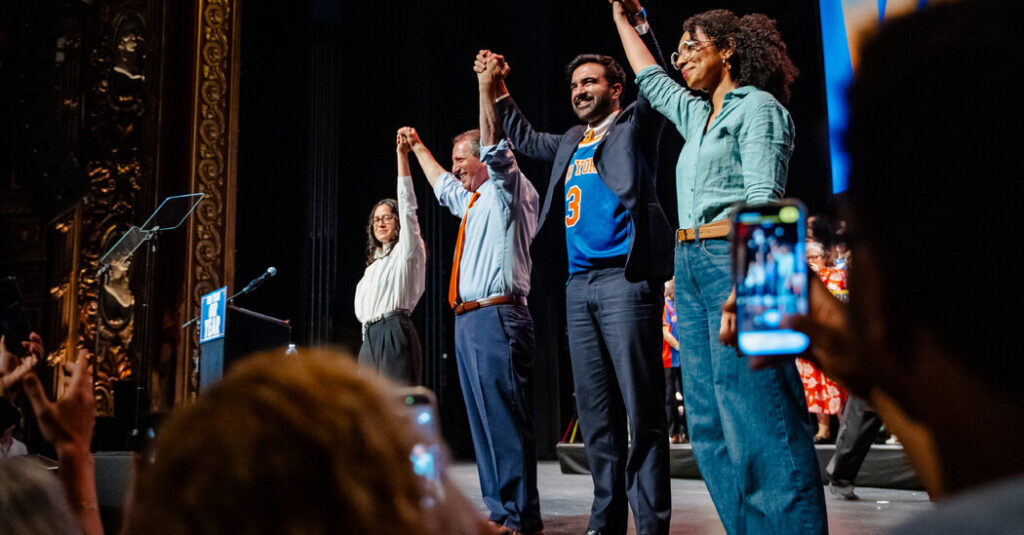
Democrats were especially shaken by the insurgent left’s success in New York last Tuesday. Voters nominated two democratic socialists who embraced anti-Israel positions and rhetoric.
“We’ve got to figure out a way so it doesn’t blow the party apart,” said Matt Bennett, a co-founder of Third Way, a centrist Democratic think tank. Mr. Bennett described a Democratic “freakout” following the results on Tuesday over whether the rise of hard-left candidates would repel Jewish and moderate voters.
Republicans are experiencing divisions of their own over the party’s support for Israel. The Iran war exacerbated underlying tensions among Republicans over what “America First,” Mr. Trump’s resonant but ill-defined campaign message, means when it comes to backing Israel in conflicts in the Middle East.
“It’s much more fun, I think — for most of us who lean right or right-leaning independents — to be fighting with the left,” the podcaster Megyn Kelly told Vice President JD Vance earlier this month. “But it’s been kind of civil war-y over on the conservative team since this whole thing got launched.”
Still, Mr. Trump’s hold on his party remains dominant, with Republicans he has derided as insufficiently loyal losing their primaries. That grip has tamped down some internal party conflict.
Decisive primary outcomes
Polls show that the Israeli-Palestinian conflict has radically changed attitudes among Democratic voters, who are now largely unified in sympathizing with the Palestinians. Many leading Democrats are now sharply more critical of Israel.
But the pro-Palestinian rhetoric from far-left candidates still makes some mainstream Democrats uncomfortable. Some of it, said Scott Stringer, a Democratic former New York City comptroller, amounts to “blatant antisemitism.”
“If there is a group of people who may be having temporary electoral success who believe the path forward is to use antisemitism as a wedge,” he said, “then there’s going to be a battle within the Democratic Party.”
The tensions have produced decisive primary outcomes only in states or congressional districts that are not competitive. The New York City races are likely to turn existing Democratic districts only a darker shade of blue.
The danger for establishment Democrats is for hard-left candidates to win competitive primaries and then struggle to appeal to more ideologically diverse voters in the general election, when economic issues are expected to drive voter choices.
Mr. Trump has already branded New York’s democratic socialist victors, who had the support of Mayor Zohran Mamdani, as “communists.”
“Donald Trump wants to portray the Democratic Party as either having been overtaken by D.S.A. or Mayor Mamdani, and that is not the case,” said Halie Soifer, chief executive of the Jewish Democratic Council of America. The New York candidates, she added, “could not win anywhere else.
That has not stopped them from trying. Far-left progressives are on the ballot in several states, including Colorado, Michigan and Wisconsin, trying to challenge the conventional wisdom that extremists cannot win battleground races. The left argues that it is time to try a different tack that could win over some Trump voters — a theory that will not be tested until the fall.
Democratic leaders are perhaps most worried about Michigan’s upcoming Senate primary in August, a race they believe they must win in November if they are to succeed at gaining the Senate majority.
Senator Chuck Schumer of New York, the minority leader, who has backed moderate candidates in an attempt to flip Republican-held seats, is supporting Representative Haley Stevens against Dr. Abdul El-Sayed, a progressive former public health official.
Richard Czuba, a Michigan pollster, said it would be a “huge mistake” to infer Michigan outcomes from the New York primary results. “The Michigan electorate for an August Democratic primary doesn’t look at all like a New York primary electorate,” he said, noting that Michigan voters lean older, less college educated and 30 percent Black.
Mr. Czuba also noted that, while most Democratic primary voters in the state consider Gaza an important issue, “consistently, Gaza comes in last on that list” as far as the issue that moves them to actually go vote.
In an interview, however, Dr. El-Sayed argued that Michigan voters share some of the same sentiments as New York City voters: that politicians are more interested in fund-raising from corporate donors than in making groceries, rent or homeownership more affordable.
“They are sick and tired of all of it, and they want answers,” he said on Friday. “And neither party seems to be giving it to them.”
“We make the mistake of thinking that Gaza is not a pocketbook issue,” he added. “People understand that their money is being used to kill other people.”
Declining Enthusiasm Within MAGA
Overall, Republicans still overwhelmingly support Mr. Trump, polls show. Most of his endorsed candidates have won their primaries, with a few notable exceptions in governor’s races.
And the generational divide on foreign policy is stark: 53 percent of Republican voters under 45 disapprove of Mr. Trump’s handling of the Iran war, according to a New York Times/Siena poll conducted in May, compared with the 75 percent of older Republicans who approve.
Republicans were forced to grapple with some of those questions beginning with Mr. Trump’s ascent in 2016. Over time, the party transformed into the president’s pro-tariff, anti-interventionist image, bringing into the Republican fold new voters who found those positions appealing.
That transformation made Mr. Trump’s support for Prime Minister Benjamin Netanyahu of Israel and his military campaign in Gaza, and even more so the Trump administration’s decision to attack Iran, hard for some MAGA voters to swallow.
On the same day that the two democratic socialists won in New York City last week, Marjorie Taylor Greene, the former congresswoman and firebrand, announced that she was leaving the Republican Party because of her opposition to the Iran war. She followed the conservative media giant Tucker Carlson, who also left the party, citing the same reason.
In April, Mr. Trump lumped Ms. Kelly with Mr. Carlson, both former Fox News hosts, and other right-wing podcasters who have been critical of the Iran war, calling them “nut jobs” and “troublemakers.” But Mr. Vance’s appearance on Ms. Kelly’s popular podcast to defend the administration’s preliminary peace deal with Iran showed that the White House was attuned to the divisions over foreign policy on the right.
For Ms. Kelly and Mr. Carlson, the U.S.-Israeli war on Iran represented a betrayal of Mr. Trump’s promises to avoid Middle East entanglements, and highlighted Israel’s exceptional status in American foreign policy. Even as Mr. Trump was turning away from traditional U.S. allies in Europe and Asia, he was doubling down on the partnership with Israel.
The terms of the debate switched again in the last two weeks, as the administration reached a preliminary agreement with Iran. The deal angered some of the same Republicans who had enthusiastically backed Mr. Trump’s decision to go to war in February.
Mark R. Levin, the hawkish Fox News host, called the administration’s diplomatic push with Iran “one of the most shocking flips in military and diplomatic history.”
The electoral consequences of the intraparty fight remain far from clear. Representative Thomas Massie of Kentucky, the Iran war’s loudest Republican critic in the House, lost in May to a primary challenger who was heavily backed by pro-Israel donors.
The depth of the fissures in the two parties will not become fully apparent until after the midterms, depending on how candidates representing anti-interventionist views in both parties do — and perhaps not until 2028 presidential contenders start campaigning. A presidential election, particularly in a year with no incumbent, more naturally leads to discussions about big policy questions and America’s role in the world.
“The intraparty fractures are really going to be interesting to watch,” Robert Blizzard, a Republican pollster, said. “The MAGA America First noninterventionists and progressive Democrats are not going to vote the same way on Election Day, but they’re functionally aligned.”
Robert Jimison contributed reporting.
The post How Israel and Iran Are Fracturing Both Parties in the Midterms appeared first on New York Times.