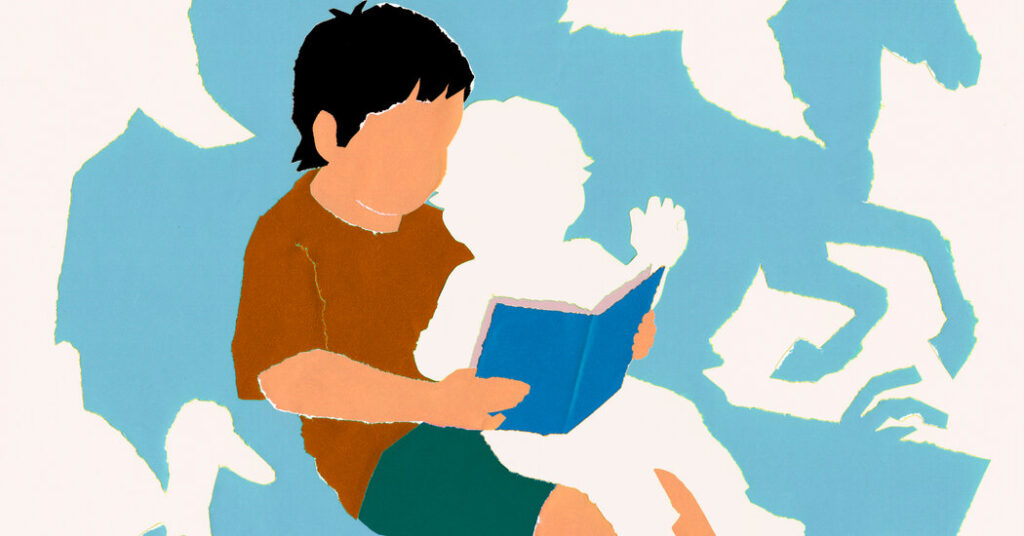
We have a word for children without parents: orphaned. We have a word for those who lose a spouse: widowed. There is no everyday word in English for growing up without siblings — until now, we’ve rarely needed one.
That is changing. Over the past 50 years, the share of American mothers with only one child has nearly doubled, from 11 percent in 1976 to about 20 percent today. Meanwhile, large families have receded: In 1976, 40 percent of mothers at the end of their childbearing years had four or more children; by 2014, just 14 percent did. The total U.S. fertility rate hit a historic low of 1.6 births per woman in 2024 — well below the replacement rate of 2.1.
In nearly every country in the European Union, the one-child household is already more common than two- or three-child households. It may soon become the standard in America, too.
I trained as an economist in the years when smaller families were widely treated as good news. The assumption in the field was straightforward: Fewer children meant more investment in each. Quality over quantity. The wider culture absorbed the same logic. Modern parents speak it fluently: We want to give our children everything.
But after years of interviewing parents of large families, I’ve come to think that calculus was incomplete. Some of what shapes a child can’t be supplied by parents at all, no matter how attentive or well resourced. It comes from siblings.
In 2019, I traveled across America to interview mothers of five or more children for “Hannah’s Children,” a book about what leads some women to have large families while the rest of the world has fewer and fewer. They were a varied group — devout Christians, observant Jews, Latter-day Saints — but on one point they agreed almost without exception: When it comes to raising children with good character, they told me, it is easier to raise five than one.
The reasoning was practical. In many large families, everybody shares a room; small disputes have to be hashed out; older children naturally take responsibility for younger ones. “There are tons of opportunities for them to be self-sacrificing and patient and charitable,” said one mother, a former litigator with six children, adding, “just endless opportunities for conflict and resolution.”
Virtue, Aristotle observed, is built by habit: “What we must learn to do, we must do to learn.” And nothing shapes our habits more than the first society we inhabit as children.
The mothers I spoke with described scenes that to outsiders might look extraordinary. Another mother of six told me about her parish priest’s enthusiasm after watching her eldest son carry his baby sister around the school parking lot. To the priest, the two kids’ close relationship was a revelation. To their mother, it was unremarkable. “He carries the baby all the time,” she told me. “He changes her diapers. He puts her down for a nap. That’s just kind of a way of life.”
Across these conversations I came to see that large families generate moral education the way an engine generates heat — as a byproduct. Parents in small families have to manufacture, through summer programs and sports leagues and carefully cultivated extracurriculars, the kind of character-forming experiences that large households once provided gratis.
The benefits of siblings reach further still, into the harder corners of adolescence and beyond.
I know this from my own life. My mother had her last two children, my seventh and eighth siblings, when I was in high school. Their births were the happiest times of my teenage years. My social life could be up or down, but those kiddos always adored me. I wanted to live up to the role. My youngest siblings kept me closer to home, and provided ballast through the inevitable difficulties of those years. They are still my closest friends, the first I turn to in hard times.
Until I began my interviews with mothers — decades later — I didn’t think to extrapolate from this experience. But dozens of conversations convinced me: There is more to the adolescent mental health crisis than screens and social media.
One mother of 14 in the Northeast told me she believed one of her sons would probably have been diagnosed with depression or anxiety if he hadn’t had a new baby sister to hold and care for. His whole demeanor changed when he held the baby, she told me, as if the newborn were a sunlamp.
Twenty-five hundred miles away, another mother told me how the arrival of her sixth child pulled her preteen son out of a mental health tailspin that medication and therapy had not been able to touch. She described him coming to the hospital to meet the newborn, cradling him in his arms and “just feeling that peace right for the first time.” The baby was someone he could love and who loved him back with no judgment. “It was healing for him,” she said.
These were not exceptional cases. I wasn’t even probing for them. But mother after mother described some version of the same dynamic — a struggling older child steadied, sometimes dramatically, by the responsibility and tenderness of caring for a younger one. Today’s middle-school- and high-school-age children rarely have that experience. They do not share a home with an infant or an adoring toddler. Many will not even remember a time when they did.
The most striking story I heard came from a West Coast mother of nine. Her seventh child was born with a chromosomal abnormality so rare that she could find no other case to match his profile. For months, this mother told me, she lived at the hospital while her older children, without being asked, stepped up to cook, do the laundry and care for one another while their father went to work. When the baby finally came home, his siblings accompanied him to every appointment — cardiology, X-rays, therapy — learning to help with gastrostomy-tube feedings, working like nurses. Specialists were impressed by his progress and speculated that the kids were behind it. Whatever the therapist assigned as homework, the mother posted for her family to see. If the baby needed to be flipped to build upper-body strength, whoever passed by would flip him. Morning and night. Without anyone setting out to teach them, these children had become habituated to caring for one another.
We hear constantly that Americans are more atomized, more polarized, more isolated than ever. Some say it’s the screens. Some say social media. Pundits on the left and right blame our political order and the ideas that animate it. The common diagnosis is that our system can no longer cultivate the virtues needed to sustain it: Virtue has been a casualty of freedom. The mothers I interviewed pointed to a different explanation. The problem isn’t freedom. It’s that we have lost the primary institution where virtues are formed — the household in which children form one another.
The 19th-century American writer and preacher Orestes Brownson once described his upbringing in just these terms. “Properly speaking I had no childhood,” he wrote, adding, “Brought up with old people, and debarred from all the sports, plays and amusements of children, I had the manners, the tone and tastes of an old man before I was a boy.” A sad misfortune, he called it — “for children form one another, and should always be suffered to be children as long as possible. Both children and youth are quite too short with us, and the morals and manners of the country suffer from it.”
Where does this leave us? There are no easy answers. Smaller families aren’t just about choosing to invest more in each child. They also reflect difficult trade-offs that fall heavily on women: career pauses that compound into lower lifetime earnings, and promotions missed during the caregiving years. And many never reach this calculation at all — suitable partners are hard to find, fewer young adults have practical experience with the joys of children (itself a consequence of the smaller families that came before), and life’s uncertainties make long-term commitments feel premature.
For all that, I don’t want to tell anyone to have more children. But if I could suggest one thing, it would be for parents to reconsider being “done.” Wait a year before doing anything permanent. Wait two. The hardest years of parenting, when your children are very small, are the worst time to decide what size family you want. The rewards reveal themselves later. I have met countless parents who said they stopped having children too soon because they did not know how good it was going to get.
Keeping the door open for another child trades on a wisdom offered by the mothers I interviewed: That more people are never a problem for a family, a nation or any one child. Quantity is a quality of its own when it comes to human beings.
This wisdom explains, too, why modern parenting has become paradoxically harder. Siblings were doing some of the work. And in our haste to make our children’s lives better, we accidentally took credit for a value they alone provided.
We do not have a word yet for what is being lost. But we are beginning, finally, to see it.
Catherine Ruth Pakaluk is the author of “Hannah’s Children: The Women Quietly Defying the Birth Dearth.” She is the executive director of the Institute for Human Ecology at the Catholic University of America, where she is an associate professor of economics.
The Times is committed to publishing a diversity of letters to the editor. We’d like to hear what you think about this or any of our articles. Here are some tips. And here’s our email: [email protected].
Follow the New York Times Opinion section on Facebook, Instagram, TikTok, Bluesky, WhatsApp and Threads.
The post What We Lose When We Don’t Have Siblings appeared first on New York Times.