World War II narratives, up for grabs
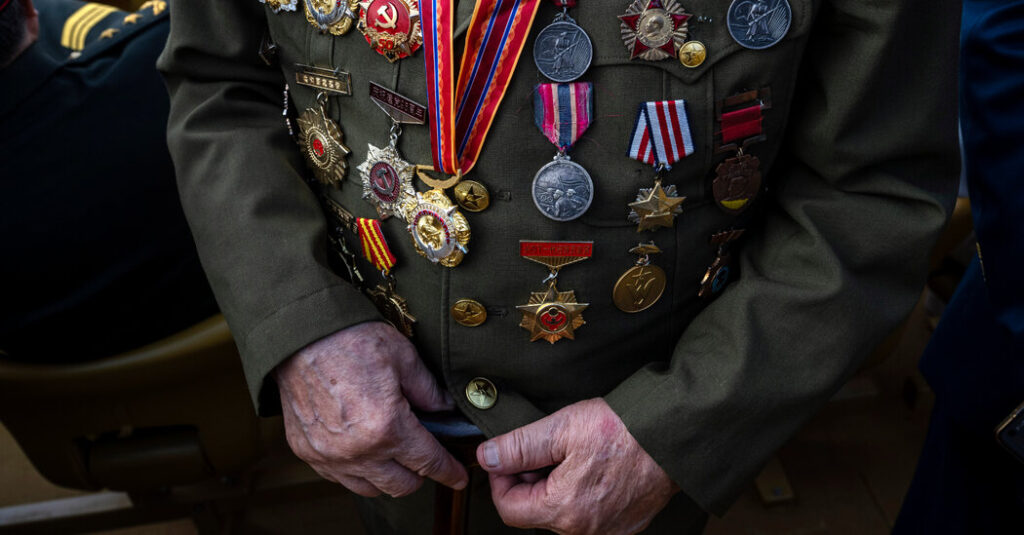
In September, China held a military parade to commemorate the 80th anniversary of the end of World War II. Cannon fire, fighter jets, missiles and goose-stepping troops filled Tiananmen Square in a display of military might and expanding global influence.
Also on display was a particular narrative of the war, one that assigns China a central role in the victory against Nazi Germany and imperial Japan. In this version, as China’s president, Xi Jinping, put it at the time, Beijing and Moscow were the “main victors.”
Since then, China has repeatedly invoked World War II — in Xi’s phone call with Trump, but also in interactions with European officials. The language always centers on defeating fascism and protecting the outcomes of the war. But the implicit message is that Japan, which recently made clear that it would intervene militarily if Taiwan were attacked, is a historic aggressor that should be regarded warily.
Every country has its own story of the Second World War. But it is largely Western stories about the war — who won, what it was about and what its lessons are — that have shaped the postwar order.
Today, that order is breaking down. And countries like China, as they gain prominence and power, are using some of that power to put forward their versions of this history — with potential implications for whatever world order emerges next.
‘A war like no other’
Why do narratives about World War II still have so much power? As the historian Antony Beevor put it to me, “the Second World War was a war like no other,” and yet for many people, paradoxically, it’s “the definition of war itself.”
Countries around the world all experienced the same event. But they did not experience it the same way. All these individual narratives have never really been reconciled into one, Beevor said. Now that the balance of power in the world is shifting, we’re seeing more competition about whose story takes prominence.
For the countries that defeated Nazi Germany and its allies, including Japan, the war was an epic battle of good against evil. These countries liberally evoke that history in regular commemorations and in school curriculums to rally people to the flag.
The countries defeated in the war have more complicated relationships to that history, but it still defines them. Germany’s postwar identity has been largely about atonement. In Japan, questions of whether the country has apologized enough and should formally abandon the pacifist stance it was forced to adopt after the war are live subjects in contemporary politics.
Germany and Japan have still been an integral part of the West’s prevailing story about World War II, because they became integral to America’s postwar system of alliances. By contrast, the Soviet Union, which lost some 24 million lives in World War II, and China, where about 20 million died, have not always featured as prominently in many Western accounts.
Russia has long made the case that it deserves more credit for its sacrifices on Hitler’s eastern front. China’s latest push to have its role in the war upgraded is reminiscent of this effort, although many historians believe Chinese nationalists, who eventually retreated to Taiwan, played a bigger role in World War II than the communists.
This isn’t just an intellectual exercise. Battles about history are always about shaping the present.
New story, new order
Western countries have often used World War II references that suited them: The Bush administration compared Sept. 11 to Pearl Harbor, and likened Saddam Hussein to Hitler. One pro-Brexit campaigner likened leaving the European Union to evacuating British soldiers from Dunkirk, France.
China is invoking World War II with Western leaders because it’s trying to shift their understanding of Japan to something that looks more like China’s: Japan as a country with a history of aggression that’s a potential threat to its neighbors.
It’s part of a broader push to eventually reclaim Taiwan, justified, in part, by Chinese ideas about what it’s owed for its sacrifices during the war. Russia, which refers to World War II as the Great Patriotic War, deliberately invokes the war when it talks about “denazifying” Ukraine.
The story underpinning the American-led postwar world order, Beevor told me, was one in which America liberated Europe from fascism and gave it liberal democracy and free market capitalism. From that sprang international institutions (and military interventions) that purported to promote democracy and free trade.
But China sees World War II as part of a longer struggle against Japanese imperialism that would end with the reunification of mainland China and Taiwan — a promise that, from China’s perspective, has yet to be fulfilled. From this story springs a whole different set of assumptions about what the world should look like, he said, from what “sovereignty” means to how other countries should respond to a Japan that is rearming.
The stories around World War II are shifting. But 80 years on, the war itself remains central to many national identities. We’re now heading into the post-postwar era. Our arguments about World War II are coming with us.
Related: In an interview at the DealBook Summit, Taiwan’s president warned that China was stepping up its campaign of intimidation against the island.
MORE TOP NEWS
The pope up close
My colleague Motoko Rich traveled with Pope Leo XIV to Turkey and Lebanon on his first international trip. In the video above, she talks about witnessing how a shy and cautious person like the pope moves onto the global stage.
OTHER NEWS
-
No breakthrough on Ukraine emerged from nearly five hours of talks between U.S. and Russian negotiators. So what could force Russia to end the conflict?
-
E.U. officials unveiled an updated plan to use 210 billion euros in frozen Russian assets for a giant loan to Ukraine.
-
Israel said it would reopen the Rafah border crossing to allow some Palestinians to leave Gaza. Egypt denied that the border would reopen soon.
-
Israel and Lebanon held cease-fire talks as fears grew that Israel might renew its offensive against Hezbollah.
-
The police in Tunisia arrested a prominent opposition figure, the latest sign of the country’s slide toward authoritarianism.
-
The authorities in Hong Kong arrested critics who demanded accountability after a fire that killed at least 159 people.
-
A Fabergé egg laced with platinum snowflakes and encrusted with thousands of tiny rose diamonds sold for a record price of more than $30 million.
SPORTS
Football: With Lionel Messi in the spotlight, this M.L.S. Cup may be the most important in the league’s history.
Formula 1: Is Lando Norris ready to claim his first world title?
CHART OF THE DAY
Remember those sky-high bitcoin prices that everyone said were here to stay? Well, they left. The cryptocurrency plunged by nearly 35 percent in November, erasing almost all its gains this year. The cause of the crash isn’t clear, but it’s a reminder that crypto is not for the faint of heart.
MORNING READ
Much of America’s musical heritage — including original recordings by artists like Bob Dylan, Bruce Springsteen and Fleetwood Mac — is stored on fragile studio tapes. But some of those old reels are prone to decay and, with age, the music can be lost.
Enter Kelly Pribble, an audio engineer. For 15 years, he has been at the forefront of a vital effort to save old magnetic tapes. Armed with hair dryers and other unconventional equipment, he has repaired compromised tapes from hundreds of artists. His techniques often make him the engineer of last resort. Read more.
AROUND THE WORLD
Coffee is more than caffeine in South Korea
South Koreans are passionate about coffee. And opening a coffee shop has become a kind of fantasy to many people. The density of cafes in Seoul rivals that of cafes in Paris, and competition is tough.
For Koreans, coffee shops mean more than caffeine. Many people live in small apartments with family, making it difficult to invite people over. Cafes offer spaces where couples can linger, old friends can catch up and students can study. Read more.
REPORTER RECOMMENDATIONS
Cairo
Vivian Yee recently ended her run as Cairo bureau chief after almost five years in the city. She sent us her favorite spots.
Visit the Gayer-Anderson Museum and Mosque of Ibn Tulun. A stunning but not dauntingly huge museum of Islamic art and antiquities spread across two centuries-old houses. The museum is also next to one of Cairo’s oldest mosques. Climb the mosque’s spiral minaret for a view of the pigeon towers perched atop nearby homes, Saladin’s silver-domed citadel mosque and Cairo’s million or more satellite dishes.
Go on a bar crawl in the city center. Alcohol licenses are hard to come by in today’s Egypt. So the few places that serve drinks in Cairo’s downtown are grandfathered in from more permissive times, and they’re probably older than your actual grandfather. They show their age, but they’re also highly charming. Head to El Horreya Café for an only-in-Cairo drink under fluorescent lights or the Greek Club for a sheltered rooftop that won’t fool you into thinking you’re in Athens but will make you laugh.
Walk the Qasr el-Nil Bridge or along Al-Moez Street. During the day, take a stroll along the historic Al-Moez Street, where you’ll pass medieval mosques, schools and walled homes. Start at the ancient Fatimid gate of Bab al-Nasr, once one of the city’s entrances, and make your way south to the double-towered Bab Zuwayla. After dark, catch one of the most striking views of Cairo from the Qasr el-Nil Bridge, which runs over the Nile.
RECIPE
In this Australian lunchtime staple, fennel- and herb-spiked meat makes a heady filling for crisp and buttery puff pastry. The original sausage roll recipe calls for ground pork. But ground chicken, turkey or plant-based meat will also work.
WHERE IS THIS?
This is the so-called polar bear capital of the world. Where is it?
TIME TO PLAY
Here are today’s Spelling Bee, Mini Crossword, Wordle and Sudoku. Find all our games here.
You’re done for today. See you tomorrow! — Katrin
We welcome your feedback. Send us your suggestions at [email protected].
Katrin Bennhold is the host of The World, the flagship global newsletter of The New York Times.
The post China, Japan and a New Narrative About World War II appeared first on New York Times.