Just over 10 years ago, I opened a small bookstore a few hours northwest of New York City. The shelves are arranged by affinity: notable people choose their 10 favorite books; elsewhere, titles gather around more whimsical themes. Early this year, I found myself creating a shelf I could not have imagined when I started: queer sports romances.
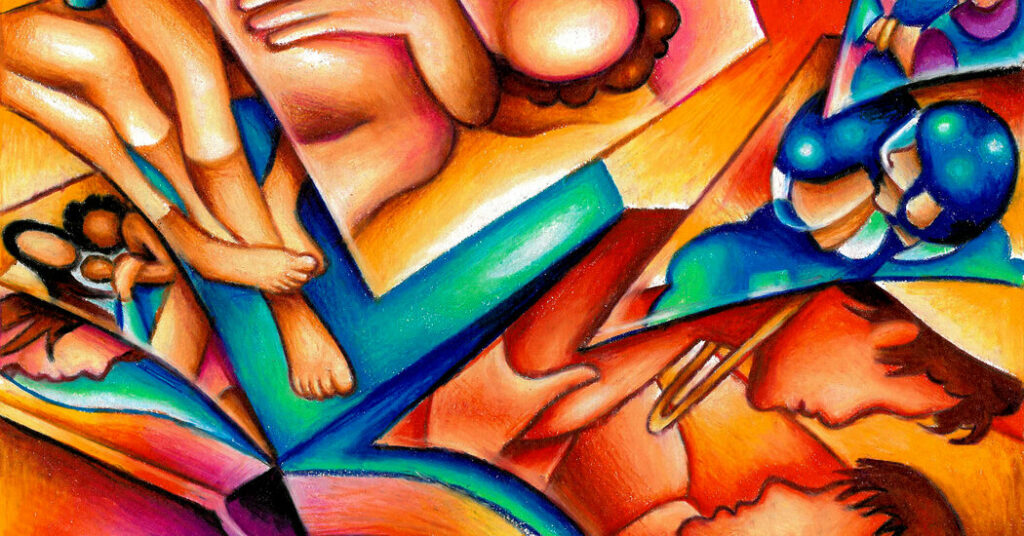
That’s where you now find “Heated Rivalry” beside “Thirty Love” and “Futbolista”: closeted hockey players, closeted tennis players, closeted college soccer players. The covers promise muscle, yearning and secrecy. Though the protagonists tend to be men, many of the genre’s writers and readers are women. At first, I saw these books as a playful little subgenre, a narrow tributary of romance publishing. Lately, I’ve come to see them as evidence of a much larger shift: Queer literature has become one of the growth engines of the publishing industry.
L.G.B.T.Q. fiction has never been more visible, more varied or better promoted. In the past year alone, Douglas Stuart received the Oprah imprimatur for “John of John”; Ali Smith won the Dublin Literary Award for “Gliff,” her speculative and unmistakably queer novel; Yang Shuang-zi won the International Booker Prize for “Taiwan Travelogue,” a historical metafiction about the charged intimacy between a female Japanese writer and her female Taiwanese translator; and Rabih Alameddine won the National Book Award for fiction for “The True True Story of Raja the Gullible (and His Mother),” a comic saga told through the eyes of a gay high school teacher in Beirut.
It is not a stretch to call the past few years the richest period for queer fiction since 1978, when Andrew Holleran published “Dancer From the Dance,” Larry Kramer published “Faggots” and Edmund White published “Nocturnes for the King of Naples.” That post-Stonewall flowering was followed by AIDS, which robbed queer literature of many of its writers and a substantial portion of its audience. Publishers retreated. To be labeled a gay or queer writer was a constraint. In 1999 John Updike rebuked a future Booker Prize winner, Alan Hollinghurst, in The New Yorker for writing “of a realm from which most human beings are excluded,” populated by “relentlessly gay” people.
The old assumption was that queerness should be downplayed to get a wider readership. In 2007, when Rakesh Satyal’s “Blue Boy,” a gay Indian American coming-of-age novel, was being shopped around, he thought its intersection of South Asian and queer experience might broaden its appeal. Publishers saw the opposite. “It was seen as a reduction of the audience,” he told me.
Today, the opposite looks true. Queerness sells. Even the canon is getting queered. In “The Chosen and the Beautiful,” Nghi Vo rewrites “The Great Gatsby” away from Nick Carraway and gives it to Jordan Baker, reimagined as a bisexual Vietnamese adoptee. Rey Terciero’s graphic novels “Northranger” and “Dan in Green Gables” are similar reimaginings of “Northanger Abbey” and “Anne of Green Gables.”
This is not simply a story of representation getting its due. The audience for literary fiction has long skewed toward women and gay men. What has changed is the industry’s willingness to acknowledge that, and the many straight women who are willing to read about gay characters.
According to data compiled from BookScan, sales of L.G.B.T.Q. fiction (excluding digital sales) were roughly $8 million in 2015, the year Hanya Yanagihara published “A Little Life,” heralded by Garth Greenwell as a great gay novel. By 2025, annual sales of L.G.B.T.Q. fiction had reached more than $80 million: a tenfold increase over a decade in which fiction more broadly has struggled. Over the same period, sales of literary fiction fell to around 33 million books per year from around 36 million.
Best sellers like “Shuggie Bain” by Douglas Stuart — which 32 publishers in the United States turned down before it went on to win the Booker Prize — and Ocean Vuong’s “On Earth We’re Briefly Gorgeous” have shown that the demand is real and robust. The boom has created room for wildly original work by Bryan Washington, Torrey Peters, Brontez Purnell, Édouard Louis and Yael van der Wouden, among many others.
The very qualities that once made queer fiction seem too risky now make it useful. Queer books also come with organic systems of circulation: book clubs, queer bookstores, online fan communities and events that double as gatherings of friends. The decline of newspapers and book reviews has created space for new influencers such as Jack Edwards, a TikTok book critic who has championed Mr. Stuart’s “John of John,” and whose millions of social media followers give his recommendations impact and influence. For publishers, that is increasingly valuable. Queer books don’t simply find individual readers; they find communities.
The boom has created incentives for publishers to package gayness, and for straight writers to borrow it. André Aciman, who is not gay, wrote one of the defining gay love stories of the last 20 years in “Call Me by Your Name.” The 28-year-old Djamel White’s debut novel, “All Them Dogs,” was subject to a six-way auction. Mr. White is straight, but his sexy neo-noir novel imagines a love affair between two Dublin mobsters.
Josh Silver’s “Fruit Fly,” published this April, is a funny and nasty novel about appropriation: A blocked straight female writer latches onto a young gay addict, imagining that his pain might supply the authenticity her fiction sorely needs. Mr. Silver said he had been thinking about “Yellowface” and “Erasure,” novels about the appropriation of Asian and Black culture, and wondered why no one had written a gay version.
In May, I moderated a conversation with Mr. White and Mr. Silver. I asked Mr. White about appropriation. He first answered with a joke. “I personally just wanted to make some money,” he said. Then he gave the question its due. “I am writing outside my own experience to an extent,” he said, “but I’ve experienced desire and I understand desire and I can understand the desire between these two people on a human level. I hope that it felt true because it felt true when I was writing it, and I think that’s the important thing.”
Mr. Silver’s “Fruit Fly” is satire, but his irritation is real. He described the insult of being told early on not to seem gay, only to find, today, that gayness had become professionally useful. “It had currency all of a sudden,” he said. “I was offended by it.” That is the catch. The thing that once made you vulnerable can become the very thing other people want to borrow.
Aaron Hicklin manages Libreria, a bookshop in London, and One Grand Books in Narrowsburg, N.Y.. He is the host of the radio show and podcast “Shelf Life” and the director of Deep Water Literary Festival. He was the editor in chief of Out magazine from 2006 to 2018.
The Times is committed to publishing a diversity of letters to the editor. We’d like to hear what you think about this or any of our articles. Here are some tips. And here’s our email: [email protected].
Follow the New York Times Opinion section on Facebook, Instagram, TikTok, Bluesky, WhatsApp and Threads.
The post Gay Lit’s Gone Mainstream appeared first on New York Times.