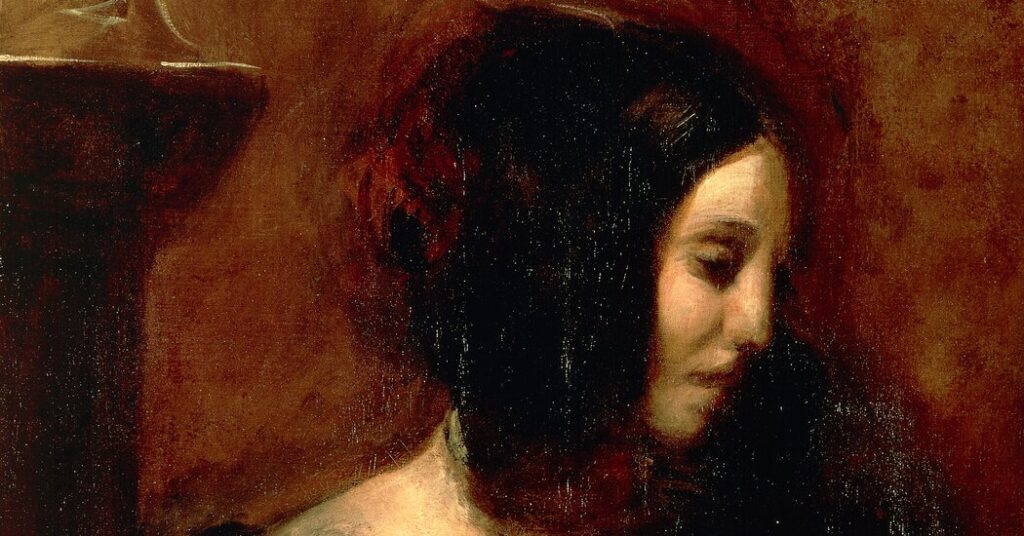
BECOMING GEORGE: The Invention of George Sand, by Fiona Sampson
For nearly half of the 19th century, the French writer George Sand dominated literary Europe. She produced over 70 novels; 17,000 letters, some to the literati of her day; numerous essays and articles; and dozens of plays. She outshone Victor Hugo and Honoré de Balzac in reviews. Elizabeth Barrett Browning penned sonnets about her. And Fyodor Dostoyevsky spent his adolescence blithely absorbing her prose.
Modern times, somehow, chiefly remember her as the lover of Frédéric Chopin and as a connoisseur of suits, cigars and much younger men.
A rather mortifying legacy for the great Mme. Sand. It is this distortion that preoccupies the British poet and scholar Fiona Sampson in her new biography, “Becoming George,” which arrives for the 150th anniversary of Sand’s death. History has turned Sand into “all personality, little art,” she asserts, her notoriety “used to occlude her work, and so obscure her place in the literary canon.” To move past this “costume drama,” she urges us to see Sand chiefly as a writer, an inventor of stories and also of the self.
Sand, born Aurore Dupin in Paris in 1804, had tremendous imagination as a child. She tired the adults around her with rambling tales. She invented her own androgynous god, Corambé. Her teenage years at a convent (a common education for girls then) gave her the chance to test her stories and plays with a live audience. And in her grandmother’s manor in Nohant, where she was largely raised, she cultivated a taste for Jean-Jacques Rousseau’s simple, unpretentious prose, a style she herself would emulate.
Aurore was boyish. She galloped astride horses in riding pants through the Berry countryside. Even her grandmother in moments of absent-mindedness called her Maurice, after her father.
But it was marriage, at age 18, to Casimir Dudevant, a boorish, unfaithful and sometimes violent man, that catalyzed her new life as a trouser-wearing libertine in Paris (with stints in Nohant to see her two children). She came to regard marriage as primitive and unjust, a theme she would revisit again and again in her novels.
Within a year of her arrival to the capital, she was wearing men’s clothes — mostly a pragmatic choice. They were cheaper than dresses; she could move freely and unharassed on the streets, occupy the budget theater seats reserved for men, and feel at ease in literary salons, oftentimes passing as a “garçon,” as her peers at Le Figaro, then a small satirical paper, liked to call her. (She was the only female staff writer and she stood barely five feet.) Badly in need of money, she wrote furiously. Her first stories appeared under the name of her lover du jour, Jules Sandeau (to bypass an editor who would not publish women), which shortened to “J. Sand” for their jointly written novel, “Rose et Blanche,” in 1831.
She transitioned to “G. Sand” with her first solo novel, “Indiana,” in 1832. This tale of a woman trapped by marriage and liberated by an equitable free love received rapturous reviews, with most critics initially unaware of the work’s female authorship. But as her success turned her into an overnight celebrity, her true identity soon became widely known.
A second novel, “Valentine,” reinforced her status as a formidable talent. But “Lélia,” which dared to frame marriage as essentially a sexual trade, provoked outrage. The Catholic Church placed her works on its banned list. It did little to stifle her popularity.
During the turbulence surrounding the 1848 revolution that deposed King Louis Philippe, Sand threw her energy into crafting socialist pamphlets, founding two opposition newspapers and creating populist works, including a trio of pastoral novels sympathetic to agrarian life. To her utter disappointment, a socialist republic ultimately failed to emerge.
In the next decade, she published her memoir, “Histoire de Ma Vie” (1854-55), considered her magnum opus. Over 1,000 pages long, the sprawling reflection on childhood, memory and French society precedes “In Search of Lost Time” by more than five decades, Sampson reminds us. (Marcel Proust, deeply influenced by Sand, pays tribute to one of her pastoral novels in his own tome.) In the 1860s, Sand and Gustave Flaubert began a close friendship, captured for posterity in their numerous letters to each other until her death in 1876. In a tribute, he called her “that genius” whose “name will live in unique glory as one of the great figures of France.”
To grasp the essence of Sand’s staggering lifework, Sampson proposes reconsidering her 70-book corpus as the “Female Comedy” to Balzac’s 90-volume “Human Comedy.” It is an illuminating comparison. And Sampson weaves these more didactic turns into the fabric of a winsome tale of reinvention, well constructed and argued (even when the book suffers, at times, from heavy-handed prose and some digressions).
Still, far more pages are devoted to Sand’s love affairs (however entertaining) than to the merits of her writing. In other words, the biography tilts toward personality over art. And as such, it doesn’t quite engage with one of the chief resistances to Sand’s writing in the modern day, however unfair: that her prose is seen as overly sentimental, trapped in the mores of Romanticism when realism became the preferred mode.
Sampson hints at this problem when she remarks that Sand’s writing is “routinely overlooked.” It stems, in her view, from a distaste in those times for female productivity — her mass output signaled lower quality. Charles Baudelaire called her “this latrine.” Friedrich Nietzsche likened her flow of words to milk from a “dairy cow.” An unknown librarian immortalized this slur about her: “ink-pisser.” The prolific Balzac suffered no such fate.
Have we carried this stigma of Sand into the present day? Have we unjustly reduced her writing to sentimental potboilers?
Sand, incidentally in her letters, had just the right retort: “Someone who knew me deeply would read me as I am: taken with beauty, hungry for truth, very sensitive of heart, very weak of judgment, often ridiculous, always open and loyal, never small-minded or bitter, angry a great deal, and, thank God, completely oblivious to evil sayings and nasty people.”
BECOMING GEORGE: The Invention of George Sand | By Fiona Sampson | Norton | 384 pp. | $35
The post The Notorious 19th-Century Frenchwoman Who Scorned the Bourgeoisie appeared first on New York Times.