The increasingly desperate search for survivors by rescue workers and ordinary people entered a fourth day on Sunday, after two deadly earthquakes cut a path of destruction through northern Venezuela earlier this week.
More than 1,400 people have died since the twin quakes struck on Wednesday and more than 3,200 others were injured, said Jorge Rodríguez, the leader of the National Assembly, in an update on Saturday.
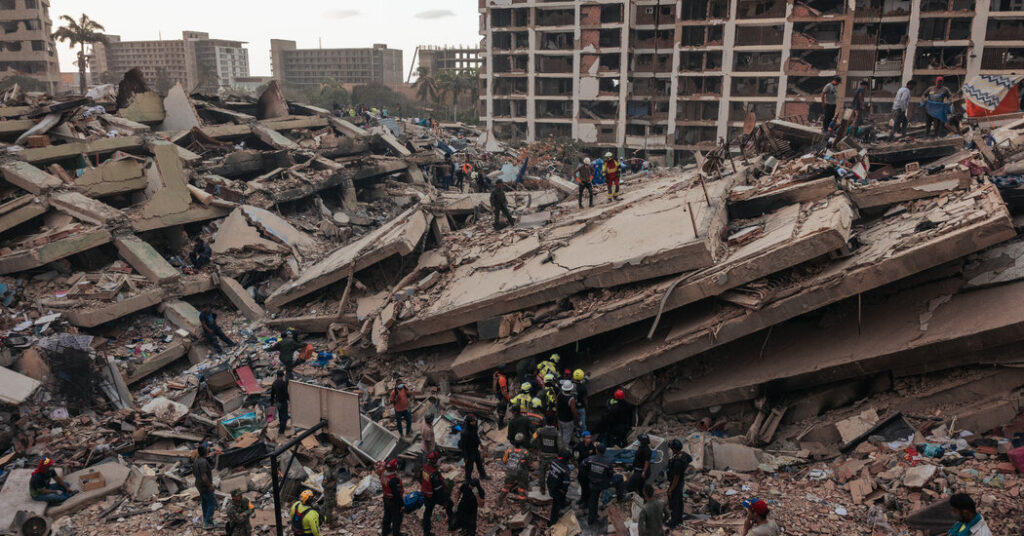
As the death toll rose, people clawed through brick and concrete with their bare hands while the Venezuelan authorities and emergency teams from around the world struggled to contend with the scale of the disaster.
Many others were believed to be missing and scores were known to be trapped in the rubble, Mr. Rodríguez said.
Rescuers feared they were running out of time to help survivors still in the rubble and to provide essential aid in a country where the medical system has been hollowed out by a decade-long economic depression.
Here’s what to know.
How big were the quakes?
Seismologists recorded the earthquakes’ epicenters in the Venezuelan state of Yaracuy, west of Caracas, the capital. Tremors were felt more than 100 miles away.
The first quake hit at 6:04 p.m. Eastern time on Wednesday with a magnitude of 7.2. The epicenter was near San Felipe, a city of about 220,000 people.
Around 39 seconds later, a second, stronger quake with a magnitude of 7.5 hit nearby. It was the most forceful earthquake to strike Venezuela since 1900.
Scientists pointed to two factors that made the quakes especially devastating.
They came in quick succession, a rare “doublet” as the Caribbean tectonic plate ground against the South American one. And they struck at a relatively shallow depth, according to the United States Geological Survey, making them particularly dangerous.
A 4.8-magnitude earthquake struck Saturday off the coast of Venezuela just days after the twin temblors, according to the U.S.G.S. The region had experienced more than 430 aftershocks since the powerful quakes hit on Wednesday, government officials said.
How many people have died?
The latest tally was from Mr. Rodríguez, the National Assembly leader, on Saturday afternoon: at least 1,430 people were killed and more than 3,200 were injured.
The strongest tremors struck the northern states of Yaracuy, Carabobo, Aragua and La Guaira, which include some of Venezuela’s most populous areas.
According to the U.S.G.S., many houses in those areas are made of unreinforced brick masonry and adobe blocks, which are particularly vulnerable to earthquakes.
In some neighborhoods of Caracas, buildings collapsed and the power went out. Witnesses described buildings shaking violently, windows rattling and water pipes bursting.
Photos and videos verified by The New York Times show concrete buildings reduced to rubble and others severely damaged. In the port city of La Guaira, buildings as tall as 10 stories collapsed.
How are emergency crews responding?
The frantic rescue effort entered a fourth day on Sunday, with the likelihood of finding survivors trapped under rubble diminishing by the hour. According to experts, the chances of finding survivors are highest in the “golden” window of up to 72 hours after an earthquake.
Venezuelan authorities have mobilized hundreds of emergency responders to look for survivors, with teams combing through rubble in disaster-struck La Guaira state with flashlights and mechanical diggers on Sunday morning.
The emergency effort has been hampered by clogged traffic on the main highway into La Guaira, delaying the arrival of rescue teams and prompting authorities on Saturday to restrict access to government vehicles and authorized personnel.
President Delcy Rodríguez said that more than 24 countries had sent aid, including 2,741 emergency workers. On Saturday, specialist units arrived from Chile, Colombia, Dominican Republic, Ecuador, El Salvador, Mexico, Panama, Spain, Switzerland, the United States, among others.
The United States made a significant contribution, sending a Marine Corps major general to direct its military relief efforts, which include two ships, helicopters and heavy cargo planes for delivering aid. Civilian search-and-rescue teams from California, Florida and Virginia were also sent.
A United Nations official said that 125 buildings were estimated to have collapsed. Mr. Rodríguez said on Friday that 243 people had been rescued.
Can the medical system cope?
Many injured patients were being treated in dire circumstances.
Venezuela’s fragile infrastructure — including rail, electricity and health care systems that have suffered from years of corruption and mismanagement — was hammered by the quakes, further hampering response efforts.
Mr. Rodríguez said in his Friday update that 13 hospitals had been damaged.
Many were overwhelmed with victims of the earthquakes. One hospital in La Guaira, the hardest-hit state, was operating without running water, a doctor said. Some patients were treated outside, in tents, or in makeshift facilities set up in places like bus terminals.
Beyond immediate medical needs, UNICEF said over the weekend that 1.8 million people in Venezuela, including 680,000 children, required humanitarian aid.
What is the political situation in Venezuela?
Venezuela is reeling from years of economic turmoil and crippling U.S. sanctions, and the earthquakes pose an immediate challenge for the president, Ms. Rodríguez.
In an audacious raid in January, U.S. forces captured and deposed the autocratic president, Nicolás Maduro, transporting him to the United States to face federal drug charges. President Trump handpicked Ms. Rodríguez as his successor and promised that the change would “unleash prosperity” by reviving Venezuela’s oil industry.
Six months on, there has been little sign of dramatic economic turnaround under Ms. Rodríguez, whose approval rating fell to 25 percent in May. Public coffers remain largely empty, leaving the government ill equipped to fund basic services.
Although the Trump administration has issued special exemptions from sanctions for companies interested in doing business in Venezuela, none has publicly committed to bringing significant capital into the country.
Annual inflation is falling but remains the world’s highest, the currency has continued to decline in value, and though wages have increased, they are still too low to lift many out of destitution.
Víctor Manuel Ramos contributed reporting.
The post What to Know About the Venezuela Earthquakes and Rescue Efforts appeared first on New York Times.