On the campaign trail in 2023, President Trump promised to throw a yearlong “spectacular birthday party” for the country’s 250th. Since returning to office, he has presided over a military parade, an Ultimate Fighting Championship fight on the White House lawn and, last week, the opening of the Great American State Fair, a 16-day patriotic extravaganza on the National Mall in Washington.
In recent weeks, the fair became bogged down in partisan rancor, as critics have accused Mr. Trump of hijacking the anniversary for political gain. But across the country, in the places where most Americans will actually celebrate, state planners who have been working for years with little publicity and often shoestring budgets have been rolling out programs of their own.
There will be festivals, parades, rodeos and potlucks. There will also be a whole lot of history, as states lean into their own contributions to the national story.
And for states outside the original 13 colonies, that means navigating not just raging culture war battles over history, but also a more basic question: What does 1776 have to do with us?
Amid President Trump’s call for a return to what he calls “patriotic” history, even that date has taken on a partisan edge. Still, some observers are hoping that the 250th, like the Bicentennial of 1976, will be a moment when a thousand local flowers bloom.
“There’s a big wave coming, and it’s going to paint a really sharp contrast with the dysfunction in Washington,” said John Dichtl, the president and chief executive of the American Association for State and Local History.
“So much of what is being planned in Washington is top-down spectacle celebrating one take on American history,” Dichtl continued. “But the states are looking much more broadly than that.”
Beyond the ‘O.G. 13’
The 250th calendar in the states includes plenty of big plans. Virginia has invested more than $20 million in its anniversary projects, including a nationally televised extravaganza at Colonial Williamsburg on July 4.
Utah’s 250th commission is organizing America’s Pot Luck, an effort to link community meals in every state on July 5. Hawaii’s group is coordinating simultaneous collective readings of the Declaration in locations from Guam to Maine, and on all seven continents.
Still, the anniversary initially posed a conundrum for states outside “the O.G. 13,” as Jason Hanson, the chief creative officer at History Colorado, a state-funded history museum in Denver, put it.
“When I first heard about 250th coming, I thought ‘What do we do?” Hanson said. “The answer was self-evidently not your typical ‘rah-rah, American Revolution.’ That just doesn’t resonate out here.”
But that doesn’t mean places like Colorado — which is also celebrating 150 years of statehood this summer — are disconnected from the legacy of 1776.
“The East Coast was where things got started,” Hanson said. “But it was really as the country expanded that the country worked out what the ideals of the Declaration really meant in practice.”
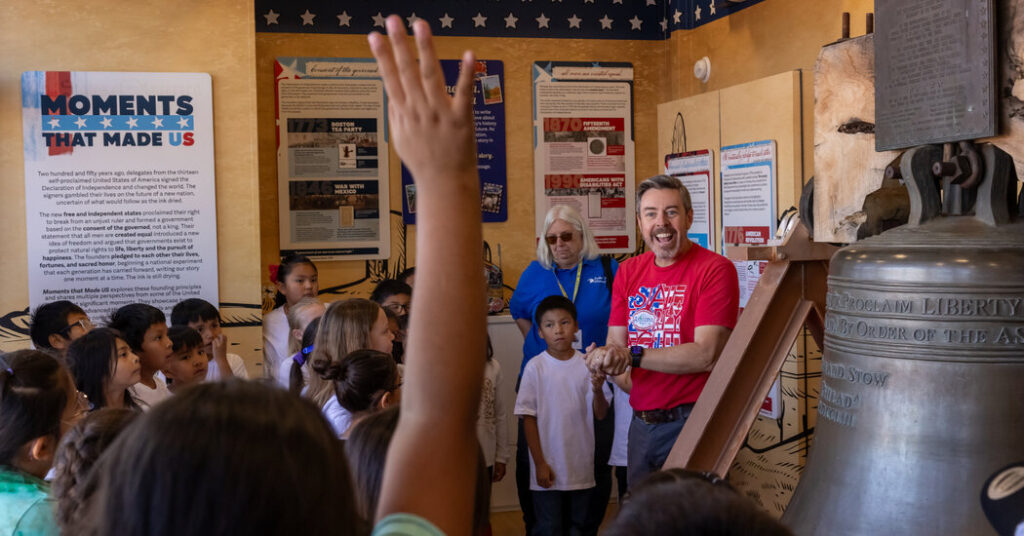
For the 250th, History Colorado is offering “Moments That Made Us,” a survey of 50 turning points in American history that emphasizes debate and multiple viewpoints.
The Denver Post called the show a “middle finger” to President Trump’s “whitewashed” vision of American history. But Hanson said the idea is to break down simplistic binaries of “patriotic” versus “woke” history, and question the idea of the American story as the unfolding of any single, predetermined narrative.
“We wanted to show that history is a series of choices and moments,” Hanson said. “And it is something we shape at every turn.”
At first glance, the exhibition, which is on view until Oct. 18, may seem like yet another riff on the now-common trope of presenting history through a resonant round number of objects. Its 50 kiosks include plenty of familiar historical signposts and A-list artifacts: George Washington’s spurs from Valley Forge, Jackie Robinson’s bat, Richard Nixon’s Oval Office tape recorder.
But there are also items that underline the show’s Western perspective. One example: a Spanish-language printing of the 1848 Treaty of Guadalupe Hidalgo, which ended the Mexican War and ceded more than half of Mexico’s territory — including parts of present-day Colorado — to the United States.
“If you were an American, this looked like Manifest Destiny,” Hanson said. But if you were Mexican or Indigenous, it looked like something else.
And the show itself is made to be revised and rewritten. History Colorado has created a free, print-on-demand version that includes panels based on 15 of the show’s moments. It also provides templates that allow anyone to create panels marking their own “moments,” pegged to key phrases in the Declaration, like “created equal” and “consent of the governed.”
So far, Hanson said, the print-on-demand version has been downloaded for use at more than 600 sites, across at least 36 states — eastern and western, red and blue.
In Arizona, the print-on-demand version has been adapted in “The Road to 250,” a state-sponsored mobile history museum that traveled the state this past spring. Along with some of History Colorado’s panels, it featured custom panels about state history, including ones dedicated to its Native nations, the legacy of the battleship Arizona and trailblazing Arizonans like John McCain and Sandra Day O’Connor.
Laura Terech, the executive director of Arizona’s 250th commission, said the project was careful to provide a “wide range of entry points,” given the political diversity of the state, which currently has split party control. “We know how personal patriotism can be,” she said.
In the Pacific Northwest, organizers from Washington and Oregon worked together to create 10 custom panels dedicated to regional history, including challenging topics like violent campaigns to drive out Chinese immigrant workers in the 19th century and Japanese American internment during World War II.
Nicholas Vann, the executive director of the Washington State Historical Society, said there had been some pushback to the project, and not just from conservatives.
“We do hear from some people who say, ‘I don’t want to celebrate America. What has it done for me?’” he said.
In Kansas, more than 40 institutions have registered to use parts of the print-on-demand exhibit, according to Cori Sherman North, president of the Kansas Museums Association. They include museums, zoos and gardens, as well as small-town historical societies, like the one in Caney (population 1,788), which printed some of the panels on regular pieces of paper and taped them up in the front window.
State planners have also created panels for 30 Kansas “moments,” including ones dedicated to Brown v. Board of Education of Topeka; the abolitionist John Brown and the bloody fight over expanding slavery to the state; and Gilbert Baker, the Kansas-born creator of the original rainbow Pride flag.
That subject matter may seem edgy in a strongly Republican state that has passed laws restricting teaching on race in public universities and banning gender-transition treatments for minors.
But Kara L. Heitz, a historian who consulted on the project, said that there had been little pushback so far.
“Kansas loves its history,” she said. “Left, right and center, we all kind of get behind John Brown.”
“People love to think that something important happened here — in my town, in my state,” she added. “It may be a bad thing, it may be a complicated thing, or it may be something to celebrate. But I’m connected to it.”
‘What Is History?’
Some states in the West are also using the 250th as a prod to update their state museums, in ways that emphasize the complexity of history.
In South Dakota, the newly renovated state history museum in Pierre, which partly opens on July 1, will include marquee artifacts, like a war bonnet that once belonged to the Lakota leader Spotted Cloud, which was recently donated by his descendants. There are also displays connecting the nation’s founding principles to historical debates in the state over things like free speech and property rights, according to Ben Jones, the state historian.
Another gallery, called “What Is History?,” emphasizes how history changes, as new evidence and new questions emerge. Historical museums, Jones said, quoting one panel, shouldn’t “tell you what to think, but encourage you how to think for yourself.”
Utah’s new state museum, which opened on June 27, features a temporary exhibit, “The Past Is Personal,” which focuses on the history of commemorations like the 250th. The first case features medicine pouches made by the Hopi and Northern Ute artist Alan Groves. The American Revolution, wall text notes, triggered what would be “unfathomable changes” for people in what would become Utah, making the anniversary complicated for Native people.
That exhibit also includes a section called “Peoples of Utah,” which updates a Bicentennial-era project with newly commissioned histories of rodeo queens, Cambodian refugees, deep-rooted Latino communities and other groups.
“We wanted to dispel myths of who does and doesn’t live in Utah,” said Jennifer Ortiz, the director of the state’s historical division. (For all its lily-white reputation, she noted, the state’s diversity is comparable to, say, Pennsylvania’s.)
That’s a delicate task in a state whose legislature passed a law two years ago restricting diversity initiatives in education and government. And the museum, Ortiz said, is careful in its language.
“We frame it as ‘whole history,’” Ortiz said — a phrase, she added, that seems “less scary” in the current climate than “inclusive.”
As a well-funded public institution with a supportive governor, Hanson said, History Colorado has more freedom to take on challenging topics. And the full version of “Moments That Made Us” on view in Denver goes to places not every public museum can go.
The last kiosk, titled simply “Our Moment,” includes four artifacts: a Black Lives Matter protest sign, a vial of a Covid-19 vaccine and a gas mask and pen that Representative Jason Crow had in the chamber of the House of Representatives during the Jan. 6 attack on the Capitol. The text keeps things simple and factual, leaving visitors’ thoughts to swirl in the air.
In 1776, no one knew what would happen next. And in 2026, neither do we.
“We all feel like we are living through a turning point,” Hanson said. “But we don’t know which way it is going.”
The post Trump Wants to Own the Nation’s 250th Birthday. States Have Their Own Plans. appeared first on New York Times.