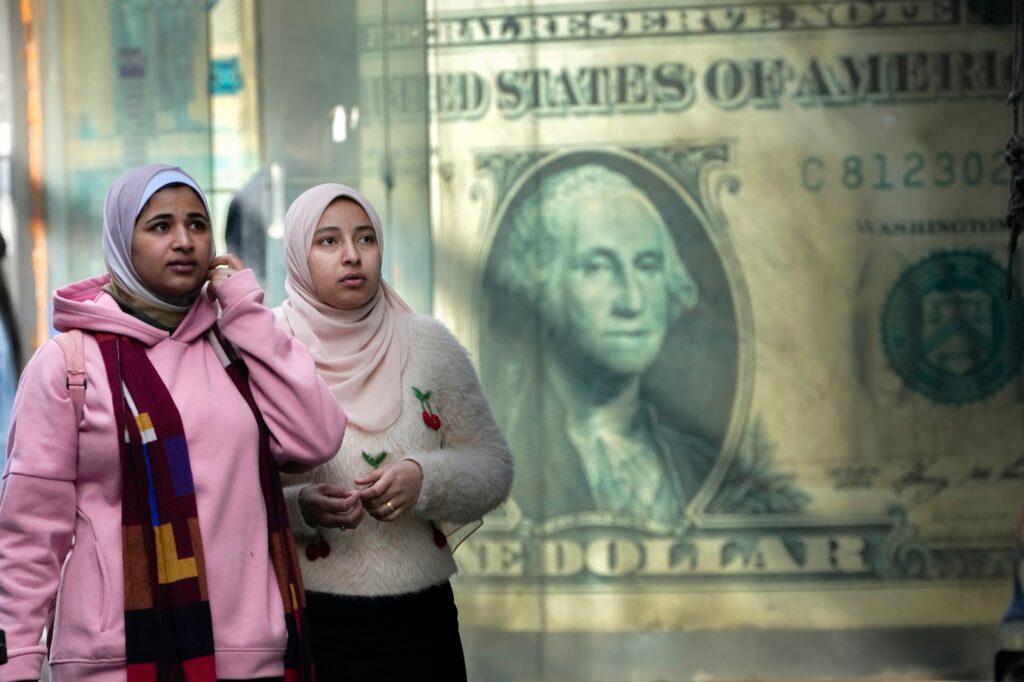
Global investors this week drove the dollar to its highest value in more than a year, as the appeal of the U.S. artificial intelligence boom and the prospect of higher interest rates eclipsed doubts about President Donald Trump’s erratic policymaking.
The greenback’s more than 5 percent gain since the end of January has quieted — for now — talk of the “Sell America” trade that emerged following the president’s April 2025 global tariffs announcement. At that time, financial markets, spooked by Trump’s plan for the highest import taxes since the 1930s, sent U.S. stocks, bonds and currency sliding in an unusual trifecta of losses.
Foreign investors remain wary of the unpredictable U.S. president. But eager to capitalize on the historic AI boom, they have piled into fast-growing technology stocks such as ASML Holding, a maker of semiconductor equipment that is up nearly 125 percent over the past year, and they’ve bought dollars to do so.
New Federal Reserve Chairman Kevin Warsh fueled the dollar’s rise this month by vowing to “unambiguously” curb inflation, reassuring markets at his public debut that he would ignore the president’s demand for lower interest rates. With inflation still above the Fed’s price stability target, rates may head higher, drawing in more foreign capital.
“You might hate the U.S. government, but if you love the opportunity presented by U.S. companies, you’re going to come here,” said Rebecca Patterson, former chief investment strategist for Bridgewater Associates, now with the Council on Foreign Relations.
The revived dollar has reversed a portion of the 12 percent decline from its January 2025 peak under President Joe Biden to its low ebb in January of this year. The currency traded this week at its highest mark since May 2025.
American tourists in Europe or Japan will find travel more affordable. But companies that depend on foreign markets, including technology giants such as Intel, Microsoft and Qualcomm, could see earnings hit when they convert their overseas profits into dollars. U.S. exports, which have risen for four consecutive months, also could sag.
The turnaround at the Fed is the biggest force driving the dollar rally.
After the central bank cut its benchmark borrowing rate three times in the final months of 2025, investors began this year anticipating additional monetary easing.
But the energy price shock from the Iran war, coupled with the effects of tariffs and the surge in AI-related spending, aggravated inflation. Prices, excluding volatile food and energy costs, were up 3.4 percent in May from one year ago, according to the Fed’s preferred inflation gauge.
The Fed’s policymaking committee made clear this month that after five years of above-target inflation, higher interest rates may be needed to cool off prices. Nine of the 18 members of the rate-setting Federal Open Market Committee projected at least one rate increase this year. Only one official forecast a cut.
“Foreign investors continue to invest in America in a pretty big way,” said Adam Turnquist, chief technical strategist for LPL Financial. “But certainly momentum now, I think, has more to do with the kind of definitive shift in monetary policy that we’re seeing.”
Higher U.S. interest rates would mean more expensive mortgages and business loans for Americans. But they would deliver higher returns for investors, especially compared with what is available in other developed markets. The European Central Bank raised its main policy rate this month to 2.4 percent while the Fed’s benchmark holds in a range of 3.5 percent to 3.75 percent.
Given the weak state of the euro area economy, which contracted by 0.2 percent in the first quarter, the ECB has little room to raise rates further while a majority of investors expect a U.S. rate hike at the Fed’s September meeting, according to CME Group’s Fedwatch, which tracks prices in the Fed futures market.
The increasingly healthy U.S. economy is catnip for foreign investors. The Commerce Department last week said growth in the first three months of the year hit an annual 2.1 percent rate, up from its initial 1.6 percent estimate. The pace may be quickening, according to the Federal Reserve Bank of Atlanta, which forecasts a 2.5 percent rate for the April-June period.
After a weak 2025, hiring has strengthened. Employers through the first five months of this year created an average of 114,000 jobs per month, more than 10 times last year’s anemic pace, according to the Bureau of Labor Statistics.
“We’ve had very resilient economic data. So not only are we getting the hawkish Fed, but we’ve got what appears to be a restrengthening of the U.S. economy,” said Marc Chandler, chief market strategist for Bannockburn Capital Markets in New York.
Some foreign markets this year, notably including Japan’s Nikkei index, have outperformed their U.S. counterparts. But U.S. stocks have a long history of outperformance. Over the past 20 years, an investor would have earned an annual return of 9 percent vs. just 2.4 percent in the rest of the world, according to a J.P. Morgan Asset & Wealth Management analysis.
In a recent speech, Treasury Secretary Scott Bessent touted the U.S. attributes that attract global capital: “the deepest, most dynamic markets; the preeminent role of our dollar; and an ecosystem of innovation that has pushed the boundaries of the possible for two and a half centuries.”
The broad “Sell America” trade, which Bessent derided earlier this year as a “false narrative,” faded as Trump dialed back his most extreme tariff plans and backed off his threats to the central bank’s independence and U.S. short-term rates began rising.
In a sign of the dollar’s endurance, its use as a global payments currency has actually increased since Trump unveiled his tariffs to 51 percent of all transactions from 49 percent, according to the Society for Worldwide Interbank Financial Telecommunication, which operates a secure financial messaging network.
Yet even as foreign financial institutions and individual investors load up on dollars, global central banks are edging away. For the past four years, as geopolitical risk flared, including from an unpredictable United States, central banks seeking an alternative to the dollar purchased unusually large amounts of gold.
As the price of gold roughly doubled over the past two years, the metal’s share of central bank reserves topped that of U.S. Treasurys. Gold now accounts for 27 percent of the assets central banks use to backstop their currencies compared with 22 percent held in U.S. government securities, the European Central Bank said this month.
Since Russia’s 2022 invasion of Ukraine, the heaviest buyers of gold have been located in areas facing the greatest conflict risk, including China, Poland, Turkey and India, the ECB said.
The embrace of gold is part of a slow shift from the dollar. Over the past 20 years, the greenback’s share of reserves has dropped to around 57 percent of the total from more than 66 percent, according to the International Monetary Fund.
“All the central banks are just saying, ‘Do I have too many dollar assets, generally, given the risk around the U.S.?’” Patterson said.
Overseas anxieties about the disruptive U.S. administration were highlighted by the president’s January demand for the U.S. to control Greenland, a NATO ally. But the dispute was shelved and, in hindsight, the episode marked the end of the dollar’s relative decline.
Foreign investors, however, are troubled by the deteriorating U.S. government fiscal situation. Since the 2020 pandemic, Washington has incurred unusually large amounts of red ink.
The federal budget deficit for the current fiscal year is expected to exceed $1.8 trillion or nearly 6 percent of the economy, a level historically seen only during war or financial crisis, according to the Congressional Budget Office.
With the $31.6 trillion U.S. public debt now larger than the economy, Washington’s annual interest bill hovers around $1 trillion. Some foreign investors worry that borrowers will demand higher returns, hurting the value of the U.S. securities they own. Earlier this year, AkademikerPension, a small Danish pension fund, sold its $100 million Treasury holdings, citing worries over the U.S. public debt.
The use by multiple presidents of punitive export controls and financial sanctions — plus emerging restrictions on the most advanced AI models — also has foreign governments reluctant to deepen their reliance on the United States. The dollar’s recent rise, as a result, should be viewed with caution.
“Even though financial markets are reacting in the normal way that we would expect them to based on the fundamentals of the economy and interest rates, this is still not an accurate barometer that trust in the U.S. has been restored writ large,” said Matt Swinehart, a managing director at Rock Creek Global Advisors in Washington.
The post Dollar hits 13-month high as foreign investors overlook worries about Trump appeared first on Washington Post.