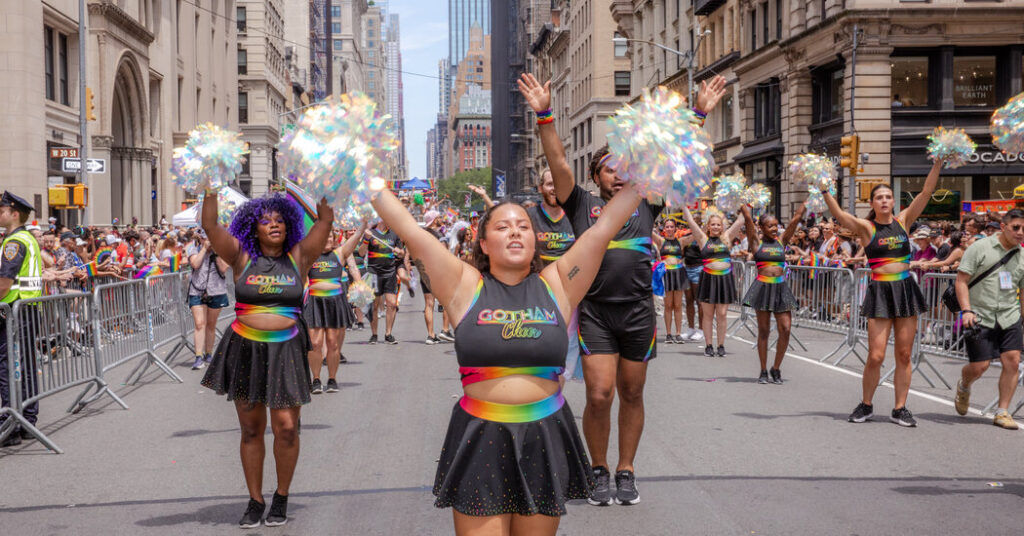
Millions of people are expected to gather on Sunday for the New York City Pride March, a jubilant and rainbow-bedecked celebration of the L.G.B.T.Q. community that is one of the city’s largest annual public events.
The march, which commemorates the 1969 Stonewall riots widely seen as the start of the modern L.G.B.T.Q. rights movement, arrives during a season of optimism for New York that has bloomed against the backdrop of a more anxious national mood.
New York City this June has been buoyed by a stretch of warm days after a brutally cold winter; the excitement of the Knicks’ N.B.A. championship win and global soccer fans arriving for World Cup matches; and the sunny vibes of its new mayor, Zohran Mamdani. But that brightness has been tempered by gathering storm clouds at the national level, as the Trump administration continues to target L.G.B.T.Q. people amid a decline in public support for same-sex marriage, gender transition and homosexuality itself.
“Well, it’s amazing to be in New York right now — go Knicks!” said Sean Ebony Coleman, the founder and chief executive of Destination Tomorrow, an L.G.B.T.Q. center in the Bronx. “But this year, you know, the climate has kind of shifted.”
The New York City Pride March is the largest of its kind in the United States. Organizers estimate that it draws roughly 750,000 participants and two million spectators each year, and it is the marquee event of a series of Pride festivities held in the city throughout June.
The event has always been equal parts celebration and protest, and advocates said that spirit was perhaps needed now more than ever.
Mr. Coleman said the list of challenges was long: the retreat of corporate sponsors from Pride events for the second year in a row; a drumbeat of legal and rhetorical attacks from the White House; and concerns about physical safety, especially for transgender people. But he said all of that had “shown us how resilient we are as a community.”
“We wanted to send a strong message that we’re still here, we’re not going anywhere and we’re going to party,” Mr. Coleman said.
The Trump administration has sought to end gender transition treatments for young people, and has inundated health care systems across the country with investigations and threats to pull funding if they do not end their youth gender medicine programs.
It has also mounted a campaign against diversity initiatives across the country, which led to a legal showdown this year over the fate of the rainbow Pride flag at the Stonewall National Monument in Greenwich Village in Manhattan.
The federal government’s attacks come at a delicate time for L.G.B.T.Q. people, who have secured political victories and a degree of social acceptance over the course of one generation that was once difficult for advocates to imagine.
The march, once viewed by many as a fringe spectacle, is now a major public event broadcast on television. But public support for many of the community’s gains has begun to soften, according to national survey data released by the Pew Research Center this month.
That trend is visible across a range of issues that have been longtime political priorities for gay and transgender groups. Those include support for legalized same-sex marriage, which has fallen to 65 percent compared with a recent peak of 72 percent in 2023, but also more fundamental questions like whether Americans believe it is morally acceptable to be gay or transgender.
The share of people who say homosexuality is morally acceptable has fallen to 64 percent, down from a peak of 71 percent in 2022, and the share who say it is acceptable to change one’s gender has declined to 38 percent from a peak of 46 percent in 2021, according to Pew.
New York City, long seen as a liberal bastion and safe haven for gay and transgender people, has not been insulated from those challenges.
The Trump administration’s drive to end transgender care for minors has met some success in New York, where at least one major health care system, NYU Langone Health, shut down its program after being targeted by the federal government. After NYU Langone and another hospital system, Mount Sinai, received subpoenas demanding identifying information and medical records about adolescent patients who had received gender transition care, a federal judge on Wednesday ordered the Department of Justice to stop seeking such information from city hospitals.
Some Parents, activists and elected officials have accused NYU Langone of complying with a bigoted demand and abandoning its patients. In February, New York’s attorney general, Letitia James, warned hospitals that ending gender-affirming care for transgender young people could violate state anti-discrimination law.
In response, Mr. Mamdani on Friday said the city would spend $15 million to improve access to medical care for transgender young people and adults, including a call and text line to connect people with medical providers and direct funding for both medical care and research. He said the city would also start a pilot program to offer hormone therapy for adults at a public clinic in Queens this year.
“Every New Yorker should have the freedom to live as themselves and access the health care they need,” Mr. Mamdani said in a statement announcing the plan. “We will protect care, support the providers delivering it and make clear that trans New Yorkers belong in this city.”
Last week, a coalition of L.G.B.T.Q. groups and 20 previous grand marshals of the Pride march demanded that Heritage of Pride, which organizes the New York celebration, bar hospitals that have ended their transgender youth programs from participating in the festivities.
“Institutions cannot claim solidarity with L.G.B.T.Q.+ communities one day a year while abandoning trans youth when political pressure mounts,” the coalition said in an open letter posted online.
Raquel Willis, a past grand marshal and a founder of the Gender Liberation Movement, an activist group, said in a statement that the organizers of New York City Pride “must hold the line and disallow hospitals that have unlawfully upheld hateful policies.”
Heritage of Pride said in response that it supported the rights of transgender youth, but that the contingents sent to the parade by hospitals were composed of employees from “the organization’s L.G.B.T.Q.+ groups, not the leaders making systemwide decisions.”
“By keeping these partners at the table, we can use our relationships to hold them accountable, advocate for the underrepresented and marginalized and propel progress,” the organization said in a statement. “We have had and continue to engage in productive, advocacy-focused conversations with these institutions about their approach to providing the affirming care trans youth need.”
There have been more symbolic battles, too. In April, the federal government agreed that a longstanding rainbow Pride flag could fly at the Stonewall National Monument in Manhattan, after the Trump administration had ordered it removed earlier in the year.
The flag’s removal from the monument drew outrage from state and local elected officials, as well as L.G.B.T.Q. people across the country, who viewed it as an assault on the symbolic heart of the gay rights movement in Greenwich Village.
Brad Hoylman-Sigal, the Manhattan borough president, was active in the campaign to reinstate the flag. He plans to march in the parade with his husband and two children.
The event this year made him think of “that old bumper sticker: ‘Think Globally, Act Locally,’” he said, “or maybe in this case, ‘Think Nationally, Act Locally.’”
“There are wins at the local level and the mood is positive, but the community here is in a bubble,” said Mr. Hoylman-Sigal, the first openly gay person to serve as a borough president in New York. “And that is kind of the world in which we operate right now.”
The post Pride March Caps Joyous New York June While Threats Mount appeared first on New York Times.