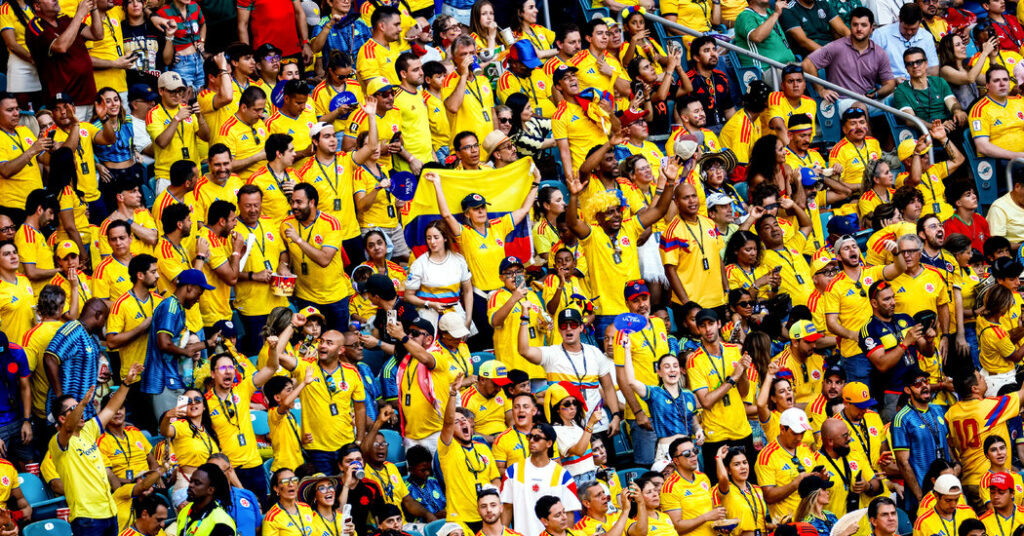
Team U.S.A. does not need to play a single 2026 World Cup match in South Florida for the region to embrace a home team.
Make that several home teams: Uruguay, when it played Saudi Arabia and Cape Verde this month. Brazil, when it played Scotland this week. And Colombia, when it played Portugal on Saturday night.
“Everybody’s in yellow!” said Merardo Becerra, a Colombian who lives in Miami, as he looked at the sea of Colombia jerseys streaming into the Hard Rock Stadium in Miami Gardens.
Miami has long cast itself as the capital of Latin America, always looking south to attract immigrants and businesses that have reinvented the city into a heavily Spanish-speaking metropolis. In doing so, Miami has become home to some of the biggest — and rowdiest — events in South American and Caribbean sports.
It’s not just soccer: World Baseball Classic games held in Miami this spring, including the final between Venezuela and the United States, drew sellout crowds that turned the Marlins’ stadium in the city’s Little Havana neighborhood into raucous parties. Some games were so heavily Dominican or Venezuelan that many fans felt as if they were in Santo Domingo or Caracas.
But soccer’s cachet has indisputably grown since the Argentine superstar Lionel Messi joined Inter Miami of Major League Soccer three years ago. The club’s distinctive pink jersey has become one of Miami’s biggest cultural exports. The club opened a sparkling new stadium this spring.
The soccer furor has not come without growing pains. The final of the Copa América tournament between Argentina and Colombia two years ago devolved into mayhem as some ticketless fans tried to force their way into the Hard Rock Stadium.
That tournament was not run by FIFA, which organizes the World Cup, but the debacle still led to questions about whether the stadium would be better prepared to handle even bigger crowds this year.
FIFA put stringent protocols in place: Fans without a parking pass are not allowed to walk into the stadium. Instead, those fans must take off-site shuttles that require a match ticket to board.
The biggest test of those protocols was Saturday’s match between Colombia and Portugal, which had reportedly drawn the highest demand for tickets of any match ahead of the tournament.
Both teams play well, and Portugal has the superstar Cristiano Ronaldo. But having Colombia play in Miami was also a perfect fit.
More Colombians live in Florida than in any other state — more than 434,000 of them as of 2023, according to the Pew Research Center. Some have been here for decades, having fled past armed conflicts in the South American country.
On Saturday, fans were relieved to enter the stadium without incident.
“The level of control was intense,” said Nick Quintero, 31, who also attended the 2024 Copa América final. “Unfortunately, it was something that was necessary.”
Mr. Quintero was born in Bogotá, the Colombian capital, but lives in Orlando, Fla., where he grew up. He attended Saturday’s match with his father, Josué Quintero, 60, who called seeing Colombia play at a World Cup a “bucket list item.”
“Now, I can die happy,” the elder Mr. Quintero said.
Father and son spent Friday night in Fort Lauderdale, Fla., supporting the team at what is known in Spanish as a banderazo, a flag-waving gathering typical among Latin American fans. Similar events were held around the greater Miami area ahead of earlier Uruguay and Brazil matches in the World Cup.
On Saturday, the vastly outnumbered Portugal fans mingled cheerfully with the Colombians, sometimes asking them to take their picture.
“When we pulled up I was like, ‘Oh, wow,’” said Katrina Ferreira of Daytona Beach, Fla., who wore a Portugal jersey, as did her husband and children. “‘We’ve got to be nice to people!’”
Inside the stadium, a D.J. played songs by the Colombian artists Carlos Vives and Karol G. Colombian chants filled the stadium. Some Colombian fans booed Mr. Ronaldo.
Colombians’ fervor may soon be matched by another adopted home team: The Miami Gardens stadium will host a knockout match on Friday between Cape Verde and the defending World Cup champion Argentina.
The post The City Where Colombia, and Much of Latin America, Plays as the Home Team appeared first on New York Times.