Kyle Thomson is still dealing with wildfires extinguished more than nine months ago.
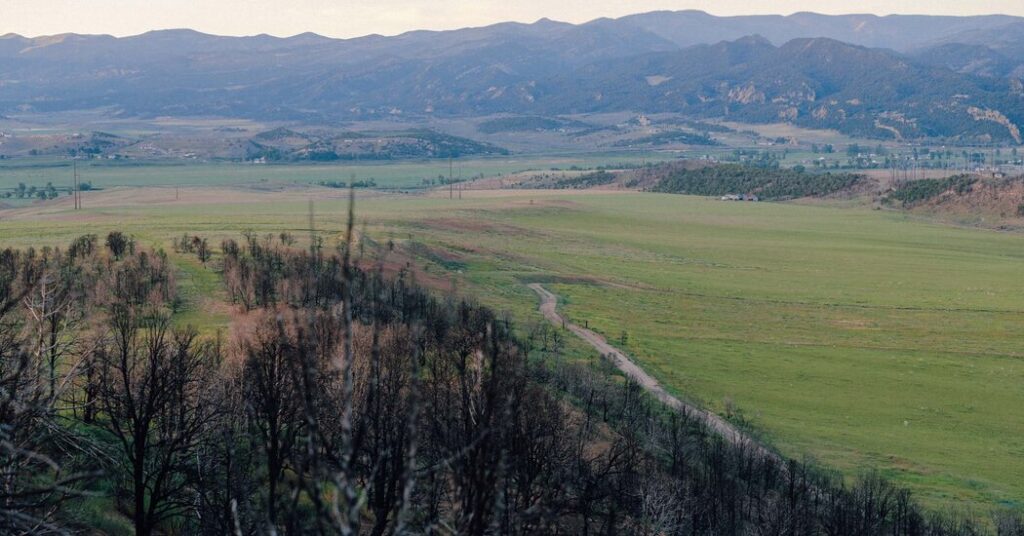
The Lee fire tore through Rio Blanco County, Colo., on the state’s Western Slope, in August and September, burning close to 137,800 acres. For months, Mr. Thomson, a lineman for White River Electric Association, a small utility cooperative, trekked several miles a day, picking up charred debris from burned power lines and restringing wires that cut through the rugged terrain.
But funding to finish the repairs has become contentious. And a brutal fire season is expected this summer, with a historically low snowpack and drought conditions in the West.
The Lee fire was the fifth-largest wildfire in Colorado history, “a tornado of fire,” as Mr. Thomson put it. Last year, as embers still smoldered, he assessed the damage. On his tablet, he pecked out his findings with dirt-caked fingers: $104,557 for 32 burned poles on Highway 13; $250,000 for 55 burned poles on County Road 22.
His calculations went to Colorado’s Democratic governor, Jared Polis, who quickly sent a formal request to President Trump asking for a major disaster declaration in order to unlock support from the Federal Emergency Management Agency.
A bipartisan group of state lawmakers endorsed the governor’s request, which assessed damages at $27 million. Mr. Thomson assumed the federal government would rush to send aid, most of which would go to utility repairs.
But then, in late December, came the news: The administration had denied the request, with little explanation. It was the first time in 35 years that Colorado, no stranger to fires and floods, had been denied federal assistance as part of a major disaster declaration request, state officials said.
“Clearly I thought there was a mistake,” Mr. Thomson said.
The rejection came as Mr. Trump was criticizing the state and its Democratic leadership. He was angry because Tina Peters, a former Colorado county clerk who believed that Mr. Trump had won the 2020 presidential election, was serving a nine-year sentence for tampering with voting machines. On Truth Social, the president’s social media platform, he castigated state officials and referred to her as a “hostage,” adding “FREE TINA PETERS, NOW!”
Rio Blanco County has 6,600 residents spread out over an expanse twice the size of Rhode Island. The offices of White River Electric are in a tiny brick building in the town of Meeker, the type of place where everyone — cattle ranchers and high school teachers, the utility worker and the owner of a hamburger stand — all seem to know one another. It’s a true rancher community with boot scrapers outside the entrance of the county administration building.
Residents of Rio Blanco tend to feel misunderstood by politicians, both in Denver and in Washington, D.C. The aftermath of the fire in the county, where 81 percent of the citizens voted for Mr. Trump in 2024, made them feel not only ignored, but also like pawns in a political chess game. At the county fairgrounds and in booths at the Meeker Cafe, some ranchers railed against Mr. Polis while others whispered that maybe Mr. Trump had gone too far.
‘A Way of Life Burned’
Nearly a year since the Lee fire, power outages are rare compared with the months after the inferno, and some of the region’s crucial oil and gas companies are not operating at full electrical capacity. Ranchers are reeling from losses and fear of rising utility rates.
Cattle ranching is already a tough business, because of persistent drought and rising production costs. The U.S. cattle herd is at its lowest level in 75 years.
Kathleen Kelley’s family has owned what has become a 2,000-acre ranch in Rio Blanco County for close to 60 years. She grew up driving tractors and fixing fencing. For years, she taught English at the local high school, but also returned to the ranch, where she and her husband grazed cattle before exiting the business, partly because of the worsening drought conditions. She leased her land to Chad Carter, a neighboring rancher whom she had known for years.
In the early 1980s, Ms. Kelley, who is 71, served one term as a Democrat in the state legislature, and she still follows politics. So she watched with interest as Mr. Trump harangued Mr. Polis and other Colorado leaders to release Ms. Peters. The pressure on the governor only increased when the Trump administration announced the relocation of U.S. Space Command, along with hundreds of jobs, from Colorado to Alabama — a move widely interpreted as a direct rebuke of the state’s Democratic leadership.
The Space Command announcement happened in early September, a few weeks after the Lee fire and the smaller Elk fire ignited in western Colorado. But even that slap to the state did not prepare Ms. Kelley, her neighbors or the executives at White River Electric for the denial of FEMA aid. Days after the rejection, Mr. Trump also vetoed a bipartisan bill for a pipeline project to provide clean drinking water to rural communities in southeastern Colorado.
“What we are living is real,” Ms. Kelley said. “But there is a disconnect, and the politicians are playing games.”
The Lee fire destroyed most of Ms. Kelley’s ranch. Some 20 miles of fencing burned down, making it impossible to keep a herd there, even if the animals could have grazed the scorched earth. No longer able to lease the land to a rancher, Ms. Kelley lost critical income. To reseed the land and repair the fencing and roads will cost at least $500,000, she estimated.
Mr. Carter, the rancher she had leased to for a decade, lost five cows and was forced to move his herd to the eastern part of the state to graze. He said the costs of moving the animals and lost grazing time had set him back hundreds of thousands of dollars. He was barely getting by even before the fire, he added.
Mr. Carter and Ms. Kelley have developed a tighter bond in the past year, commiserating over financial stresses and a shared fear that the utility company will raise rates. The state request for FEMA assistance, which Mr. Polis said the agency had initially validated at $27 million, would have gone mostly to White River Electric. None of the assessed damages were for individual ranchers, who were not covered by the FEMA program for which the state had requested approval. Instead, some said, they were offered financial assistance and loans from the Department of Agriculture and the Small Business Administration.
That option, Mr. Carter and Ms. Kelley agreed, is not ideal. Neither wants to borrow money or go into debt. But they disagree on who has the responsibility to help.
Ms. Kelley said the federal government should be doing more. The fire started on acreage run by the Bureau of Land Management, 18 miles west of her ranch, she said.
“We have livelihoods at risk out here,” she said. “I’m mad as hell. They can build ballrooms and do renovations in Washington, D.C., but can’t help us.”
Ms. Kelley, who said she was registered as unaffiliated and did not like either party, did not support Mr. Trump in 2024, but said plenty of her friends did.
Mr. Carter, a Republican and a supporter of Mr. Trump, said the State of Colorado should have done more to listen to ranchers.
“You can’t borrow your way out of debt,” he said, faulting Mr. Polis and Democrats, who he said he felt had consistently ignored this part of the state. Mr. Carter attended a couple of public briefings in the days after the Lee fire began. Not once, he said, did Mr. Polis show up in the county to talk with residents and ranchers.
“No one died,” he said. “But,” he added, “a way of life burned.”
Consumers ‘Foot the Bill’
Mr. Polis appealed the administration’s denial, but the request was rejected again in April and deemed “not warranted.”
As of June, Mr. Trump has issued 57 major disaster declarations in his second term, according to the Revolving Door Project, which scrutinizes the influence of money in politics. The group calculates that the president has rejected 23 extreme weather-related requests, a majority from Democratic governors, including the one for Rio Blanco County.
In an interview, Mr. Polis said that disaster management should be “administered competently, objectively,” and that it should meet “the needs of the American people wherever they’re at, whether they’re Democrats, Republicans.”
Abigail Jackson, a White House spokeswoman, said in a statement that the federal government had provided aerial support to battle the blazes and that there was “no politicization to the president’s decisions on disaster relief.” (A spokesperson for FEMA said the agency was providing support for firefighting-related costs.)
Alan Michalewicz, the chief executive of White River Electric, said the utility company had taken out a line of credit to repair its two major transmission lines. But without FEMA funding to repay the debt, the utility will have to raise rates on its 2,000 members.
“The reality is our members are the ones that end up having to foot the bill,” Mr. Michalewicz said, if FEMA funds do not arrive. “We’re hoping to keep our increase under 5 percent.”
That’s not easy for people like Mr. Carter, who already operate on thin margins.
In his appeal to get support, Mr. Polis noted that the Enterprise Products Meeker Gas Plant, White River Electric’s largest customer, had to cut its power in half because of the utility’s limited capacity. Representatives for the plant did not respond to a request for comment.
In May, Mr. Polis commuted Ms. Peters’s sentence. It wasn’t a pardon, but she was freed this month, having served nearly two years.
The day after Ms. Peters was released, Mr. Thomson, the lineman, and Ms. Kelley stood on her back porch overlooking the vast land.
“There is no doubt, politics has been involved in all of this,” Mr. Thomson said.
Ms. Kelley, who retired this year from teaching, talked about entering a land conservation agreement with a company that sells carbon credits. She needs supplemental income.
“The fires are only going to get worse,” she said.
Days later, a brush fire began in a nearby county, just as late spring temperatures began to creep into the 90s.
Alain Delaquérière contributed research.
The post In Colorado, the Long Aftermath of a Fire Feels Political appeared first on New York Times.