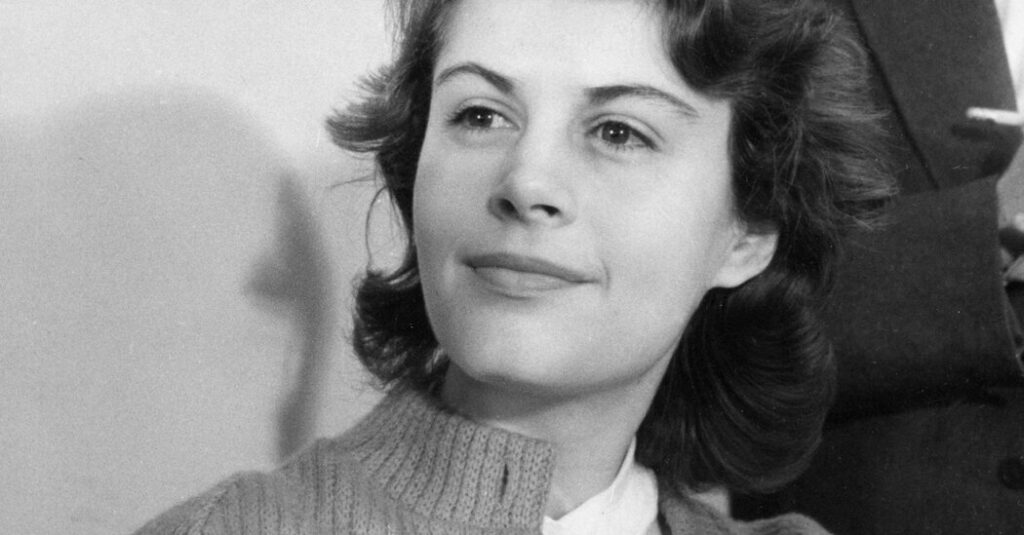
Colette Shulman, whose career as an influential analyst of Soviet affairs began in the late 1950s as a Moscow correspondent for the United Press wire service, writing about ground-shaking events and the lives of workaday people, died on June 20 in Danbury, Conn. She was 94.
Her death, in a hospice center, was from colon cancer, her brother, Robert Schwarzenbach, said.
Ms. Shulman “was always someone who had insight into a system that for so many in this country was opaque, was distant, was at worst, demonized,” Katrina vanden Heuvel, the editor and publisher of The Nation, said in an interview.
With a master’s degree in Russian history, Ms. Shulman arrived in the Soviet capital in 1955, two years after the death of Joseph Stalin, teaching at, and running, the Anglo-American School of Moscow until she was hired by United Press the next year.
Ms. Shulman worked to cut through the thicket of obfuscation and propaganda to illuminate the political and cultural trends of a geopolitical adversary that, under Nikita Khrushchev, continued to terrify and baffle many Americans.
“We were seriously challenged in our reporting,” she later recalled in an article for Harriman Magazine, published by the Harriman Institute — founded as the Russian Institute — at Columbia University. “No travel outside Moscow without permission, and then only to major Soviet republic capitals.”
Ms. Shulman said she found the main sources of information were bulletins from Tass, the state-owned news agency, along with “often-useless press conferences, reading between the lines of newspapers, talking with West European ambassadors briefed by their own intelligence sources.”
She had better luck talking to people on the street. “Some people put me off with ‘Come back tomorrow,’” she wrote. “Others talked, and out of these conversations came dozens of feature articles. About Soviet cars: Who could get hold of one and afford to buy it? What were people watching on Russian TV? How easy was it for a woman to get an abortion, which once again was legal?”
As Ms. vanden Heuvel said, “she always tried to support the view that there are people in these countries. It’s not just the high leadership, it’s not the just the summits.”
Ms. Shulman scored a journalistic coup in securing an interview with the dissident Russian writer Boris Pasternak, the Nobel Prize-winning author of the novel “Doctor Zhivago,” which was banned by the Soviets for its unflattering portrait of the Bolshevik Revolution and its aftermath, among other reasons.
In person, the author was charming, patient, cosmopolitan. “It was impossible,” she recalled, “to recognize the Pasternak I had listened to in the vitriolic attacks by Pravda and the Literary Gazette calling him a traitor, a slanderer, an immoral second-rate writer.”
Colette Joan Schwarzenbach was born on April 6, 1932, in Manhattan, the elder of two children of Ernest Schwarzenbach, who became a general partner at Smith, Barney & Co., and later the president of Sony Corporation of America, and Marcelle (Guignard) Schwarzenbach, a French teacher.
After receiving a bachelor’s degree in history from Wellesley College in 1953, she earned a master’s degree from Columbia in 1955.
“When I became a journalist the following year, I was working with almost all men,” she recalled in a 2017 oral history for the Harriman Institute. “I think that’s one thing Wellesley did for its women. It made them feel that they could do things in life, they could go on and explore.”
She returned to United States in 1959 to cover the United Nations for what by that time was United Press International. The next year, she married Marshall D. Shulman, later the longtime director of what became the Harriman Institute who during the Carter years served as the principal adviser on Soviet matters to Secretary of State Cyrus R. Vance.
She left the news agency to move to Cambridge, Mass., where Dr. Shulman held a post at Harvard University.
In 1963, she resumed her career as a host of “Soviet Press This Week,” a 15-minute prime-time survey of the latest Soviet newspapers and cultural magazines. The show was broadcast by the Boston public television station WGBH.
She returned to New York City in 1967, when her husband was named leader of the Russian Institute.
Ms. Shulman, too, had a long relationship with the institute. In the 1980s, she helped found Women’s Dialogue U.S.-U.S.S.R., a series of “kitchen table dialogues,” as she called them, involving female academics, philanthropists and activists from both countries.
In addition to her brother, she is survived by two stepchildren, Lisa Rubinstein and Michael Shulman.
Following the collapse of the Soviet Union in 1991, Ms. Shulman and Ms. vanden Heuvel published Vyi i Myi (which translates to You and We), a Russian-language feminist magazine created in the United States that was designed to continue a dialogue with Russian women on topics such as domestic violence, trafficking and child-rearing.
The publication, which lasted about 14 years, started in 1989 as a newsletter. “It was stapled together,” Ms. vanden Heuvel said, “but it had an impact.”
The post Colette Shulman, Soviet Analyst With On-the-Ground Insights, Dies at 94 appeared first on New York Times.