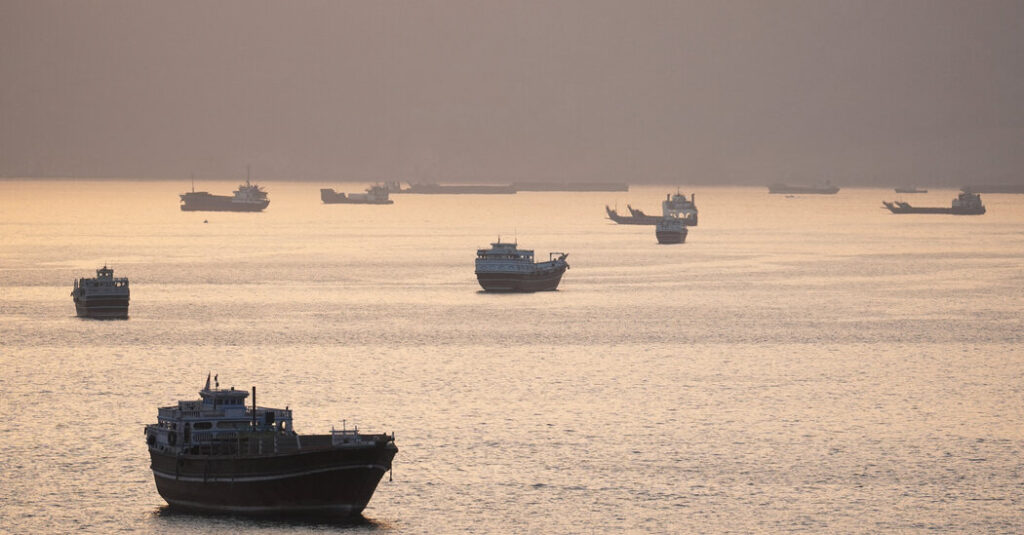
A renewal of strikes by the forces of Iran and the United States threatened the nascent recovery of shipping in the Persian Gulf, where traffic through the Strait of Hormuz recently rose to the highest levels since the start of the war.
The attacks over the past three days showed that both countries are willing to use military force to gain the upper hand in the strait, prompting many ship operators to remain wary of the waterway, a crucial choke point for oil and gas shipments from the gulf.
“Shipping is literally caught in the crossfire as the U.S. and Iran battle for control of Hormuz strait,” said Michelle Wiese Bockmann, an analyst at Windward, a maritime intelligence firm. “This does little to restore confidence that security and safety can be guaranteed to get stranded ships out.”
On Saturday, Bahrain, a U.S. ally in the region, said it had been attacked by Iranian drones, apparent retaliation for strikes that American forces made on Iran on Friday. The U.S. attack was itself in response to Iran for firing on a cargo vessel, the Ever Lovely, navigating the strait on Thursday.
The attacks occurred about a week after the United States and Iran signed a preliminary peace agreement that included a provision to reopen the strait.
But the waterway has not returned to normal. After the Iranian attack on the Ever Lovely, the International Maritime Organization, a United Nations agency, halted an effort to evacuate hundreds of ships stranded in the Persian Gulf.
On Saturday, the U.K. Maritime Trade Operations agency raised its assessment of the threat level in the Strait of Hormuz to “substantial,” citing attacks on ships. The organization, which is led by the British navy and acts as a monitoring and emergency service for commercial shipping, said that it had received reports that a tanker in the strait had been struck by an “unidentified projectile” on Saturday, noting that there were no injuries or environmental damage.
Iran has in recent weeks tried to establish formal control over shipping in the strait, something it did not have before. Iran has been demanding that vessel operators gain its permission before going through — and it has threatened ships that have not done so.
Iran attacked the container ship when it was traveling through the strait close to Oman.
For nearly two months, Central Command has been helping commercial ships go through the strait on routes near Oman’s coastline, and it said this week that it had assisted the passage of over 500 vessels since early May.
“The unwarranted aggression against commercial shipping by Iranian forces clearly violated the cease-fire,” U.S. Central Command said in a statement on Friday. It added that it continued to provide safe passage coordination and support to commercial vessels transiting the strait.
Before Iran’s strike, ship traffic through the waterway had been increasing. On Wednesday, 73 ships went through and 54 on Thursday, according to data from Kpler, a maritime analysis firm. Information for Friday were not immediately available.
Those traffic numbers were higher than the minuscule daily totals that occurred during the war but still well below the roughly 130 ships that transited daily before the conflict.
The latest tallies include Iranian ships and those vessels that have obtained permission from Iran to go through the strait; the vessels transiting with U.S. assistance; and the ships that the were part of the evacuation organized by International Maritime Organization, a United Nations agency.
Arsenio Dominguez, Secretary General of the I.M.O., said on Friday that 115 vessels, with about 2,500 crew members, had been evacuated since Tuesday. Of the total, 51 exited on Thursday and 16 on Friday.
The I.M.O. has said that the ship attacked on Thursday had not been part of his organization’s evacuation, and Mr. Dominguez said he needed “additional information” to determine whether the ship was part of the Centcom effort. A Centcom spokesman declined to say whether the Ever Lovely had been part of its initiative.
The United Nations evacuation effort appealed to ship operators who did not want to deal with Iran and who did not want to take the risk of going through with U.S. assistance and potentially become the target of an Iranian strike, shipping experts said.
After the Iranian and U.S. strikes, such ship operators will now most likely avoid the strait until conditions appear safer, which could delay a return to prewar traffic.
“Risks will remain high for shipping,” said Noam Raydan, a senior fellow at the Washington Institute for Near East Policy. “Iran is unwilling to halt its attacks on ships and threats — and this will continue requiring a response from the U.S.”
Ms. Wiese Bockmann of Windward said that soon after the U.S. attacks, ships began turning off the systems that broadcast their locations.
The post Renewed Strikes Threaten Setback to Shipping Recovery in Persian Gulf appeared first on New York Times.