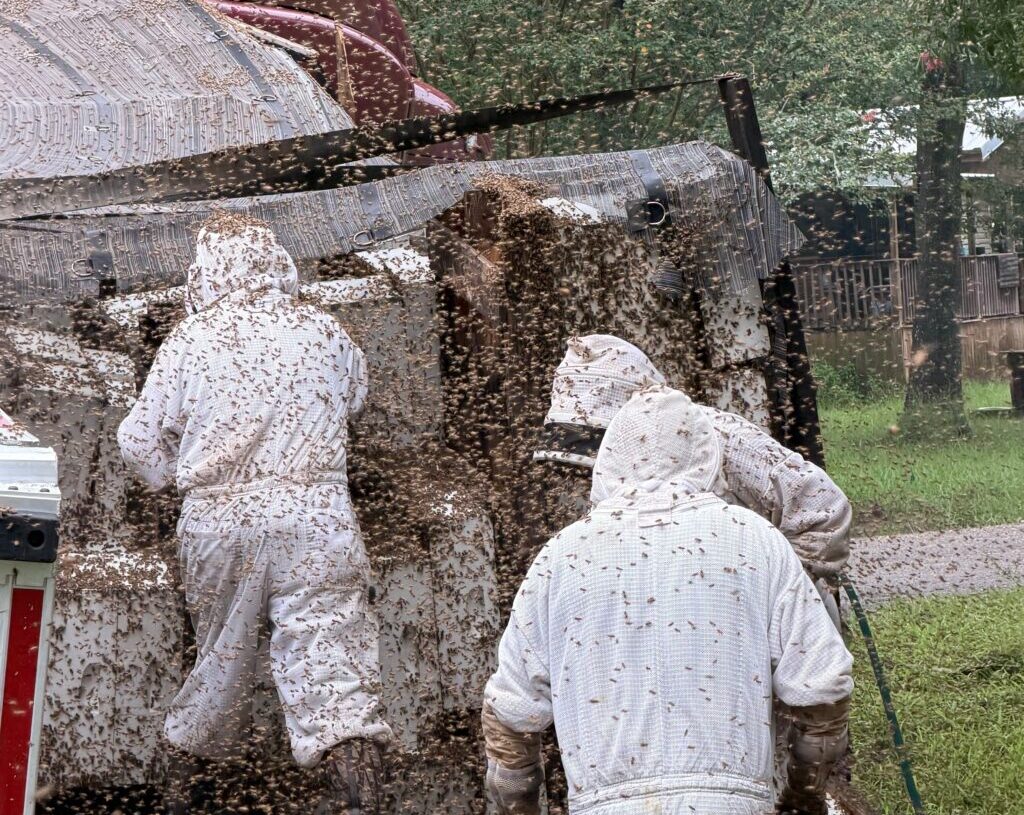
Beekeeper Christie Ray arrived at the scene and was stunned. She knew a swarm of honeybees had escaped after a truck overturned on a Texas road, but nothing prepared her for what she saw.
About 20 million bees were flying in groups so large they resembled dark clouds. So many sat on a tree branch that it broke. The air smelled like honey, beeswax and bananas, the odor bees release when they sting.
Orange County officials told people in the area to stay indoors, but Ray and a few colleagues rushed over with beekeeping suits, bee smokers and other equipment, hoping to save as many as they could.
“We are a family,” Ray told The Washington Post about beekeepers in her area. “… If somebody needs help, we’re all pitching in.”
The massive bee escape happened Sunday after the truck transporting the bees from a nearby farm to one in North Dakota overturned while making a sharp turn. The truck was just a few miles into its roughly 1,500-mile journey.
About a dozen local beekeepers raced over and removed more than 400 hives from the overturned truck and stacked them onto the backs of their own trucks. This lured many of the bees back to their colonies, and the beekeepers then began taking the hives back to the honeybee farm they came from.
The driver was taking the bee cargo to pollinate crops during peak bloom season in North Dakota, said Capt. Dylan Gray of the Orange County Emergency Services District.
When he received the dispatch call about millions of loose bees, Gray said he had one thought: “This can’t be true.” As he approached the crash site, he heard buzzing from about 150 feet away.
“It was unlike anything I’ve ever encountered,” said Gray, 30, who added that he was stung about 30 times.
Gray searched the internet for local beekeepers to help corral the bees.
The call reached Ray, 53, while she was getting ready for church. Jake Moore, a beekeeper in Kountze, Texas, changed his Sunday plans and drove about 50 miles east with colleagues, lugging bee smokers and forklifts.
“That’s what we do for each other,” said Moore, 29. “Those guys would do the same for me.”
When collecting rogue bees, beekeepers often search for queens because the rest of their nests will follow them. But because there were so many escaped bees, apiarists said they struggled to identify queens. Thousands of bees ended up in a ditch full of rainwater and didn’t survive.
Beekeepers removed the hives from the overturned truck and hoped that bees, in their confusion, would return to the hives where their queens had released pheromones.
The full hives weighed about 100 pounds, so Moore used a forklift to place them on his flatbed truck. When the flatbed filled up, Moore strapped the hives in place and returned them to their original honeybee farm, which county officials have not identified.
After more than four hours of repeating that process, about 75 percent of the hives were recovered. However, bees need their queens to survive, and because many bees were separated from their queens, Moore expects only about 25 percent of the bees to live. Still, he said it’s more than would have survived had he and the other beekeepers not rushed over to help.
On Sunday night, they said they removed dozens of stingers from their skin. They wore their protective gear, but it’s still a hazard of the occupation.
In the following days, beekeepers returned to the scene and set out boxes for bees to fly into. Some attracted the bees with honeycomb.
Beekeepers plan to take the ones they catch back to their farms in hopes of starting colonies.
“They’ll do everything they can,” Ray said, “to save as much as they can.”
The post A truck crash released 20 million bees. Local beekeepers rushed to save them. appeared first on Washington Post.