This sweltering week, the signs of a breakdown have been everywhere.
Train networks across Western Europe were snarled by heat that threatened to buckle tracks. Several nuclear reactors in France shuttered or slowed because the cooling water they were discharging into rivers was getting too hot. Museums curtailed hours because they couldn’t control the heat.
At a French auto plant, union leaders called for a strike, saying conditions on the factory floor had become excruciating. And electricity outages knocked out power for hundreds of thousands in France and Italy.
The heat seeped through thick-walled apartments and turned cities into hotboxes that couldn’t cool at night. Sleep-deprived Europeans staggered into parks after midnight, or joined in frenzies to buy portable air-conditioning units, or even sought refuge in hotels.
“Everyone is asking, why are we not ready?” said Francois Gemenne, a professor and specialist in environmental politics at HEC Paris, a business school. “We are becoming aware of our own vulnerability.”
The heat wave, holding its grip for nearly a week, has toppled temperature records in Britain, Spain and France. It’s also hastened a realization that Europe isn’t prepared for what is coming as heat waves intensify because of rising greenhouse gas emissions. The world’s fastest-warming continent is filled with buildings and infrastructure designed for a climate that no longer exists.
That is making extreme stretches of high temperatures far more disruptive in Europe than in parts of the world more accustomed to such conditions. A recent report from Allianz, the German financial and insurance company, singled out Italy, France, Germany and Spain as among the “most exposed economies” to economic losses from heat.
The insufficient infrastructure has deadly consequences.
On Thursday, France put its health system on the highest alert level, as its health minister, Stéphanie Rist, described a fourfold rise in cardiac arrest cases. In Spain, statistics showed a bump in mortality.
While these are just early signals of a potentially larger toll, they match research showing the risks for Europe. A 2023 study compared 800 cities, looking at the rate at which mortality can curve upward as temperatures rise. While heat barely increases the risk of death in cities like Houston or Tokyo, it leads to drastic upward spikes in the cities of France, Spain and Italy.
Reduced access to air-conditioning contributes to these differences. But that is far from the only factor. In Northern Europe, buildings that may have been built decades or even centuries ago tend to use insulating materials and end up trapping warm air. They rarely have external shutters, one of the easiest ways to block solar radiation and prevent indoor temperatures from rising.
“They are not well prepared to cope with this level of heat,” said Anna Mavrogianni, an expert on the built environment at University College London.
Policymakers for years have talked about retrofitting buildings and improving other infrastructure for an era of rising temperatures. France last year released a 388-page adaptation plan with 52 measures. And London this week rolled out a city heat plan that calls for widespread home renovations and upgrades to public buildings, citing more than 1,300 schools, 60 hospitals and 351 care homes at high risk.
But all these goals come at huge cost, and it has so far proven easier to put them on paper than find money to implement them. The European Environment Agency said last year that all European Union countries have adaptation plans, but cited “insufficient long-term funding” as a common obstacle.
“It’s the tragedy of the horizons,” Dr. Gemenne said. “You need to put money on the table right now to avoid costs in the future.”
At a news conference Thursday, French President Emmanuel Macron defended his country’s response to global warming but added that France was experiencing a “completely unprecedented moment.”
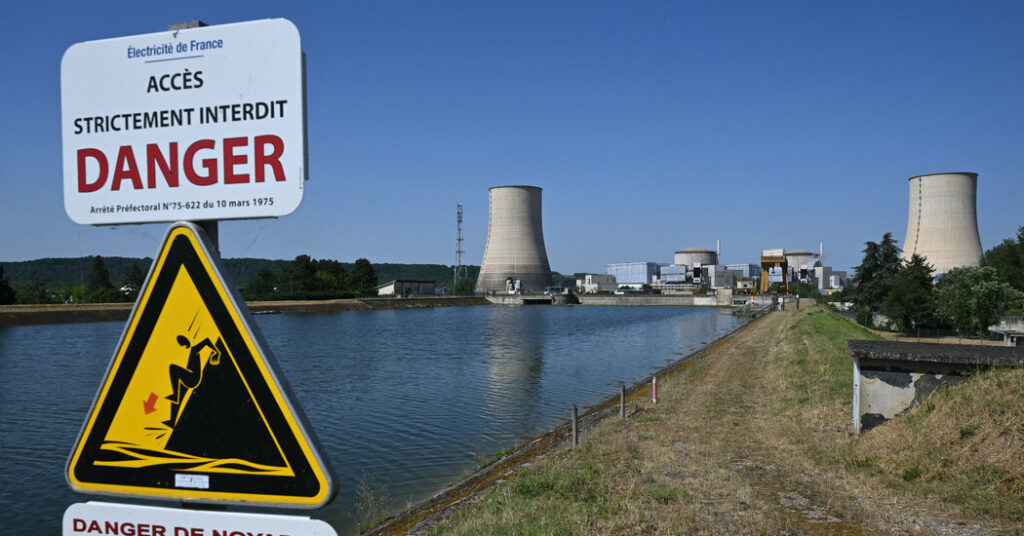
The heat reached such a level that it forced stoppages or slowdowns this week of reactors at four French nuclear power stations, said EDF, which operates France’s nuclear plants. In normal times, plants keep their reactors safely cool with river water, and then discharge that water at a higher temperature. But regulations designed to protect the river ecosystem prohibit that discharge if temperatures get too hot.
An EDF spokeswoman, Laura Mandin, said in a statement that the company is investing to make its plants “even more resilient” during heat waves. At one facility in Civaux it is already using a system that cools down water before it is discharged.
Europe has been warming at the rate of 1 degree Fahrenheit per decade — meaning infrastructure is facing stresses that would have been unthinkable when built. Train tracks are at particular risk, because heat can make them expand and buckle. This led to cancellations in Germany, Switzerland and Britain. Other routes, including in France, were canceled because trains lacked air-conditioning or because onboard systems couldn’t withstand the temperatures.
“Unfortunately it takes extreme events to trigger change,” Ms. Mavrogianni said. “Hopefully this won’t be forgotten when temperatures drop.”
The post Europe’s Trains, Nuclear Plants and Factories Can’t Take the Heat Either appeared first on New York Times.