The U.S. military said it launched strikes on Iran on Friday in retaliation for an Iranian attack in the Strait of Hormuz a day earlier, hours after President Trump called the Iranian action a “foolish violation” of the fragile cease-fire between the two countries.
U.S. Central Command said in a statement that it had struck Iranian missile and drone storage locations and coastal radar sites as a “powerful response” to the Iranian attack on Thursday.
The extent of damage from the new U.S. strikes was not immediately clear. A U.S. defense official, who spoke on the condition of anonymity because the person was not authorized to speak publicly, described the strikes as a retaliatory measure and not a restart of major combat operations.
The strikes on Friday concluded after about 90 minutes, a U.S. official said, and included strikes by American fighter jets against four Iranian sites along the Strait of Hormuz and on Qeshm Island, a U.S. official said.
Iran’s security forces claimed that in response to the American attacks on Friday, Tehran had struck U.S. Army positions in the region. There was no immediate confirmation from the U.S. military of such strikes.
Iran’s Islamic Revolutionary Guards Corps said in a statement carried by state media that the U.S. strikes had violated the cease-fire, and warned that if such aggression “is repeated, our response will be more extensive.”
Earlier, Vice President JD Vance said in a social media post about the new round of U.S. strikes that the United States had “honored” the cease-fire agreement, but warned that the United States would respond to Iranian aggression.
“If they have disagreements about how the MOU is being applied, they can pick up the phone,” he said, referring to the memorandum of understanding the United States signed with Iran. “But violence will be met with violence.”
Mr. Trump said earlier in a post on social media that Iran had launched at least four one-way-attack drones on Thursday, one of which hit the upper deck of a “of a large and very expensive Cargo Carrying Ship,” adding that the United States had knocked down three other drones. He added that the ship, though damaged, was able to continue on its way.
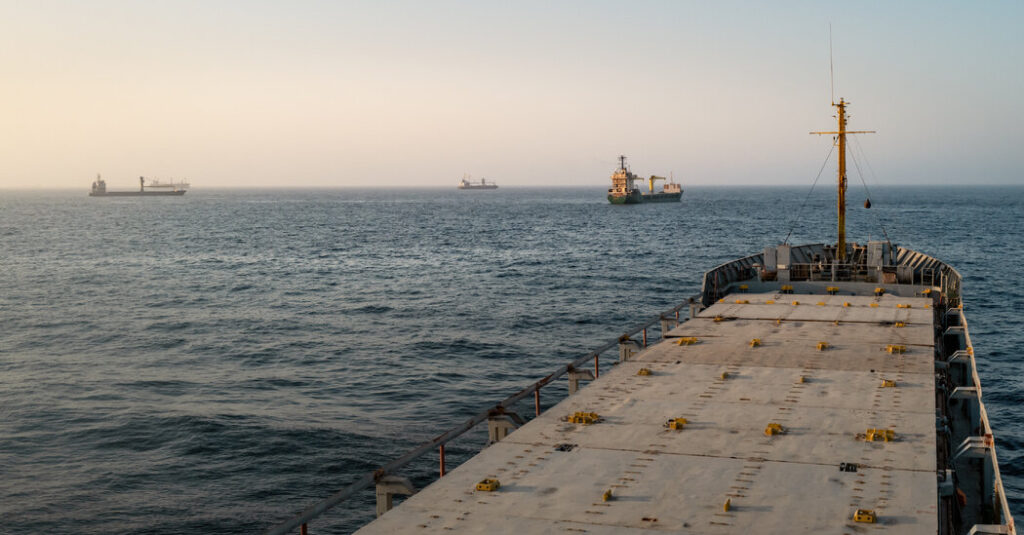
Iran’s strike on the vessel, the Ever Lovely, a container ship that was passing near the Omani side of the strait, appeared to be the first known Iranian attack on a commercial vessel since the signing of a preliminary peace agreement between Tehran and Washington last week. It laid bare the challenges to restoring prewar levels of traffic through the strait, a crucial conduit for oil and gas shipping.
The attack prompted the International Maritime Organization, a United Nations agency, to suspend an effort to help hundreds of stranded vessels leave the Persian Gulf. At least two tankers turned around after Iran’s warning earlier that day, according to Lloyd’s List Intelligence, while the number of ships passing through the strait fell to 54 on Thursday from 73 a day earlier, according to Kpler, a maritime data firm.
Although the United States and Iran have agreed to restore access to the strait — with Mr. Trump declaring the waterway open to unrestricted navigation — the preliminary accord does not stipulate exactly how that should happen.
Iran reaffirmed its claim to being a central authority in managing marine traffic through the strait. The Iranian Foreign Ministry said, in a statement carried on state media, that the strait lay within Iranian and Omani waters, and cited a section of the U.S.-Iran deal that Tehran says allows it to manage marine traffic in the strait.
The agreement says that Iran would “make arrangements using its best efforts” for the safe passage of commercial vessels. That wording is vague, leaving room for differing interpretations, according to Jakob Larsen, chief security officer at BIMCO, a global shipping association.
Mr. Larsen said that some shipping companies, and their insurers, might conclude after the Thursday attack that the situation was too risky to proceed with plans to pass through the strait. “There are real fears that hostilities will break out again,” he added.
The strike on the container ship came hours after Iran, demonstrating its hold over the strait, warned that the only way through was via its waters. Many ships, like the Ever Lovely, had been using a U.S.-backed route on the southern side of the strait, hugging the Omani coast.
Iran’s deputy foreign minister, Kazem Gharibabadi, wrote on social media on Friday that safe passage through the strait was “not guaranteed under vague arrangements, parallel routing systems or decision-making processes that exclude Iran as a coastal state.”
After the U.S. counterattack on Friday, Ebrahim Azizi, a conservative Iranian lawmaker and the head of Parliament’s national security committee, said in a social media post that the U.S. attacks had been a “reckless violation of the cease-fire” and warned that the attacks would lead to “retreat and regret” for the Americans.
Mr. Azizi, a hard-liner, may not speak for Iran’s government, but he echoed a sensitivity among officials there about American attacks amid peace negotiation efforts, saying the attacks reflected how Mr. Trump “has no commitment to the principles of negotiations”
Over the past week, Mr. Trump had made sporadic posts about the Strait of Hormuz, including a declaration that there would not be tolls for passage through the waterway unless they were imposed by the United States.
Iran has discussed with Oman the idea of charging passing ships service fees, a proposal that has drawn the ire of Mr. Trump.
The Iranian attack on Thursday came shortly after Secretary of State Marco Rubio had left the Persian Gulf, where he had met with foreign ministers from the Gulf Cooperation Council as he sought reassure regional allies about the preliminary deal with Iran.
In a joint declaration after the meeting, the United States and the Gulf countries in that organization called for “free, unconditional and unrestricted navigation” through the strait and rejected tolls, fees or attempts by any country to assert control over the waterway.
Iran’s Foreign Ministry denounced that declaration as “interventionist, irresponsible and provocative,” in a statement carried by state media on Friday.
Reporting was contributed by Erica L. Green, Leily Nikounazar, Farnaz Fassihi and Rozhin Razavi.
The post U.S. Strikes Iran in Retaliation for Attack on Vessel in Strait of Hormuz appeared first on New York Times.