Search and rescue teams from Virginia, California and Florida began arriving in Venezuela on Friday, joining efforts to pull survivors and recover bodies from the rubble of back-to-back earthquakes that leveled buildings and left more than 900 dead.
The units from Los Angeles County and Fairfax County, Va., are the only two from the United States that are trained to work internationally. They were joined by two search and rescue teams from Florida because of their proximity to Venezuela, according to Anthony Marrone, the Los Angeles County fire chief.
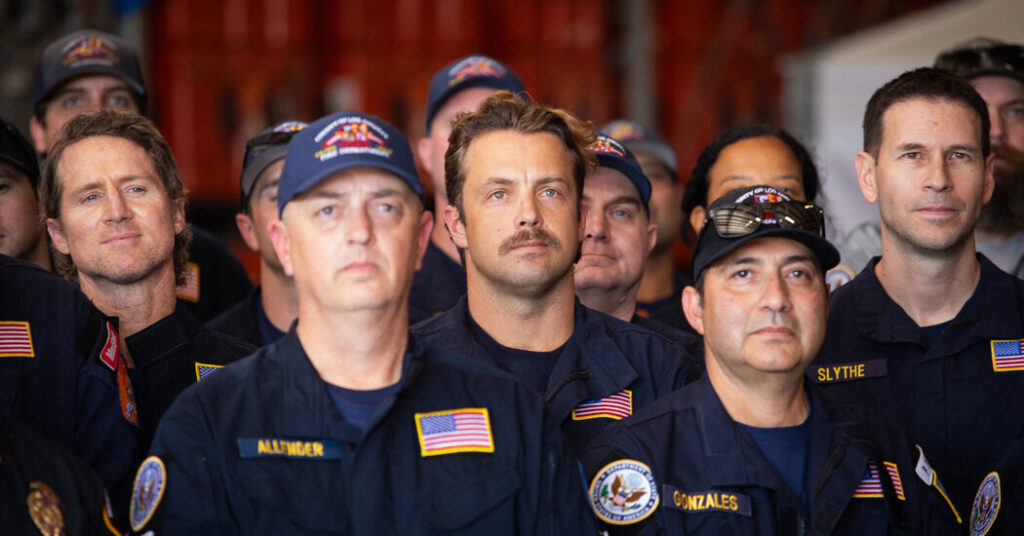
The Los Angeles County team, which took off in a C-17 aircraft from March Air Force Base in Riverside, Calif., on Friday morning, consisted of 73 people that included firefighters, medical personnel, handlers of six canine teams, and structural engineering specialists. They will be hauling 84,000 pounds of equipment, such as concrete-busting machines, using listening devices to detect people buried under the wreckage and deploying generators for where the power is out.
“When the team hits the ground, they’ll go to assigned areas and start searching to prioritize rescues,” Chief Marrone said. “Then they’ll fold into a 24-hour mission, day shift and night shift. We won’t stop searching at night.”
The team from Fairfax County is roughly the same size, with 80 people and six dogs.
The teams were sent by the State Department under new protocols meant to make it easier for the United States to help in international disaster areas. The emergency workers from Fairfax and Los Angeles Counties — known respectively as USA 1 and USA 2 — have responded worldwide to hurricanes, earthquakes and other crises. The Los Angeles County team alone has been to Turkey, Mexico City, Nepal, Haiti (twice) and most recently Jamaica to assist in rescue and recovery efforts, Chief Marrone said.
He added that the State Department, which has assumed control of the search and rescue units, had moved quickly. The agencies that previously administered relief efforts — FEMA and USAID — often took days to get people on the ground.
“It’s much more streamlined,” he said. “And that’s good. Because time is the enemy.”
Another adversary can be the weather. But in Venezuela, the typical tropical forecast — 70 to 80 degrees, afternoon rains and strong winds — “didn’t look bad,” he said.
The canine units that are with the teams are trained to search for dead or live bodies, said Jonathan Torres, a spokesman for the L.A. County Fire Department. While several of the California dogs are labradors — one black, one yellow and one brown — they are various breeds.
“We can only do so much as humans,” Mr. Torres said. “They have a nose like no other.”
The post Search Teams From California, Virginia and Florida Head to Venezuela appeared first on New York Times.