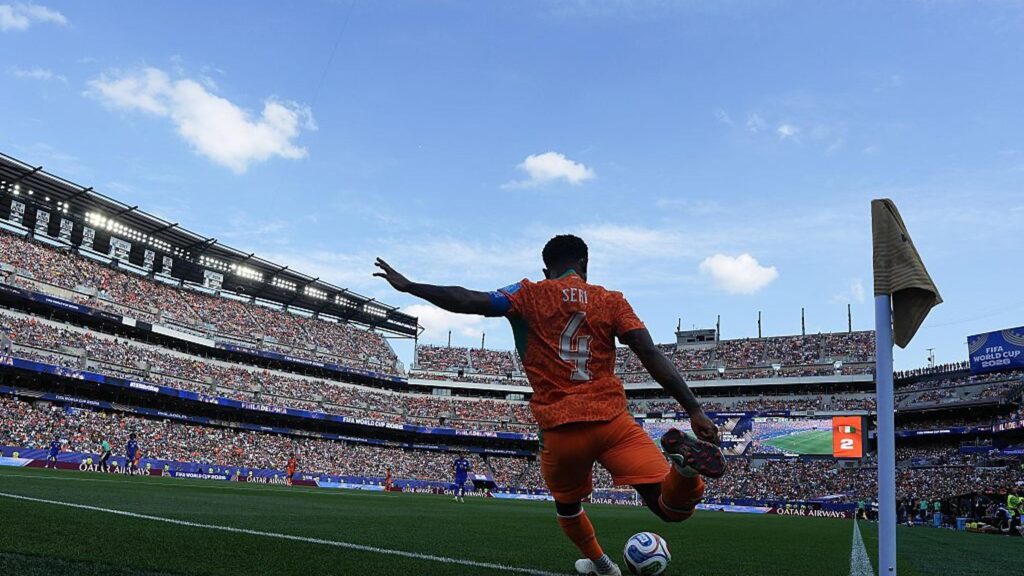
After years of anticipation, the World Cup has finally arrived on U.S. soil. For the players, it’s an opportunity to be etched into soccer immortality as they battle for the game’s most prestigious prize.
I myself am not playing in this World Cup. But as a professional soccer player of Cameroonian and Malagasy descent who plays in America, this tournament has brought me immense pride. It brings me pride to share the game that has given me community, security, and fulfillment with an American audience that is discovering and embracing the sport. And it brings me pride to see so many African players making their mark on the world stage.
The opening matches have already upended expectations. Cape Verde, a nation of half a million playing in its first World Cup, held the reigning European champions, Spain, to a scoreless draw in Atlanta. Then, they took a point off Uruguay (another former World Cup Champion). Egypt led Belgium before holding on for a 1-1 draw, then beat New Zealand 3-1. Morocco, a semifinalist four years ago, drew with Brazil while outplaying them for long stretches, then dominated Scotland. And Folarin Balogun, born in New York to Nigerian parents, scored twice in the United States’ opening win, a reminder that African talent shapes this game far beyond the continent’s own teams. None of this is a fluke. It is the latest evidence of something the rest of the world has been slow to price in.
But beyond the game lies a bigger, more important fight, one that involves the future of Africa.
African players are the pride of their nations, often carrying the weight of proving what the continent is capable of. This summer, the stakes are even higher, as they attempt to leverage the World Cup’s platform to inspire audiences and help reshape harmful narratives that have depressed investment and limited development for one of the world’s fastest-growing populations.
Playing for Africa
To be sure, players come from across Africa to represent it on the biggest stage, but their fights don’t end at the final whistle.
Long before Sadio Mané lifted Senegal to its first African Cup of Nations, his father passed from illness and the lack of hospitals nearby. It’s the type of childhood grief that can derail a life, let alone a career. Decades later, Mane’s newfound financial freedom allowed him to build a hospital and invest in the village that shaped him. The same humility and execution has led him to championships and transcends sport as he provides his village with the infrastructure needed to flourish.
Too often, stereotypes about Africa lead us to treat players like Mane as outliers rather than as embodiments of the continent’s spirit. This bias can leave players and institutions working in fragmented environments that limit the scale of their impact.
Africa currently boasts a median age of 19, compared to 39 in the U.S. By some estimates, 1 in every 4 humans will be African by 2050. A population this young and vast calls for innovative policy thinking, disciplined execution, and mobilization of capital at scale—rather than piecemeal projects from individuals and institutions—to keep pace with demand for jobs, infrastructure, and security. This cannot happen if lazy tropes around risk and governance continue to overshadow the ingenuity already present on the continent.
The World Cup alone will not change these narratives, but it’s a starting point for a broader conversation that recognizes the limitless potential of Africans when properly invested in.
Bet on Africa
As it stands, African countries consistently face significantly higher sovereign bond yields compared to other emerging markets thanks to a phenomenon often referred to as the “African risk premium.” One major culprit behind this problem: negative stereotypes that paint an entire continent as unstable and obsolete.
As a result, borrowing costs among African countries have surged 91% over the last five years. Now, many African communities are being priced out of financing, which restricts their ability to accelerate their development.
Still, African entrepreneurs persevere. New businesses are dedicated to addressing the continent’s most urgent needs. And each new unicorn company contributes to a global picture of an investable Africa. For their part, African nations recognize the need to streamline regulatory environments, with the African Continental Free Trade Area (AfCFTA) serving as a sign of the region’s commitment to attracting capital at scale, capturing more value, and building resilient economies.
What’s missing in Africa is not the innate ability or willingness, but rather the uniform embrace of these qualities. African athletes at this summer’s World Cup will be celebrated, but will the recognition finally extend to the communities they come from?
Soccer has the power to shift narratives. Didier Drogba and his Ivorian teammates’ plea after a historic World Cup qualification helped end a civil war. South Africa’s 2010 World Cup, a mere 16 years after the end of apartheid, shone a light on the continent’s hopes and strengths. And Egypt’s Mohamed Salah’s tenure as a Liverpool player coincided with significant decreases in anti-Muslim hate crimes across the city.
But Africans’ impact extends far beyond soccer. Excellence in sport is merely a glimpse into the resolve, grit, and talent pervading communities across the continent. These qualities are abundant and, under the right conditions, can drive innovation while building generational companies and institutions. To think that a region that will soon be home to 2.5 billion people cannot materially change the world simply defies reason.
The world faces a critical choice. It can back the emergence of a generation set to power the world, or it can allow outdated narratives to maintain a status quo of fear and indecision. Either way, Africa will not wait.
In the meantime, African teams will continue to chase their World Cup dreams. And in doing so, they will make it impossible to ignore Africa’s inexorable rise.
The post Why All Eyes Are On Africa at the World Cup appeared first on TIME.