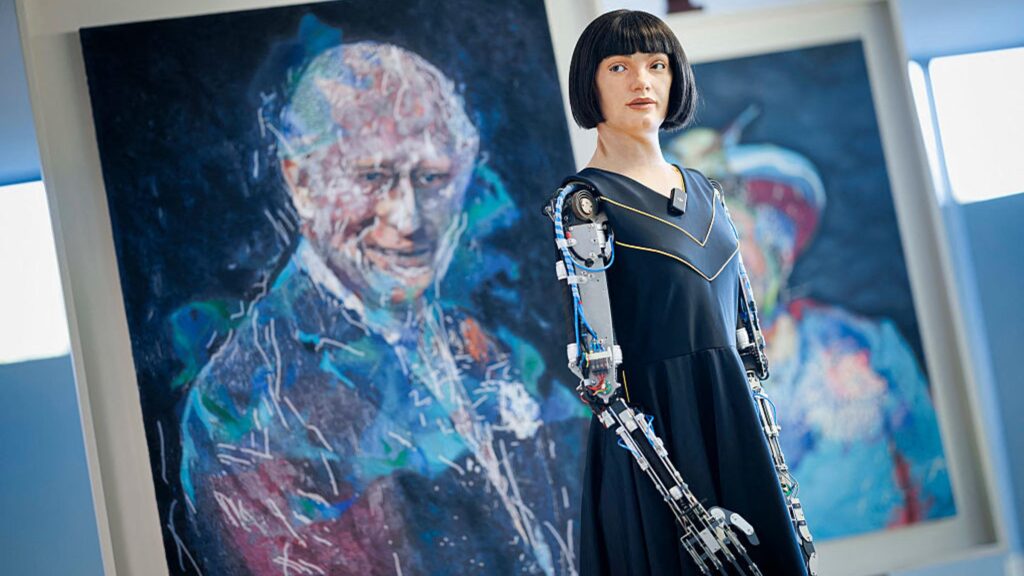
Many live in quiet fear that AI will someday be, if not the death of art itself, then at least of the human artist’s livelihood. Between Hollywood screenwriters taking to the streets to protect their jobs from large language models and robot artists like Ai-Da fetching millions at auction, the future of art can seem rather grim.
Fortunately, the annals of art history paint a different, brighter picture. Viewed from a distance, the pressure AI exerts on human artists appears as part of an evolutionary process that far predates its own invention. Throughout history, technological innovation, by extending and facilitating our capacity to create, has shifted attention from form to content: from what the finished product looks like towards how and why it is made.
Following this trend, we can expect AI to push artists to be less perfect and more human, and for their art to get better by becoming “worse.”
To be sure, AI is not the first technology to face the accusation that it will ruin art forever. When photography emerged in the nineteenth century, painters feared the worst. In 1840, after seeing a photograph for the first time, the French painter Paul Delaroche famously declared, “From today, painting is dead!”
In truth, the camera didn’t kill painting so much as force it to evolve, ushering in an era of unprecedented creativity and experimentation. Movements like Impressionism, Fauvism, and Cubism all arose in part from painters asking the same question: What can I do that this new machine cannot? The answer, broadly, was to represent the world subjectively, as they themselves experienced it.
Today’s artists, in any medium, must also wrestle with this question. Only this time, the answer will be harder to find. AI is a more versatile tool than the camera, not to mention increasingly capable of acting on its own accord. It also evolves at a quicker pace and along a more unpredictable trajectory, so much so that even its creators can’t agree on what the future will and should look like. We do have a general idea of how human artists will cope, though, not least because their options are increasingly limited.
One of the few (and obvious) things AI can’t do that humans can do is simply exist in the world: to live a life that will be inevitably unique from any other, and—as a result—become inevitably unique themselves. We can therefore expect human-made art in the age of AI to turn increasingly personal and idiosyncratic, informed by and inseparable from the artist’s own character and most intimate life experiences.
Where previous generations of artists organized themselves into schools, collectives, and cooperatives, their future counterparts will work alone or, if together, then polyphonously, their different voices kept distinctly identifiable, like family members at a Thanksgiving dinner discussion.
Artists will also want to constantly reinvent themselves. The more you stick to a specific style, and the more that style resembles other styles, the easier it will be for AI to do what you do.
Currently, AI has little trouble creating images in the familiar aesthetic of a Pixar or Studio Ghibli film—here is someone who used AI tools to imagine what The Lord of the Rings would look with Hayao Miyazaki as its director)—but AI can’t reliably grasp the essence of animators who didn’t stick to a consistent look, like Richard Williams or Satoshi Kon.
Originality won’t be art’s only aim. Inimitability, through any means necessary, will become just as important.
One medium where we already see these shifts happening is the YouTube video essay. Previously, most content creators did voice-overs, their commentary set to tightly edited footage in a style that traces back to a handful of successful pioneers. Now, more and more creators are delivering their monologues on camera with little to no editing—partly to prove their humanity amidst the rise of AI-generated content, but also so they can better lean into what distinguishes them from the competition: themselves.
Right now, AI hallucinates left and right. However, if the technology continues to improve, we should expect to arrive at a point where hallucination will be a thing of the past. While today’s AI tools struggle to produce anything other than slop, we should eventually arrive at a point where AI can—without human input or feedback—create art that will genuinely have something to say, that makes us think and feel as much as our favorite human artists do.
If the relationship between technology and art is often one of repulsion, with one pushing the other in opposite direction, it follows that the better the AI artist becomes at doing its job—be it writing a page-turning thriller or stirring up heated philosophical debates in the vein of Marcel Duchamp’s urinal or Maurizio Cattelan’s banana—the worse human artists will get at doing theirs.
By “worse,” I do indeed mean of an inferior quality, but not for lack of skill or trying. As AI art becomes increasingly competent in both conception and execution, human artists will seek to distinguish themselves by creating art that is deliberately incompetent: flawed, incoherent, and even ineffective or confused in what it’s trying to achieve.
In contrast to AI’s glossy finish, human art will also become more inchoate: unpolished, half-baked, and rough around the edges. Think rough sketches rather than finished paintings, or first drafts of novels sent to the printers without edits or proofreading.
Mistakes will no longer be regarded as accidents, but key components of an AI-era aesthetic, one where failure is a marker of talent and success the sign of a lack thereof.
Artists will no longer want to become or be seen as masters of their craft. Instead, they will strive to remain amateurs and preserve the untrained, uninformed spirit of their earliest work. To some extent, human art will become the mirror image of present-day AI slop: wrong in ways that are almost instinctively obvious, but difficult to articulate. Only this type of art won’t be the stuff of social media ragebait or weird gambling commercials, but galleries and festivals.
The more AI can do, the more our notion of what makes us human will change, and human-made art will reflect that.
The post How AI Will Make Art Worse appeared first on TIME.