President Trump and Republicans got a win on Tuesday night — and it set off alarm bells for the party.
Just like every other congressional contest held this year, the Tennessee special election for the House tilted sharply in the Democratic Party’s direction compared with the 2024 election. The Trump-backed Republican candidate, Matt Van Epps, won by nine percentage points in a ruby-red seat that Mr. Trump had romped through a year earlier by 22 points.
That 13-point swing to the left — if it continues into 2026 — threatens to be an undertow strong enough to subsume a range of Republicans in less lopsidedly red seats and deliver Democrats a comfortable House majority next year.
Republican candidates, as they have been for much of the last decade, are caught between Mr. Trump’s singular popularity with the Republican base and his distinct, and dipping, unpopularity with swing voters.
He alone gets out the vote that Republicans need. And he alone gets out the vote that Democrats need, too.
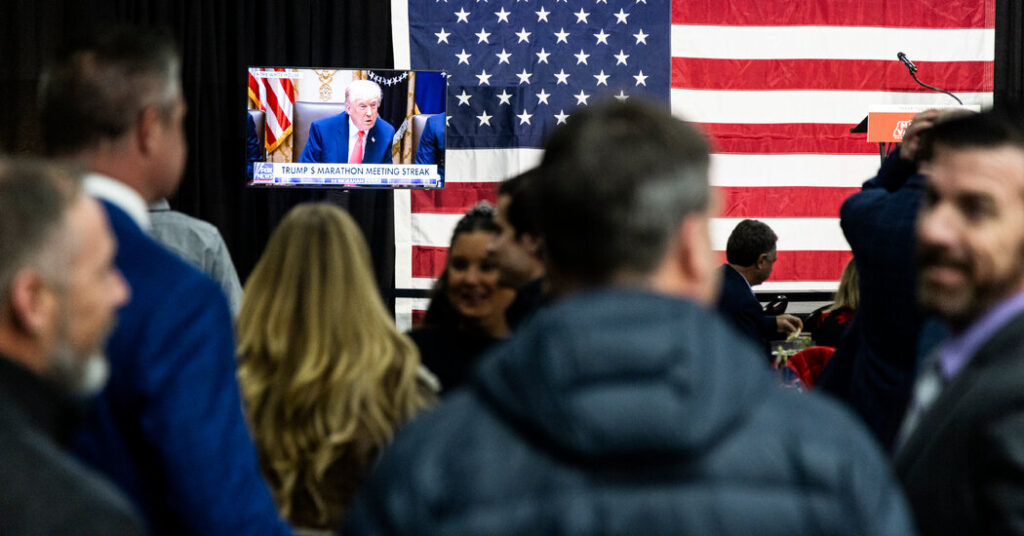
“The left will show up,” Senator Ted Cruz, Republican of Texas, warned of Democratic voters in next year’s elections as he spoke on Fox News on Tuesday night. “Hate is a powerful motivator. They hate President Trump.”
Republicans are still trying to figure out what their big motivator will be. For now, strategists say the default is likely to be a blitz of negative advertising trying to disqualify all types of Democratic nominees. Tennessee offered a preview with a kitchen-sink-style advertising assault on Aftyn Behn, the Democratic candidate, over her positions on taxes, transgender issues and immigration.
“The MAGA death star landed on our heads,” said Ian Russell, a Democratic strategist who made ads for Ms. Behn and has worked on numerous House races.
But he added that the final margin should still frighten Mr. Trump’s party.
“It has to be a very scary thing for the Republicans,” Mr. Russell said, “for the millions that they spent, with the opposition research they did, deploying the president, deploying the speaker of the House — all to win by single digits in a district Trump won in a walk last year.”
A memo from Mr. Trump’s super PAC, reviewed by The New York Times, described the breadth of its $1.7 million effort, which included everything from $70,000 in radio ads aimed at rural voters to sending 700,000 text messages to get out the vote.
One focus of the super PAC was to reach the kinds of less frequent voters whom the Trump operation so successfully turned out in 2024. The memo said that an internal study had shown that those who cast ballots early for Mr. Van Epps were 32 percent more likely to be lower- or middle-propensity voters than those who voted for Ms. Behn.
“We’ve dumped just an absolute ton of money, lot of resources, both from a financial perspective and a manpower perspective,” Joe Gruters, the chairman of the Republican National Committee, said in a radio interview in Tennessee this week.
Yet every county in Tennessee’s Seventh Congressional District still swung to the left, from Wayne County on the border of Alabama to Davidson County, home of Nashville.
The reason Democrats are optimistic even in defeat is that the party does not need to win seats like the Tennessee one to take power back in the House. Notably, as millions of dollars poured into the race, including $1 million from the leading House Democratic super PAC, the party’s official House campaign arm spent nothing, remaining focused on more winnable contests to come next year.
It is not clear whether Democrats will seriously contest the district again next year, with some party strategists seeing Representative Andy Ogles, a Republican in the neighboring Fifth District, as more vulnerable. Chaz Molder, the mayor of Columbia, Tenn., is running as a Democrat to challenge him and had raised nearly $800,000 through September.
The Behn campaign had bet that she could freshly mobilize a progressive base in Nashville. And she did. Davidson County swung toward the Democrats by 20 points compared with 2024 — far more than any other county in the district. But Ms. Behn, a state legislator with an outspoken progressive record, appeared to bump up against the upper limits of what a liberal “radical” — she once called herself that in a video clip that featured heavily in Republican ads — could accomplish in such a red area.
Ms. Behn focused heavily on affordability and the impact of Mr. Trump’s tariffs, which is the new Democratic playbook.
“She didn’t campaign as a left wing liberal, but as a moderate focused on affordability and transparency,” James Blair, Mr. Trump’s deputy chief of staff, who oversees his political operation, wrote on X.
But she did not exactly pivot toward the center either. She campaigned with one of her party’s leading flamethrowers, Representative Jasmine Crockett of Texas, and joined one of its most prominent progressives, Representative Alexandria Ocasio-Cortez of New York, for a virtual rally on election eve. Nor did she renounce or disentangle herself from old social media posts about defunding the police.
“It is healthy for the party to have a clear experiment of, ‘Can you get over the hump in a red district running a Brooklyn-style campaign?’” said Liam Kerr, a co-founder of Welcome PAC, a group that promotes centrist Democrats.
“She was the dream candidate — for both the online left and for Republicans, as so often happens,” Mr. Kerr said of Ms. Behn. “She is exactly who the online left wants to be the face of the Democratic Party and who Republicans wanted to be the face of the Democratic Party.”
The 13-point swing toward Democrats was actually the smallest of the five congressional special elections that were held this year outside a major election day.
Multiple Republican operatives said the party would have stronger chances in 2026 if Democrats — who are facing a large number of primaries — nominate more candidates that can be more easily caricatured.
“We need Democrats to continue to be crazy, to say crazy things and be for crazy things,” said Corry Bliss, a veteran Republican strategist who guided the party’s leading House super PAC during the 2018 midterm elections. “It helps to provide a contrast.”
In some ways, it is the inverse of 2010 and the height of the Tea Party, when Democrats depended on Republicans to nominate zany candidates in competitive races. Now it is Democrats facing the possibility of a Tea Party-style revolt from a restive base that could choose candidates the party establishment might otherwise shun.
Republicans, meanwhile, are still searching for a message on affordability.
The economy section of Mr. Van Epps’s issues page started by blaming former President Joseph R. Biden Jr., who left office nearly 11 months ago, for the current state of affairs.
“Tennessee families are struggling under Bidenflation,” it began.
Yet the next line mirrored the Democratic talking points: “Prices are higher, paychecks are stretched thin, and Washington’s reckless policies are crushing working families.”
There are growing signs that voters now hold Mr. Trump accountable for the state of the economy, the biggest of which were the results in November’s elections.
The president’s approval rating in Gallup’s November poll hit a second-term low of 36 percent — with an abysmal 25 percent approval among independents. Yet the president still had 84 percent support among Republicans.
Mr. Trump helped make Mr. Van Epps the nominee by endorsing him in the primary race, and then held multiple telephone rallies in the abbreviated general election, though the president did not travel to the state in person.
“As we have seen time and again in the last 10 years, it is something only he can do,” Mr. Bliss said of Mr. Trump “turning out his base.”
Erick Erickson, a conservative radio host based in Georgia, said in an interview that the “best gift” that Mr. Trump and Republicans could receive in the coming months was if the Supreme Court reined in Mr. Trump’s tariff program, which Mr. Erickson said was unpopular and raising prices.
“I think you can take from this race that there is a path to mitigate the damage,” Mr. Erickson said. “But it is a very narrow path and it’s one with the wild card of Donald Trump making it ever more narrow.”
Shane Goldmacher is a Times national political correspondent.
The post What Tennessee Revealed About the G.O.P.’s Trump Trap in the Midterms appeared first on New York Times.