In the 50 years since America last celebrated its birth in a big way, historians have unearthed troves of myth-puncturing facts about the men who founded this country and their era.
Thomas Jefferson and George Washington are known to us more fully as slaveholders, not just as statesmen. The “fathers” have received unvarnished psychological portraits with titles like “First Among Men: George Washington and the Myth of American Masculinity.” The dispossession of American Indians is no longer a footnote but a central theme in Revolution scholarship. Even the losers from this time have received rich historic renderings: the long-erased American loyalists who became refugees after the war, as well as British leaders, who never really matched their buffoonish portrayals.
With greater knowledge has come a great fracturing. Americans who grew up hearing the canonical story starring a handful of leading actors now must contend with a larger cast, with blemished heroes, with a growing list of claimants to their rightful place in the country’s origin story.
The idea of celebrating such a troubled and complex era is enough to make some Americans wince. Meanwhile, conservatives argue that a necessary form of nationalism has been sacrificed at the altar of ideologically driven scholarship. Gov. Ron DeSantis of Florida has used the occasion of the 250th to place statues of American figures like Washington, Jefferson and Madison across his state, attempting to reverse the tide in which men of history are more likely to be removed from pedestals than placed upon them.
With so many prisms through which to see the past, is there a story about the founding that can still be unifying?
This tension over how to narrate the country’s origin has existed since its earliest days. As soon as the central figures of the Revolution died, many Americans began regarding them as demigods whose singular gifts had created a new nation. That picture did not remain simple for long. By the middle of the 19th century, people had produced alternate histories on the Revolutionary-era contributions of African Americans and women.
Since then, generations of Americans have sparred over the truth and meaning of their country’s founding, all while revering its central figures and documents. The historian Pauline Maier once memorably called the Declaration of Independence “American scripture,” because Americans treated it with the sanctity of a biblical text. And much like scripture, it’s a story that generates endless meaning.
This was perhaps inevitable for a nation like ours, which began its journey without the markers that often define a people. There was no official faith; multiple Christian groups jostled for primacy. There was no unique language. There was no divinely chosen family or hereditary aristocracy. There was not even a settled geographic territory to mark where the country began and ended.
The founding is the well to which Americans inevitably return as they try to give their polity meaning. “To talk about mythologizing the revolution is not to tell exaggerated stories,” said Michael D. Hattem, author of “The Memory of ’76: The Revolution in American History.” “It is to tell the story of the revolution specifically for the purpose of explaining how the United States came to be and defining its core principles.”
And 250 years is long enough for even the myths to produce their own history. Americans of every political persuasion have debated and reshaped the ideals in their country’s creation story. They have lived and died for them. Can they ever make peace over them?
A fairy tale unravels
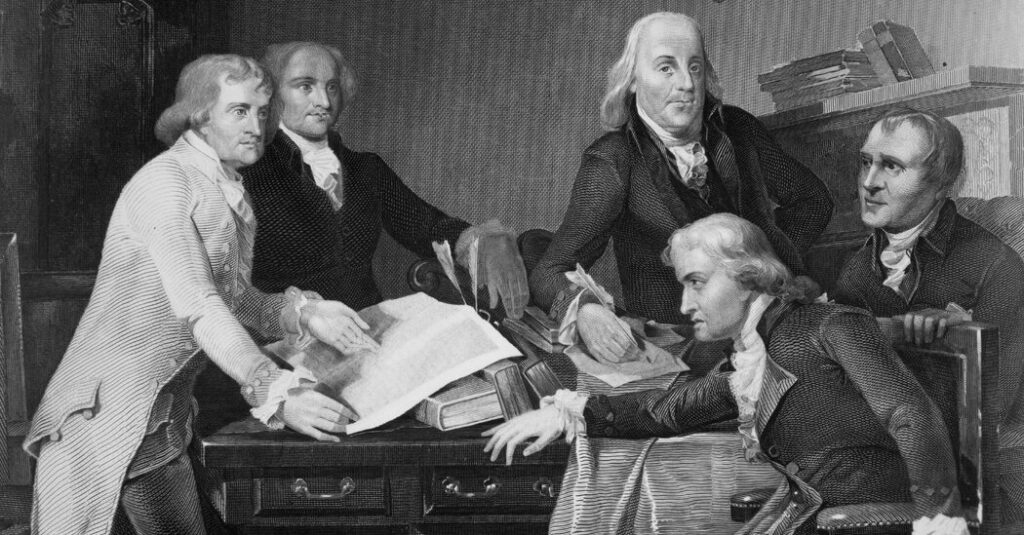
The work of history has not always been so concerned with the vetting of facts. In fact, until the 19th century, history was considered a form of literature: It was the telling of stories from the past, out of which a group of people could draw meaning — morality plays to form our characters and our national spirit. After the founding, the former colonists had no stories binding them together. They needed to find them, and quickly.
In 1800, soon after George Washington died, a traveling Bible salesman named Mason Locke Weems wrote an adoring biography of his political idol that became an instant sensation. Called “The Life of George Washington,” the book was aimed at children, so that “every youth may become a Washington,” wrote Weems. The work, expanded over a number of editions, was essentially a book of fairy tales. Weems invented the story of Washington as a child chopping down a cherry tree, before later admitting to his father that he could not “tell a lie.” For many Americans, the book turned a “religiously ambiguous Washington,” as Hattem writes, into “a more palatable national hero.”
Like other tales of the founders’ glory, the stories about Washington spread because they gathered the country under a single ideal of virtuous citizenship. After eight years of violence and turmoil during the Revolutionary War, mythmaking was a balm. “This was a way of having Americans more or less forget all the trauma of that immediate past to look ahead toward the future,” said Patrick Griffin, a professor of early American history at the University of Notre Dame.
A period of widespread Christian revival in the 19th century brought even more vigorous attempts to breathe myth into the country’s history. Beginning in 1834, and for the next 40 years, George Bancroft, the most popular historian of his time, released a 10-volume totem called “History of the United States.” It held that America was divinely chosen to realize God’s kingdom on earth. For Bancroft, the work of a historian was lofty because it could show the hand of God through human events.
This became a moral blueprint for some of the century’s most significant social movements, in particular the abolitionists. Frederick Douglass blasted his country in speeches across the country for falling short of its own statement of divine purpose that “all men are created equal.” Scholars would later establish that the Declaration’s writers were perhaps not quite so bold in their intent. But there was no point in leaving the document trapped in amber: The founding had to be turned into a powerful myth, so that it could be used toward a righteous end.
The justness of the cause, however, is never a given. Those who defended slavery embraced the founders at least as fiercely as their opponents. The Confederacy placed an image of Washington at the center of its seal. And Jefferson Davis intentionally chose Washington’s birthday as the date for his 1862 inauguration as president of the rebellion.
By the late 19th century, history looked more like the modern practice we recognize today: more science than literature. Any story about a country’s past now required a certain rigor around facts. There had to be evidence, carefully documented and able to withstand testing. There was also no telling where these inquiries would lead.
It did not take long for the myth-busting to begin. In 1913, Charles Beard, a professor at Columbia University, wrote a book that dared to question the motives of the country’s founders. In “An Economic Interpretation of the Constitution of the United States,” Beard argued that the founders, far from being altruistic souls, were in fact elites who waged revolution to protect their material interests.
But even in this moment, Americans did not turn cynical about the future of their national project. Instead the progressive movement, disturbed by a concentration of elite power, used this new account to bolster their view that the common people of America had been ignored for far too long. For the left, Beard’s history wasn’t cause for disillusionment. It only served as further proof that their cause was just.
Still, Beard’s history created an uproar among conservatives, who could sense that the country’s grip on the most patriotic version of its history was slipping. In 1916, President Warren G. Harding coined the phrase “founding fathers,” inaugurating an extended period of resistance on the right to history that smudged the country’s reputation. The two sides were now set in our modern dialectic over the national founding: one focused on removing shibboleths; the other on shoring them up.
This defensiveness reached a peak during the Cold War, when textbooks presented America as a paragon. In an ideological war against the dictatorial Soviet Union, conservatives began to draw a new story out of the founding that the documents were focused on personal liberty, more than equality. And they argued that any American history that revealed too many flaws would only provide intellectual ammunition to the enemy.
Even some historians argued that their profession had a moral duty that superseded the search for new facts. “Total war, whether it be hot or cold, enlists everyone and calls upon everyone to assume his part,” said the historian Conyers Read in 1949 at the annual dinner of the American Historical Association. “The historian is no freer from this obligation than the physicist.” Further comparing historians to scientists, he added, “We must realize that not everything which takes place in the laboratory is appropriate for broadcasting at the street corners.”
There would be no keeping a lid on the truth, though. In the 1960s and 1970s, an explosion in scholarship and activism on behalf of women and minorities upended the nation’s founding myths. Whatever had upset the country about Beard’s scholarship paled in comparison to what came later. The founders were not saints but slaveholders. A new approach, called social history, invited into the national story figures who had previously been excluded: women, American Indians, the poor. The list of original American sins was only growing.
As the country spent these years planning its bicentennial celebration, organizers faced the challenge of telling a story that by now had splintered. The country was also in a state of total unrest with protests over Vietnam and racial inequality, the Watergate scandal, a presidential resignation. An official government commission tasked with running the bicentennial was accused of partisanship.
Still, many Americans kept interpreting the founding in ways that lent their causes the greatest meaning and legitimacy. Evangelical Christians, upset over developments like Roe v. Wade, used the bicentennial to revive a vision of America as God’s uniquely chosen nation. In 1977, a popular history called “The Light and the Glory,” by two evangelical writers, warned that America was falling short of the founders’ supposed Christian vision. “God’s call on this country,” they wrote, “has never been revoked.”
Liberal activists began alternative bicentennial groups to highlight the shortcomings of the country and argue for reforms that might rectify them, such as greater federal funding for American Indian tribes. The activists viewed their efforts as ultimately patriotic. As one major group put it, they were trying to revive “a mass revolutionary consciousness in tune with the revolutionary legacy of 1776.” Another group demanded a greater place for Black Americans in the telling of the country’s history, in order to reveal their connection to the spirit of the revolution.
By the 1980s, though, and the rise of Ronald Reagan, the right had cemented a Cold War-era national story of personal liberty and limited government, rooted in the founding itself. The more liberals insisted on telling the truth about America, the more conservatives insisted on its exceptionalism. The two sides only hardened, as the right argued that critique implied a lack of patriotism.
In a way, President Barack Obama offered a truce when he rose to power, by reviving an idea from Douglass that the country was imperfect, yet redeemable. Obama’s account allowed for America’s fallibility without succumbing to cynicism. The Constitution, he said in a 2008 speech, was both “stained by this nation’s original sin of slavery” and the source for our notion of “a union that could be and should be perfected over time.”
Still, for decades now, patriotism has coded more conservative than liberal. Since the early 2000s, Republicans report greater pride in being American compared to Democrats. President Trump frequently makes a show of hugging and kissing the flag. Central to the identity of the G.O.P. is that its greater reverence for the founding also makes it the more rightful heir.
A common story
This year’s celebration of the founding appears to be even more troubled than the last, 50 years ago. The opening event this week was a campaign-style rally for Trump, blurring the lines between patriotism and idolatry of the president.
This anniversary, there is little appetite to educate the country about any of the more recent scholarship on the founding. Instead, the administration has taken steps to subtract politically disfavored messages. Last year, Trump signed an executive order called “Restoring Truth and Sanity to American History” in which the Smithsonian was banned from putting on programs that “degrade shared American values” or “divide Americans based on race.”
Unlike the bicentennial, though, the left has not organized a plethora of competing groups to argue against the right’s interpretation of history. This suggests an instinct to simply forfeit the entire era to the other side, since the moral conflicts are too fraught. Like much of our politics these days, neither side appears interested in the art, or even possibility, of persuasion.
Yet full persuasion may not even be the right goal, some historians argue. They say the country needs to recover its tradition of debating the core ideals present at the founding. Disagreement is inevitable, even desirable. “Let interests clash and argument prosper,” as the historian Maier put it in her 1997 book, “American Scripture,” even as she stripped back some of the country’s magical thinking about the founding. Maier did not view her work as settling any of the most important questions. The very contest over America’s founding is a sign that the project is working. It’s the absence of disagreement that we should fear the most.
The historian Hattem says there’s a reason that the memory of the Revolution has not united all Americans. “How could it possibly do that?,” he said. “Think of the political circumstances that you would need to create in which all Americans agreed on what the Revolution meant. That would be terrifying. That would be Stalinist circumstances. We are too large and too diverse a nation to ever agree on what the Revolution means. That is a good thing.”
In a way, the modern standard of studying the past — in which legends are waiting to be busted — has become so dominant that Americans have lost practice in the much older tradition of drawing a collective identity from their history.
In a 1960 book of essays called, “Truth and Opinion,” the British historian C.V. Wedgwood warned, “History dispassionately recorded nearly always sounds harsh and cynical.” She added, “telling it without comment is, inevitably, to underline its worst features: the defeat of the weak by the strong, the degeneration of ideals, the corruption of institutions, the triumph of intelligent self-interest.” An account of the past that withholds the possibility of meaning is not only uninterested in the future. It invites the listener to abandon all hope of it.
That’s why history alone cannot tell a society what to do next. Even the promise that it can help humanity avoid repeating its worst mistakes is dubious (look at our wars). What it can spark, though, is moral imagination. When previous generations of Americas faced their own crises, they looked to the origin of the nation for inspiration. They discovered new ideas of freedom, liberty and equality that suited their own times and needs. They reinvented their country.
What they found was not a single story but a single conversation, across time, about a common inheritance. The facts will always matter. But the search for a country’s purpose is a different undertaking, and it is not one upon which anyone can lay absolute claim. Wherever there are people debating the meaning of the founding, what is old has already passed away. A new nation is coming into view.
The post Is There a Founding Story That Can Unify Left and Right? appeared first on New York Times.