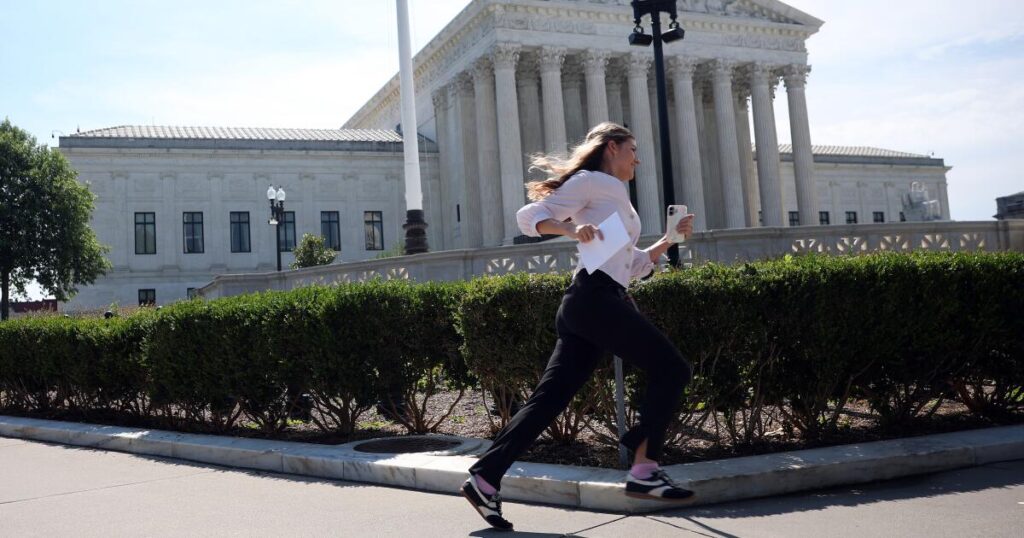
A disturbing theme noticed in the Supreme Court’s decisions this week has been the ways it is closing the courthouse doors to those who have been seriously harmed. Rights are meaningless without a remedy, and the court’s decisions are leaving injured people with no recourse at all.
On Tuesday, the court decided Landor vs. Louisiana Department of Corrections, which precluded individuals from suing under a federal statute that protects their religious freedom. Plaintiff Damon Landor is a Rastafarian whose religious convictions require him to leave his hair uncut. Landor was imprisoned in Louisiana in 2020 and near the end of his sentence was transferred to a different facility to finish his term. There the guards planned to cut his hair despite the federal court of appeals having expressly ruled that a federal statute — the Religious Land Use and Institutionalized Persons Act — barred prison staff from cutting Rastafarians’ hair.
Landor had a copy of the court’s opinion and gave it to the guards. They threw it in the trash, forcibly held him down and shaved his head.
Landor sued under the Religious Land Use and Institutionalized Persons Act, which says that state and local governments that receive federal funds for their prisons and jails cannot infringe on a person’s religious beliefs unless the action is necessary to achieve a compelling government purpose. No one disagreed that the Louisiana prison guards blatantly violated this law.
But the Supreme Court, in a 6-3 decision, held that there cannot be suits against individual government officials who violate the statute unless they consent to being sued. Of course, no one would agree to allow themselves to be sued.
Justice Neil Gorsuch wrote the opinion for the court and said that Congress adopted the act under its power to spend money, adding that when Congress spends funds it is a contract with those who receive it. A contract is enforceable only if the parties consent. Since the prison guards did not consent to being sued, no action can be brought against them.
This reasoning is deeply flawed. The act empowers courts to provide all “appropriate relief.” Congress could not have been clearer in wanting there to be a remedy for violations of prisoners’ religious freedom. The Supreme Court has long held that Congress may set conditions on those who receive federal funds. It is a grant with strings attached; it is not a contract. And even if it were a contract, that contract is with the state and local governments that accept the funding and they have consented that any appropriate relief can be imposed by a court for violation of the law. The idea that individual government employees must consent to be sued has no basis.
No one disputes that the prison guards in Louisiana were obligated to comply with the Religious Land Use and Institutionalized Persons Act. No one disputes that the prison guards egregiously violated it. But Damon Landor and all prisoners whose rights have been violated are left with no remedy. The implications extend far beyond this law. Countless federal laws have been adopted under Congress’ spending power, including ones dealing with the environment and health and safety. The court’s reasoning suggests that those injured by violations of these statutes are left with no ability to enforce them even when Congress has expressly authorized suits and remedies.
Another example of the justices closing the courthouse door came on Thursday in Monsanto Company vs. Durnell. There are many lawsuits claiming that the weed killer Roundup causes cancer. John Durnell brought a lawsuit in Missouri state court against Monsanto Company, the maker of Roundup, claiming he had used Roundup products for about 20 years and that the products had caused his non-Hodgkin’s lymphoma. A jury found in Durnell’s favor, awarding $1 million in damages, concluding that the label on Roundup failed to warn users of the cancer risk.
Roundup argued that it could not be sued because neither the federal law regulating such products — the Insecticide, Fungicide, and Rodenticide Act — nor the Environmental Protection Agency had required warning labels. The act precludes state governments from imposing requirements “in addition to or different” from those in federal law.
But the Missouri courts, like those throughout the country, had found that creating liability for a failure to warn did not violate this act. They held that holding a company liable for failure to warn furthered the federal goal of ensuring safe products, like pesticides and weedkillers. Justice Ketanji Brown Jackson in her dissent made exactly this point: “Durnell’s failure-to-warn claim is not ‘in addition to or different from’ FIFRA’s mandates; it is equivalent to FIFRA’s key labeling requirement — the misbranding prohibition.”
This decision leaves Durnell and those injured by Roundup with no remedy whatsoever. Monsanto, and its parent company Bayer, had entered into a proposed settlement of $7.25 billion to compensate those injured by Roundup. This settlement is likely to vanish after Thursday’s Supreme Court ruling. It also will make it more difficult for those injured by other products in the future to sue when there is federal regulation.
Also on Thursday, in another case closing the courthouse doors, the Supreme Court ruled that the government may prevent asylum seekers from entering the U.S. to seek that protection. In another 6-3 decision, in Mullin vs. Al Otro Lado, the court upheld the federal government’s policy of systematically turning back asylum seekers before they can reach the U.S.-Mexico border. Justice Sonia Sotomayor dissented in an opinion joined by Justices Elena Kagan and Jackson. Sotomayor wrote that “the consequences of today’s decision are predictable. More people will die. More people will attempt to cross the border illegally, and some will make it while others will not.”
The decisions this week are not isolated examples. In recent years, the Supreme Court has expanded immunity doctrines that make it much harder to sue governments and government officials who violate the Constitution. The Supreme Court has made clear that federal courts cannot hear some constitutional claims, such as challenges to partisan gerrymandering. The Supreme Court has also ruled that those injured by generic drugs cannot sue the manufacturing companies for design defects in the products or the failure to warn consumers.
These decisions are especially insidious because they don’t get much public attention. But they leave many who have suffered serious injuries with no remedy. They favor government officials and businesses over citizens, consumers and employees. They truly slam the courthouse doors shut on those who should have a legal right to relief.
Erwin Chemerinsky is the dean of the UC Berkeley Law School.
The post Justices’ decisions slam closed the courthouse doors appeared first on Los Angeles Times.