The Supreme Court on Thursday confronted two questions that have also confounded many Americans for the past decade: How seriously should people take President Trump’s wild, coarse and ugly statements? And are some of them marred by racial animus?
Like the country itself, the court was deeply divided on both.
In ruling that President Trump could deport some 350,000 Haitians, the Supreme Court’s conservative majority first had to determine whether race had played a role in his decision to remove the humanitarian protections that had shielded them. If discrimination was “a motivating factor” in Mr. Trump’s determination, the leading precedent said, it would violate the Constitution’s equal protection clause.
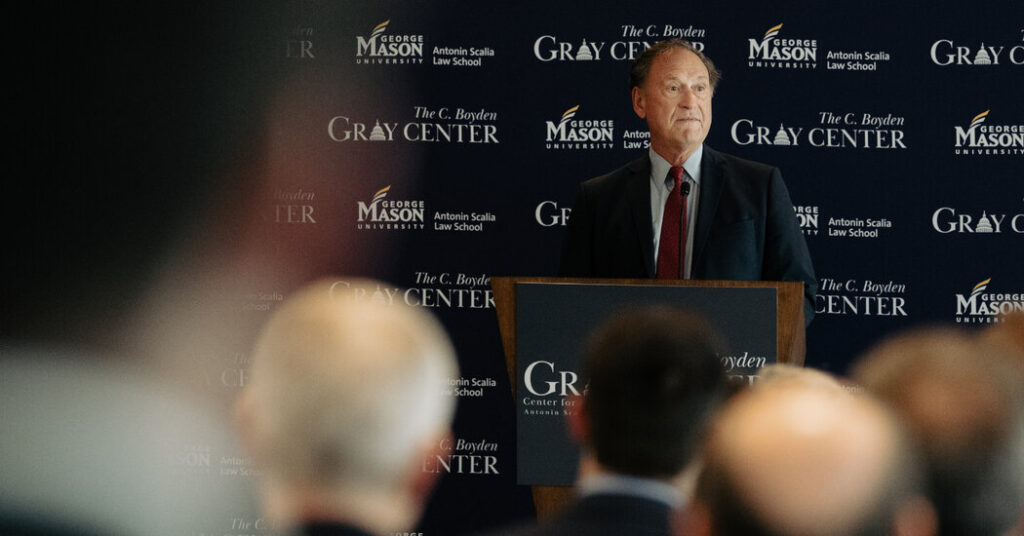
Writing for the majority, Justice Samuel A. Alito Jr. concluded that Mr. Trump’s many statements about Haitians were not “overtly racial,” and that it was unlikely that race had been a motivating factor in the administration’s decision to end the protections. He was joined by the court’s five other Republican appointees.
What Justice Alito did not do was set out a single example of those statements.
In dissent, Justice Elena Kagan was incredulous.
“The statements fairly shout,” she wrote, “in their racial undertones and overtones alike, that race entered into the president’s resolve to remove Haitians from this country.”
The clash was a vivid example of what critics say has been the court’s tendency to give Mr. Trump the benefit of the doubt, interpreting even his most extreme remarks charitably.
The case concerned the Temporary Protected Status program, which was created by Congress in 1990 to allow people whose home countries are deemed unsafe because of war, natural disasters or other crises to live and work in the United States. Mr. Trump has long questioned the program.
Thursday’s decision concerned people from Haiti and Syria, though only the Haitian plaintiffs challenged the termination of their status on equal protection grounds. Other aspects of the decision will most likely allow the administration to withdraw protections from even more immigrants.
The most telling aspect of Justice Alito’s majority opinion, Justice Kagan said, was that he could not bring himself to quote a single example of Mr. Trump’s statements about Haiti and Haitians. Mr. Trump’s remarks were “so repellent and racially inflected that the majority declines to put them in print,” she wrote.
She filled the gap by setting down a litany of statements by Mr. Trump about Haiti and its people.
Her list included these comments from Mr. Trump: Haitians in Ohio were “eating the pets” of their neighbors. Haitians “probably have AIDS.” Haiti is a “shithole country,” which is “filthy, dirty, disgusting.” Haitian immigration is “like a death wish for our country.” Haitians are “poisoning the blood” of the nation.
Justice Kagan said those comments were more than sufficient evidence of racial animus. “The references — of filth, disease and primitiveness — are shot through with racial stereotypes and tropes,” she wrote.
Mr. Trump, she added, seemed to have no problem with some immigration. “Why can’t we have some people from Norway, Sweden?” he once asked.
“Haitians are Black,” wrote Justice Kagan, who was joined by Justices Sonia Sotomayor and Ketanji Brown Jackson. “(Norwegians and Swedes not so much.)”
The court’s conservative majority has a history of interpreting Mr. Trump’s remarks generously. In 2018, in upholding his ban on travel from several predominantly Muslim countries, Chief Justice John G. Roberts Jr. recounted Mr. Trump’s call for a “total and complete shutdown of Muslims entering the United States.”
But the chief justice said Mr. Trump’s comments had to be balanced against the powers of the president to conduct the national security affairs of the nation.
“The issue before us is not whether to denounce the statements,” Chief Justice Roberts wrote. “It is instead the significance of those statements in reviewing a presidential directive, neutral on its face, addressing a matter within the core of executive responsibility.”
In Thursday’s opinion, too, Justice Alito said there were neutral reasons for lifting the Temporary Protected Status protections for Haitians.
“One may oppose T.P.S. and favor tighter restrictions on immigration for economic or other reasons that have nothing to do with race,” he wrote. “And a person without racial bias can provide a harshly unfavorable description of living conditions in some of the countries with T.P.S. designations.”
He allowed that “political discourse by prominent public figures is increasingly couched in terms that would have scandalized the public just a short time ago.” But he concluded that the administration opposed immigration generally and had not used racial criteria in its decisions.
Justice Alito wrote that the temporary protections had been lifted in more than a dozen countries, including Nepal, Burma, Afghanistan, Yemen, Syria, Somalia, Ethiopia, South Sudan, Cameroon, Nicaragua, Honduras and Venezuela.
“Most would regard this as a racially diverse group of countries,” he wrote. The plaintiffs contended that they were all “nonwhite.”
When the case was argued in April, Justice Alito suggested that “nonwhite” was not a meaningful category.
“Do you think that if you put Syrians, Turks, Greeks and other people who live around the Mediterranean in a lineup, do you think you could say those people, that all of them, are they all nonwhite?” he asked.
After an extended back-and-forth with a lawyer for the Haitian plaintiffs, Justice Alito said, “I don’t like dividing the people of the world into these groups.”
In his opinion on Thursday, the justice wrote that “only the termination of a T.P.S. designation for a Nordic or Germanic country” would satisfy critics who said that Mr. Trump’s determinations were tainted by race discrimination.
For his part, Justice Alito depicted Haiti’s plight in sympathetic terms at odds with Mr. Trump’s rhetoric. “It is a very poor country, and living conditions there are unquestionably difficult,” he wrote, adding: “But poverty and deprivation are no reflection on character, and there is no justification for denigrating the character of Haitians who suffer from and bear no responsibility for their country’s ills.”
He went on to describe the many positive contributions Haitians had made to the United States “from the very beginning, and they continue to do so today.”
Justice Amy Coney Barrett, who adopted two children born in Haiti, signed Justice Alito’s majority opinion along with Chief Justice Roberts and Justices Clarence Thomas, Neil M. Gorsuch and Brett M. Kavanaugh.
The post Justices Clash on Whether Race Played a Role in Trump’s Bid to Deport Haitians appeared first on New York Times.