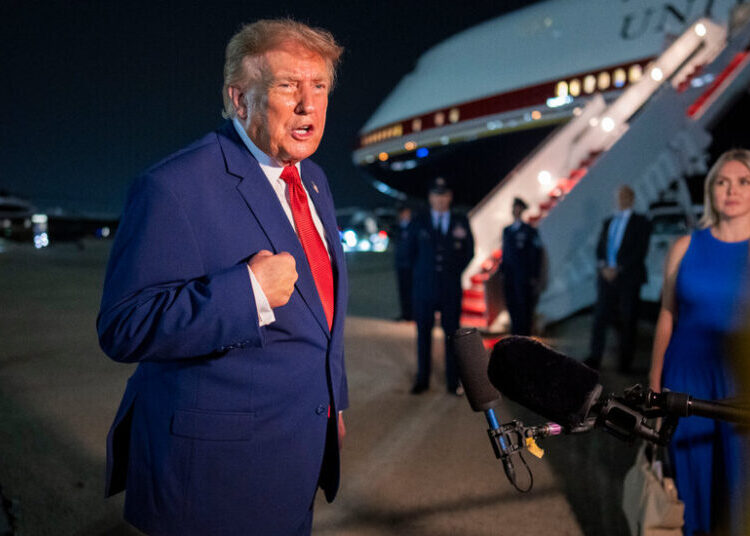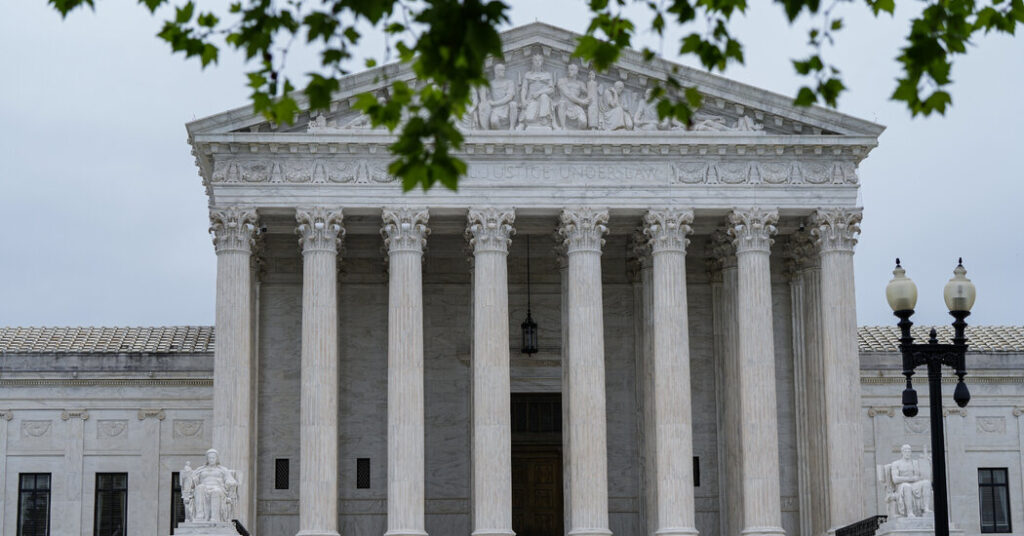
In a pair of sharply divided decisions on Thursday, the Supreme Court allowed President Trump’s aggressive crackdown on immigration to move forward, permitting the administration to both expel some migrants from the country and to turn away others at the southern border.
Taken together, the court’s conservative majority signaled deference to the president’s ability to set the nation’s immigration policy, as the justices prepare in the coming days to issue more rulings that will decide how much power to give Mr. Trump across his boundary-pushing agenda.
In one ruling on Thursday, the justices allowed the Trump administration to end humanitarian protections that have permitted hundreds of thousands of people from Haiti and Syria to live and work legally in the United States.
Mr. Trump has long pushed to terminate the program, known as Temporary Protected Status, as part of his efforts to restrict immigration. The program was created by Congress with bipartisan support in 1990 to provide temporary legal status to people whose home countries were deemed unsafe because of war, natural disasters or other crises.
The court’s 6-to-3 decision, divided along ideological lines, clears a path for the potential deportation of 350,000 Haitians and 6,100 Syrians, and it is likely to have implications for T.P.S. holders from about a dozen other countries.
The ability of the government to quickly expel individuals who previously had protections will depend on whether they already have deportation orders pending. In many instances, T.P.S. holders have not received such orders, which will allow them some ability to contest their removal from the country.
In a separate decision that also split 6 to 3, with the liberals dissenting, the court said the Trump administration could turn away migrants seeking asylum along the U.S.-Mexico border by physically preventing them from crossing into the United States as they sought protection from persecution.
The administration had asked the court to permit the government to revive the policy, first used in 2016. Under that so-called turn-back policy, the government had stopped asylum seekers from setting foot on U.S. soil, where federal law would have entitled them to try to claim asylum and receive protections.
The decisions were announced in the final days of the Supreme Court’s term that began in October. On Monday, the justices are expected to announce another batch of opinions, and the president has been bracing for a likely defeat when the court rules on the legality of his effort to end the guarantee of birthright citizenship for the U.S.-born babies of illegal immigrants.
Immigrant advocates denounced Thursday’s decisions as major departures from the nation’s long history of providing refuge to immigrants escaping persecution and unsafe conditions.
Ahilan Arulanantham, a lawyer representing the Syrian migrants, said the court’s decision had allowed the government to “ignore a bedrock humanitarian protection that Congress, in bipartisan fashion, established three decades ago to ensure that vulnerable refugees would not be subject to partisan whims.” Millions of people, he said, “are at risk of being sent back to countries in crisis.”
The administration called the rulings a vindication of its efforts.
“The T in TPS stands for TEMPORARY, yet many of these designations became de facto amnesty,” James Percival, the general counsel of the Department of Homeland Security, said on social media. “This is a win for the rule of law and common sense.”
In the majority decision allowing the president to strip deportation protections, Justice Samuel A. Alito Jr. said the federal law at issue prohibited courts from second-guessing an administration’s determination.
“This text is clear, and its plain meaning is very broad,” he wrote.
The court also rejected claims that the administration’s decision was motivated by racial hostility toward Haitians.
The three liberal justices dissented, with Justice Elena Kagan quoting extensively from Mr. Trump’s derogatory comments about Haitian immigrants.
“The statements fairly shout, in their racial undertones and overtones alike, that race entered into the president’s resolve to remove Haitians from this country,” she wrote.
Since Mr. Trump returned to office last year, his administration has attempted to end T.P.S. for people from 13 out of 17 countries with the designation when President Joseph R. Biden Jr. left office. The administration has separately halted the resettlement of refugees and has dramatically slowed the consideration of asylum claims. The changes collectively have made it far more difficult for people who come from troubled or war-torn nations to find refuge in the United States.
The homeland security secretary determines when T.P.S. should be available to migrants from any specific country, and the designation can last from six to 18 months. There is no limit to how many times a designation for a particular country can be extended.
The law allows the secretary to periodically review such protections, terminating or extending them for certain countries. But the law requires the secretary to consult with relevant federal agencies, including the State Department, about conditions in a country and then make a decision based on those assessments before initiating a change.
The program had been repeatedly extended, becoming all but permanent for recipients from Haiti, Syria and several other nations where crises have spanned many years. Last year, Kristi Noem, the homeland security secretary at the time, moved to withdraw the protections from various countries.
Both sides in the case before the court agreed that the law allows the administration to periodically remove countries from the T.P.S. program and that once terminated, beneficiaries lose legal protections and have to leave the United States.
But immigrant rights advocates said Homeland Security Department officials failed to properly assess country conditions as required by the law. In the case of Haitians, they said the administration was motivated by anti-Black and anti-Haitian prejudice in violation of constitutional prohibitions against discriminatory government actions.
Class-action lawsuits were filed by T.P.S. holders, including engineers, students, doctors and caregivers, who want to continue to work and live in the United States because, their lawyers say, they could be killed if they were forced to return to Syria or Haiti.
During oral arguments in April, the court’s liberal justices pressed the administration’s lawyer about whether the decision to end the program for Haitians was racially motivated. The justices cited the president’s false accusations during the 2024 campaign that Haitians in Springfield, Ohio, ate their neighbors’ pets and Mr. Trump’s comments in December about Haitian immigrants being undesirable because they come from a “filthy, dirty, disgusting” country.
D. John Sauer, the solicitor general, said those statements were “unilluminating” and were references to poverty and crime rather than race. Federal law, he said, makes clear that courts cannot second-guess the government’s decision to extend or to end the protections.
The text of the statute prohibits “judicial review of any determination” of the secretary “with respect to the designation, or termination or extension of a designation.”
Lower court judges, however, sided with the Haitians and Syrians, finding that the secretary’s process was subject to court review and that her decisions had been preordained and not based on meaningful analysis. The judges postponed the terminations, prompting the government’s lawyers to ask the Supreme Court to intervene.
Hamed Aleaziz contributed reporting.
The post Supreme Court Expands Trump’s Power Over Immigration appeared first on New York Times.