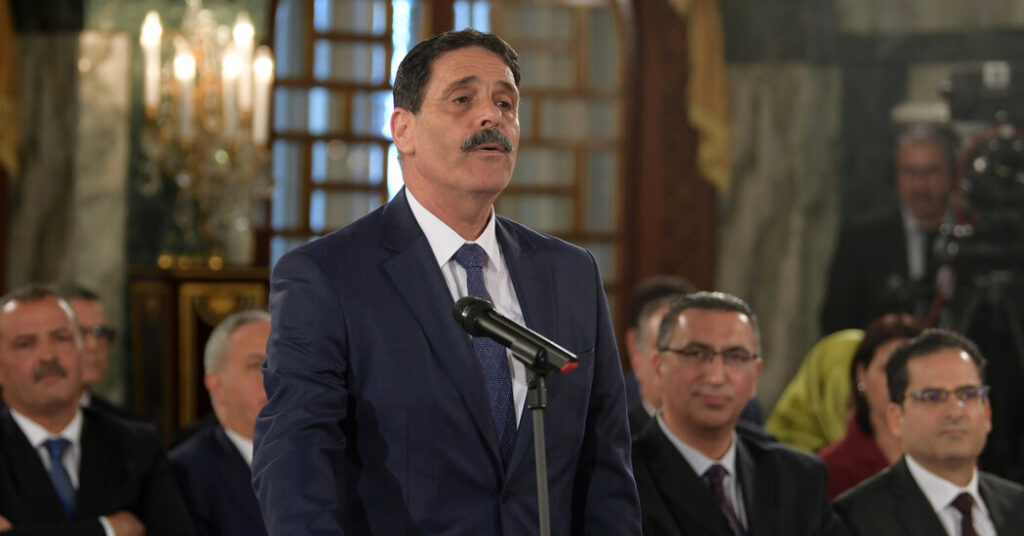
The police in Tunisia on Tuesday arrested Ayachi Hammami, a prominent opposition figure and human rights lawyer, according to Human Rights Watch, the latest sign of backsliding toward authoritarianism in the country that ignited the Arab Spring.
Mr. Hammami, who was arrested at his home outside the capital, Tunis, was sentenced by an appeals court last week to five years in prison for belonging to a terrorist group and conspiring against state security, according to rights groups. His sentence was part of a broader case against roughly 40 people who were convicted on conspiracy charges.
Mr. Hammami and the other defendants, including opposition leaders, lawyers, businessmen, rights activists and journalists, were originally sentenced in April, according to Human Rights Watch. Their subsequent appeal failed last week, when a judge sentenced them to prison terms of up to 45 years.
Rights groups have said that the charges were baseless and politically motivated.
“This isn’t justice — it’s a sham trial, plain and simple,” said Ahmed Benchemsi, a spokesman for Human Rights Watch. “Hammami wasn’t punished for any crime, but for standing up against oppression and defending human rights.”
After Mr. Hammami was arrested, a prerecorded video appeared on his Facebook account in which he condemned his imprisonment and called it a “political decision” by Tunisia’s president, Kais Saied. Mr. Hammami also said he was embarking on a hunger strike in protest.
“Just as I fought outside prison for democracy, human rights, freedoms and social justice, I will turn the cell in which Kais Saied imprisons me into a space of struggle as well,” he said.
Mr. Saied’s office did not immediately respond to a request for comment on Wednesday.
The arrest of Mr. Hammami was the latest escalation in Mr. Saied’s crackdown on dissent and was a stark sign of the country’s retreat toward autocracy.
Tunisia, an ally of the United States in North Africa, was the birthplace of the Arab Spring uprising, the movement against autocratic rule that began in late 2010 and swept through the Middle East and North Africa. It was in Tunisia that Mohamed Bouazizi, a street vendor, set himself on fire in a protest that inspired calls for democratic reform and protests across much of the region.
In Tunisia, protesters toppled a 23-year-old dictatorship, and the country went on to establish free elections and an independent news media. Even as other revolutions across the Middle East descended into civil war or authoritarianism, Tunisia’s fledgling democracy held strong, and for roughly a decade was seen as one of the few successes of the Arab Spring.
But in recent years, the country has been sliding back toward autocracy. In 2021, Mr. Saied suspended parliament, re-establishing one-man rule.
Since then, he has cracked down on political opponents, taken over formerly independent government institutions and rewrote the constitution to increase his power. Many Tunisians say they are now afraid to speak out against the government.
Michael Ayari, a senior Tunisia analyst at the International Crisis Group, said that as the country’s economic crisis has worsened in recent years, corruption and crime have been on the rise. The government, he said, has been unable to solve these issues and has tried to project strength in other ways.
“In response, they resort to charging people known for their integrity with serious crimes,” he said.
Mr. Hammami, a former minister in charge of human rights, actively campaigned against the country’s authoritarian government in the 2000s, and his career defending human rights and democracy made him a popular figure among a diverse set of political groups.
Human Rights Watch said that several of those convicted in the conspiracy case had done little more than engage in basic political acts, including holding meetings with foreign diplomats or international organizations. Others were charged with forming or joining terrorists groups, inciting unrest or causing damage to food security and the environment. But the rights group said those charges were also unfounded.
More than 20 of the defendants had fled the country before the verdict was delivered, and eight were detained when prosecutors first brought the case in 2023. At least two of those detained are currently on hunger strikes, the group said.
Jonathan Wolfe is a Times reporter based in London, covering breaking news.
The post Tunisia Arrests Opposition Figure in Widening Crackdown appeared first on New York Times.