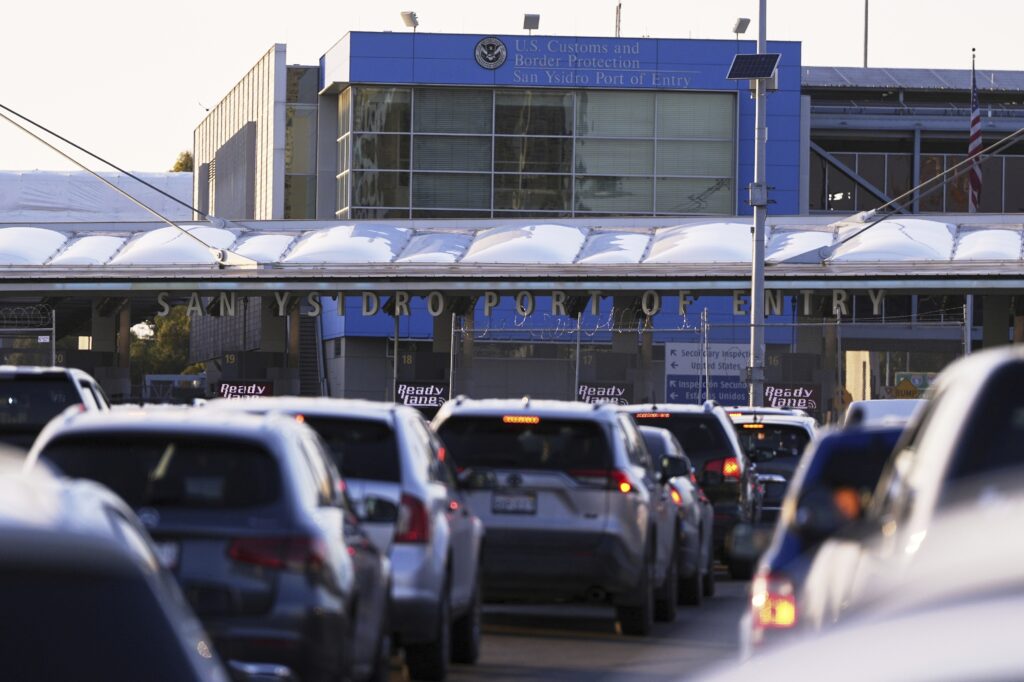
Migrants arriving at the U.S.-Mexico border are not entitled to apply for asylum until they set foot in the country, the Supreme Court ruled Thursday.
The 6-3 decision clears the way for the Trump administration to resume a policy that allows federal agents posted at the border to turn back asylum seekers before they enter the country. The case hinged on how to interpret immigration laws that say any noncitizen who “arrives in” the U.S. must be allowed to apply for asylum.
A group of migrants sued to block the policy, which began informally under the Obama administration, arguing that they should be entitled to seek the humanitarian protection even if they were stopped before entering.
What’s important is that migrants are in the process of arriving, attorneys for the migrants said. The government countered that asylum seekers must be physically in the U.S. to apply.
In an unusual statement from the bench, conservative Justice Samuel A. Alito Jr. said he was unaware that his liberal colleague Sonia Sotomayor was going to deliver a dissent from the bench and indicated he would have included more in the reading of his opinion if he had known about it.
Delivering a dissent from the bench indicates a justice is strongly opposed to the majority’s ruling. Alito’s statement could indicate possible discord, or at least a lack of communication, between the justices as the term winds down.
The decision comes as the high court is poised to rule in a separate case that also arose from President Donald Trump’s efforts to narrow legal pathways for immigrants to reside in the U.S. That case centers on the administration’s efforts to cancel temporary protected status (TPS) for Haitian and Syrian immigrants. The designation allows people from countries beset by war, natural disaster and other emergencies to live and work in the U.S.
Federal law stipulates that people may seek asylum if they fear persecution based on reasons including political opinion, race and religion.
The policy of blocking asylum seekers before they are processed at the border is known as “metering.” It expanded dramatically during Trump’s first term. The effort led to confusion and even a humanitarian crisis, according to the plaintiffs. Those turned away set up makeshift camps on the Mexico side of the border as they waited for an opportunity to apply for asylum. Some migrants attempted to cross into the U.S. illegally via the Rio Grande or the Sonoran Desert, the plaintiffs say.
In 2021, a federal judge in California ruled in favor of 13 asylum seekers who had filed a class-action lawsuit alleging the policy was unlawful. U.S. District Judge Cynthia A. Bashant, who was appointed by President Barack Obama, found that officers must process asylum seekers who are attempting to enter the U.S. — not just those who are physically inside its borders. The U.S. Court of Appeals for the 9th Circuit upheld the ruling. As the case played out, President Joe Biden rescinded the policy.
The Trump administration said in court filings that even though the policy is not currently in use, it is a “critical tool” to address surges of migrants at the border. Vivek Suri, an assistant solicitor general, said during oral arguments in March that the administration would seek to revive the policy “when border conditions justify.”
During his second term, Trump has blocked asylum seekers through other means — by declaring that the U.S. was under “invasion” at the southern border. The administration is barring entry to asylum seekers for public safety, health and economic reasons “until I issue a finding that the invasion at the southern border has ceased,” Trump wrote in the proclamation.
But in April, a three-judge panel on the U.S. Court of Appeals for the District of Columbia Circuit found the declaration unlawful. The decision effectively cleared the way for the U.S. to open its borders to asylum seekers. The Trump administration said it would appeal that decision, possibly to the Supreme Court.
More coverage of the Supreme Court
The Supreme Court’s major cases during the 2025-26 term
Supreme Court sides with Cisco over Falun Gong in case on Chinese surveillance
He spent 60 years building Black political power. He sees a wipeout coming.
The post Migrants not entitled to apply for asylum while standing on Mexico side of border, Supreme Court rules appeared first on Washington Post.