On the slim chance you get invited to dinner at the sprawling Beverly Hills home of the former Hollywood power broker Michael Ovitz, it’s best to think twice before suggesting you could produce a white painting as layered as Robert Ryman’s or a Kelly green crescent as elegant as Ellsworth Kelly’s.
He owns examples of both and, as Ovitz describes it, has little patience for those who do not see aesthetic rigor in works of Modern art. Instead, he has a buzzer at the ready that summons a staff member to come to the dining room with an apron, easel and paints.
Then, the mogul says, he invites such guests to, “Have at it.”
Most people know Ovitz as the agent whose eye for talent and hard-driving — at times ruthless — business approach changed Hollywood, won him celebrity friends and led to an ill-fated run at Disney and his ugly, if lucrative, run-in with an old pal, Michael D. Eisner.
But Ovitz, 78, is also one of the world’s largest, and most obsessive, collectors — a man who doesn’t just acquire works but loves them, like children.
“He’s just voracious about it,” said the longtime gallerist Arne Glimcher. “The art collection is, more than anything, who he is.”
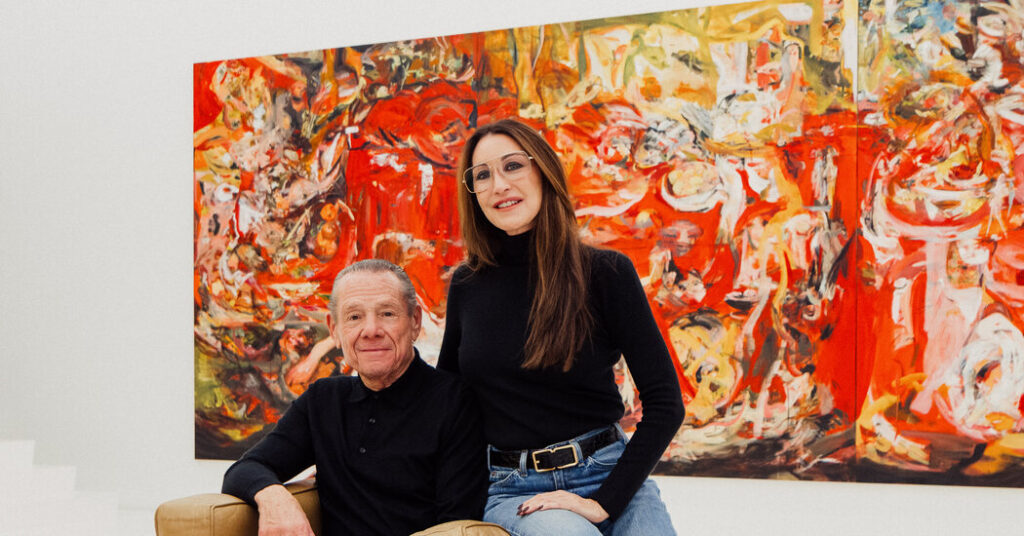
The home for that collection is what amounts to a private museum in the 28,000-square-foot glass and steel house he has shared for 15 years with his fiancée, the shoe designer Tamara Mellon, 58. The holdings are broad, deep and varied. Picassos, Lichtensteins, African masks, Ming furniture, Japanese bronze flower vases.
Ovitz regularly gives tours to the cognoscenti — museum directors, trustees, educators, artists (no photography allowed). “One day I went to take a nap,” Mellon said, “and I woke up to a group from Sotheby’s at the end of the bed.”
But he is otherwise largely private, a stickler about security and loath to let the media ramble about his home, until last month, when he agreed to walk me through his house and discuss in detail the where, when and why of his acquisitions.
I did not insist on seeing that dinner party buzzer, but I did find myself in a room with a staggering number of Picassos — including a rare 1918 study for the artist’s Harlequin series, a 1946 Françoise Gilot and a 1963 “Woman in an Armchair” — that share an intimate bar sitting room with African masks.
Moving through the house — his Belgian Malinois and German shepherd guard dog, J.J. (named after Jasper Johns) trailing him every step of the way — Ovitz described his fascination with each piece, along with its historical context and significance, as if he just bought the work yesterday.
A Donald Judd stack (“ I’m very partial to blue and purple”); Lee Ufan’s mirror piece (“earthy and minimal and very Zen”); Julie Mehretu’s “Black City” (“architectural renderings and then layering with her marks”).
“This is Chamberlain’s first stainless-steel sculpture,” he said at one spot. “And he made it for Dan Flavin’s swimming pool. And then Dan passed and it sat in his studio.”
His green curve by Kelly was made for the 1986 opening of the Museum of Contemporary Art in Los Angeles, to which it was then lent. Ovitz, a founding trustee of the museum, said he admired that work at the preview and then “put my teeth in Ellsworth’s leg and walked out owning it.”
Some pieces have particular sentimental value, like a small Frank Stella protractor that the writer Michael Crichton gave him as a gift, having originally received it from Stella.
Ovitz didn’t grow up around art. As a child in the San Fernando Valley, he felt like a fish out of water among peers focused on athletics and collecting baseball cards. “Things that were valuable in my childhood were not things that were interesting to me,” he said.
”I wasn’t a bad athlete, but it wasn’t my life,” Ovitz added. “I was very interested in artistic things, but I was never encouraged to follow it.”
He didn’t set foot in a museum until age 18, when he discovered MoMA on his first trip to New York and stayed for four hours. He went back the next day and stayed for six, then went back again and stayed the whole day. “It was a visual feast,” he recalled. “I had never seen anything like it.” (Ovitz has served on the MoMA board for 35 years.)
At 25, Ovitz bought his first serious work of art — a Jasper Johns print — for $600. (He eventually went on to buy a rare Johns “White Flag.”)
Collecting art, Ovitz said, put him out of step with much of his Hollywood brethren. “There was nobody collecting art,” he said, ticking off exceptions like the actor Steve Martin, the producer David Geffen and the filmmaker Billy Wilder.
“And most of the people in the entertainment business kind of belittled me for it,” he added. “They thought it was too New York-y.”
Ovitz’s journey to Hollywood mega-agent never strayed too far from California. He graduated from U.C.L.A., worked as a part-time tour guide at Universal Studios and rose from the mailroom at the William Morris Agency to become a junior agent.
He and several colleagues left in 1974 to found Creative Artists Agency with Ovitz as chairman, building the start-up into the world’s leading talent agency for actors, directors and screenwriters. The firm branched out into unorthodox areas — brokering the sale of three major Hollywood studios; creating advertising for Coca-Cola; and forging alliances with early Silicon Valley companies like Intel and Microsoft.
Ovitz resigned from CAA in 1995 to become president of the Walt Disney Company under its chairman Michael Eisner but was dismissed after 14 months, leaving with a severance package of $140 million.
As his fortunes grew, so did the quality and size of Ovitz’s art collection, securing him a place on an Artnews list of the world’s top 200 collectors.
Contrary to convention, Ovitz believes it is perfectly appropriate to mix genres, epochs, categories. Turn-of-the-century Japanese bronze flower vases are juxtaposed with twin figures (ìbejìs) from Nigeria; Rembrandt etchings coexist comfortably with scribbles by Cy Twombly; and legends — like Roy Lichtenstein and Isamu Noguchi — share space with living artists like Justin Caguiat, Issy Wood, Deborah Roberts, Mark Bradford, Salman Toor and Joseph Yaeger.
“Michael is a deeply serious and engaged collector who has exquisite taste and eclectic taste,” said Glenn D. Lowry, the longtime director of MoMA. “He had no problem collecting in areas that many people didn’t want to go to.”
Ovitz said he sees the timelessness in works of art, how something like a Benin headdress can seem contemporary. “It’s a piece of sculpture,” he said. “To think this was done 200 years ago. It’s as good as anything that was done in Europe by Rodin or anybody else.”
Ovitz takes pride in his close relationship to artists, like Ed Ruscha and Cecily Brown. When Chuck Close died in 2021, the artist was in the middle of painting a portrait of Ovitz. (Glimcher featured it in his Close show last year.)
Ovitz spoke at the recent memorial for the sculptor Joel Shapiro, who died in June; only after buying his first piece by the artist in the 1980s did Ovitz realize they were cousins. There are works by Shapiro throughout his house, including a set of four solid brass coffee tables that the artist made for Ovitz and for the CAA office that Ovitz commissioned I.M. Pei to design.
“Great art brings out the boy in me,” he wrote in his 2018 memoir. “The insatiably, curious kid who has to know everything about everything. I’m a frustrated artist. I couldn’t paint or sculpt. I wasn’t musical and I sure couldn’t act. So I did the next best thing with my life. I spent it around artists.”
Ovitz said he has never used an art adviser, although he said he speaks to Glimcher every day and that Glimcher was “a tutor for me in the early days.” He also discusses every purchase with Mellon, who comes from a creative background, having been a founder of Jimmy Choo shoes before starting her own namesake brand. “I’ve always used art as inspiration in my design,” she said.
Mellon, who is British and in 2010 received an Order of the British Empire, or O.B.E., from Queen Elizabeth at Buckingham Palace, grew up in Europe with friends who had artwork by old masters on the walls. Her father was business partners with Vidal Sassoon, who collected art. She was married to Matthew Mellon, whose grandmother Gertrude Mellon was on the MoMA board. She serves on the Metropolitan Museum of Art’s chairman’s council, a group of collectors and donors.
“I’ve sort of absorbed it over the years, but I have to really credit Michael with the education in art,” she said. “He’s really the one who’s taught me everything.”
Mellon’s main contribution to the collection, she said, has been adding more work by female artists, such as the sculptor Kathleen Ryan and the painters Sabine Moritz, Lauren Quin, Emma Webster, Lucy Bull and Francesca Mollett.
After traveling with Ovitz to Greece recently, Mellon encouraged Ovitz to add antiquities to the collection; their first purchase was a Roman marble torso from 1 B.C. “The Acropolis lit the fire in him,” she said.
Like many collectors, they have run out of wall space, so they have to rotate works in and out of storage — yet keep buying. (Ovitz recently commissioned five works, including an 18-foot painting by Louise Giovanelli.) They describe poring over exhibition catalogs as well as those coffee table art books that others view as purely decorative.
Ovitz and Mellon show no sign of slowing down; they have bought about 30 pieces over the last six months. Every time a monograph comes out — a comprehensive publication about an artist’s life and work — they add it to their library, which already includes more than 3,000 books. Old notes from movie stars fall out of them sometimes.
Ovitz said much of his collection has already been donated or promised to museums. Agnes Martin’s six-painting series, “With My Back to the World,” which currently stretches across the upper entry gallery, for example, will go to MoMA.
For now, it stays in his home, where the unfortunate guest who pipes up about the flaws in modern art may need to suffer through a bit of gentle tutoring as that easel arrives.
“It’s not only funny,” Ovitz said of his ritual, “it’s poignant because they then understand — how do you get that texture? How do you mix the paint? How do you get something out of nothing? I’m blown away by people who can create a story out of thin air, a piece of art from the idea to their hand.”
Robin Pogrebin, who has been a reporter for The Times for 30 years, covers arts and culture.
The post Inside the Museum-Style Home of Michael Ovitz, an A-List Collector appeared first on New York Times.