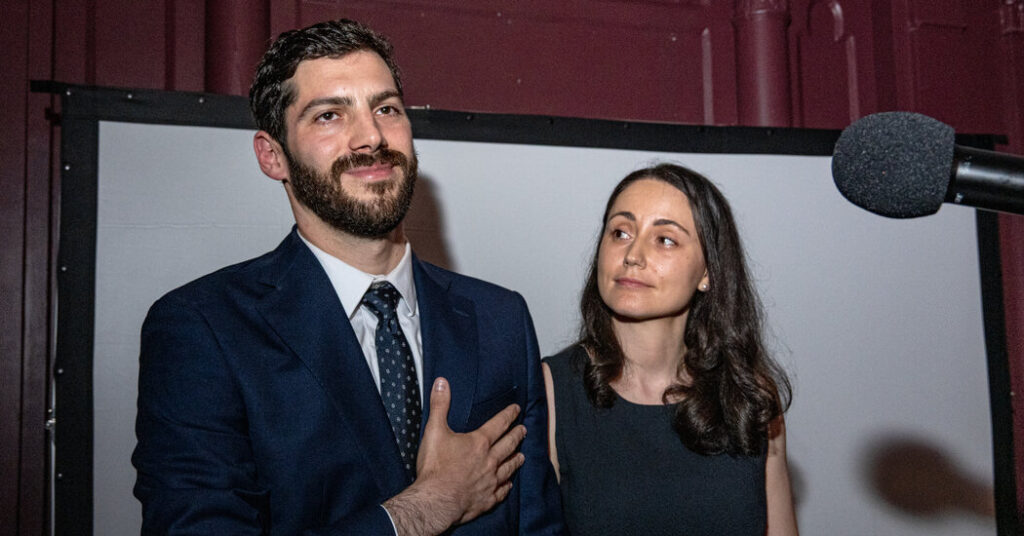
The House candidate Alex Bores was dining on eggplant at a vegan restaurant in November with his wife, Darya, as they celebrated their anniversary when he got a phone call with some unloving news: A super PAC with over $100 million wanted to crush his campaign.
The super PAC, backed by the artificial intelligence industry, was planning attack ads against Mr. Bores. He stepped out of his dinner at Cadence in the East Village of New York and reviewed a statement his team had drafted in response.
He wanted it to be even more fiery — and largely rewrote it himself, according to two people close to his campaign who spoke on the condition of anonymity to discuss internal deliberations. Mr. Bores, a state legislator who had worked on A.I. regulation, sought to make himself a sympathetic victim of the A.I. industry.
Mr. Bores’s plan to become a cause célèbre worked — to a point. He narrowly lost his race, but remarkably, he became the winner of the A.I. spending wars: Four super PACs tied to rival A.I. interests sprang up to defend him, pouring $19 million behind his bid and swamping the $8 million in spending from the super PAC that opposed him, Leading the Future.
The enormous spending for and against a previously little-known New York state lawmaker elevated his candidacy in a crowded Democratic field for an open seat in Manhattan vacated by the retiring Representative Jerrold Nadler.
Mr. Bores fell short to Micah Lasher, a state lawmaker and Mr. Nadler’s chosen successor, who wielded his strong governmental résumé and millions from Michael R. Bloomberg to prevail. But even Mr. Lasher told people during the campaign that he believed the anti-Bores spending from Leading the Future had backfired and ended up helping Mr. Bores’s bid, according to a person who spoke with Mr. Lasher.
The New York race — the first in the country to draw such large amounts of money from A.I. interests — signaled the battles to come over an industry that has quickly grown more unpopular with voters but has astronomical sums of money it can use to shape how it is regulated.
Mr. Bores’s respectable showing demonstrated how tech-skeptical Democratic candidates might be able to exploit the political liabilities of the A.I. industry, which is engaged in a midterm proxy war between two of its top companies, Anthropic and OpenAI, and their allied super PACs.
The Anthropic side is pushing for candidates like Mr. Bores who generally support stricter regulation on A.I. development, including at the state level, while the OpenAI faction is generally pushing for more industry-friendly laws that accelerate A.I. development.
Mr. Bores took a twofold approach: Tell a sob story about A.I. companies targeting you. And, simultaneously, mobilize your own A.I. megadonors.
“If the idea was that you’re going to walk out and get absolutely obliterated — that there’s no cover, there’s no backup — Alex showed that taking a principled position comes with backup,” Representative Pat Ryan of New York, a Democrat in the Hudson Valley who backed Mr. Bores, said in an interview.
Informed by the Bores race, the A.I. industry’s political activity will enter a new phase. Strategists involved in the fights say they are newly attuned to the weakening poll numbers for the industry, particularly among Democrats. They also say they are more aware about the chain reaction of consequences they can trigger when they throw their weight around in elections.
‘A Blueprint to Take Into the Future’
From the jump, when Mr. Bores announced he was running in October, he made plain that A.I. policy would be one of his themes.
At the time, his advisers considered his bid something of a long shot. Then, in November, Leading the Future announced that Mr. Bores would be its first target.
Up to that point, Mr. Bores had struggled to find enough oxygen in a packed primary. So in February, after Leading the Future’s attack ads began, Mr. Bores and his top advisers decided to reorient his campaign and lean much more explicitly into the opposition he had drawn from the A.I. industry. They plastered the motto “Feared by the Powerful” on his website and began running ads that cast him as the target of A.I. billionaires.
“Voters are smart, but they’re busy,” said Jesse Ferguson, the campaign’s top strategist, who advised on the strategy to focus on Leading the Future’s targeting of Mr. Bores. “They’re not going to reverse-engineer the super PAC’s motivations on their own.”
In his concession speech on Tuesday, Mr. Bores dedicated much of his four pages of printed remarks to his fight against Leading the Future, saying it had decided “to make me an example in this race.”
“I didn’t get in this race to make a point about A.I.,” Mr. Bores said. He offered a message for fellow Democrats: “I urge them to look at this campaign not as a cautionary tale, but as a blueprint to take into the future.”
A Wary A.I. Industry Plots Its Next Steps
Newly wary, strategists on both sides of the A.I. fight are thinking about their plans for the remaining party primaries this summer, and about where they can actually make a difference in expensive general-election races this fall.
A few factors are keeping the A.I. industry from going full-throttle, though.
First, there is an increased desire to keep a lower profile. Aware that A.I. money has become more toxic, particularly among more educated and more progressive voters, A.I.-aligned super PACs and candidates are trying to be more discreet. The situation is particularly delicate in Democratic primaries.
Take what had been expected to be the next flashpoint in the A.I. wars: a Democratic primary for the House next Tuesday in Colorado featuring Manny Rutinel, a Democratic legislator who, like Mr. Bores, wrote statewide A.I. safety legislation. Many activists who favor stronger A.I. regulation have considered their three biggest champions this election cycle to be Mr. Bores, Mr. Rutinel and Scott Wiener, a California state lawmaker who seems to be coasting into the House seat in San Francisco long held by the retiring former Speaker Nancy Pelosi.
But Mr. Rutinel’s race has drawn far less A.I.-related spending than Mr. Bores’s contest did.
Mr. Rutinel has been supported by a relatively modest $1 million ad purchase from an A.I. super PAC, which paid for a spot featuring Pope Leo XIV reading from his encyclical about the dangers of A.I. (The ad drew objections from the Colorado Catholic Church.)
Neither Leading the Future nor Public First, the main Anthropic-allied super PAC and Mr. Bores’s main backer in New York, has publicly spent money in the Colorado race.
That is in part because, at this point, Mr. Rutinel is considered to be in a strong position to win the primary. It is also in part because of pressure from allies of Representative Hakeem Jeffries, the minority leader.
Unlike Mr. Bores’s deep-blue seat, the district in which Mr. Rutinel is running, Colorado’s Eighth, is expected to be a top battleground in November. To help protect Mr. Jeffries’s bid to become speaker, his allies at the main super PAC for House Democrats, House Majority PAC, have discouraged the top A.I. groups from spending in the race, according to two people with knowledge.
Urging Democrats to ‘Seize’ on A.I.
A.I. activists are also closely watching the Democratic Senate primary and the general election matchup in Michigan, where one Democratic candidate, State Senator Mallory McMorrow, has put out policies aligned with the A.I. safety community. Primaries in Florida are also at the top of the list for several A.I. super PACs.
Leading the Future is riding high after Mr. Bores’s defeat. It has accomplished its goal in all but one of the 26 races it has spent money in, although Public First has argued that many of those races were not competitive.
Mr. Lasher, despite having benefited from Leading the Future’s spending, distanced himself from all of the A.I. super PACs in the election in his victory speech on Tuesday, ridiculing their “unusual interest” in the race.
As Mr. Bores campaigned on Tuesday afternoon in spitting rain outside an Upper East Side middle school before polls closed, several voters brought up A.I. with him, as he name-checked various A.I. megadonors in conversations with them. Some voters said they had cast a ballot for him explicitly because Leading the Future attacked him.
Even if he lost, Mr. Bores said in an interview, his campaign should serve as a confidence boost for politicians who are scared to bet their careers on the issue.
“The Democratic Party,” he said, “should seize on it.”
The post Even in Defeat, a Democrat Showed the Upside of Angering the A.I. Industry appeared first on New York Times.