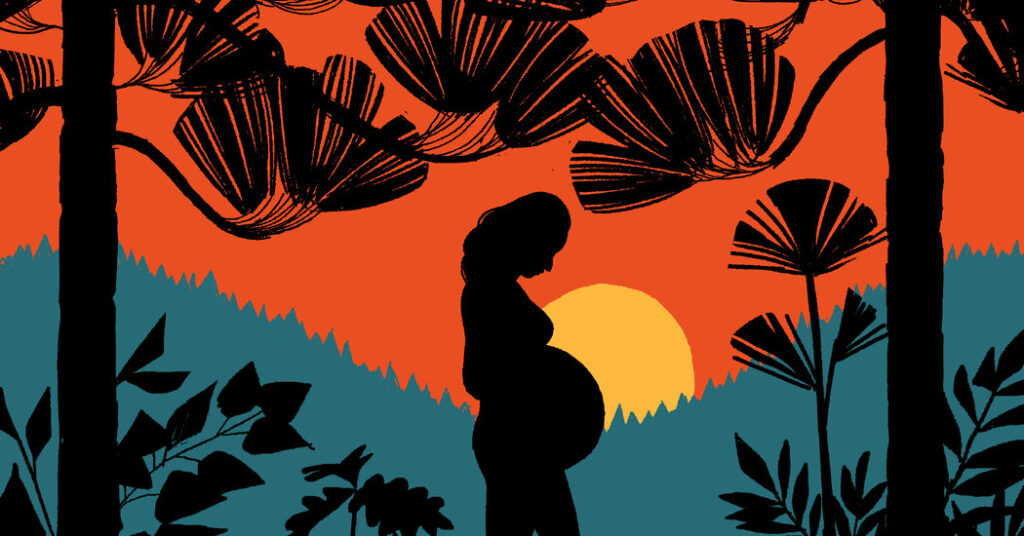
I have been reading exposés about the “free birth” movement for nearly as long as I have been covering women’s health. The movement’s adherents are women who give birth without trained medical assistance; in the most extreme versions, they receive no prenatal care or ultrasounds and, even when their births become complicated, refuse to go to the hospital.
When I first heard about it, free birthing was treated as a kind of fringe curiosity, like Octomom, the mother of octuplets. There was a Lifetime reality show 10 years ago called “Birth in the Wild” in which families boasted about having babies in the woods “about a hundred miles from the nearest road.”
I never thought that avoiding medical care while pregnant and birthing would get anywhere close to a mainstream choice, which is why I was appalled to read Sirin Kale and Lucy Osborne’s recent Guardian investigation into the Free Birth Society, which was founded and run by a former doula and birth influencer named Emilee Saldaya.
It’s impossible to know exactly how many families have been influenced by the Free Birth Society, which was founded in 2017, since it advises followers to go under the radar. The organization has a podcast that has been downloaded more than five million times and a YouTube channel with almost 25 million views. We don’t know how many of these listeners or viewers are genuine, or if some portion of them are just rubbernecking, but the Free Birth Society has a bunch of paying customers, too. According to Kale and Osborne’s reporting, it may have generated over $13 million since 2018.
The society preaches “radical responsibility,” a term its leadership cribbed from a corporate self-help book. “In F.B.S., to take radical responsibility means that a free birthing mother assumes complete responsibility for all the outcomes of her birth, including her own death or that of her child. No one is coming to save her, nor does she want them to. She is fully autonomous or, in F.B.S. parlance, sovereign,” Kale and Osborne explain.
Perhaps unsurprisingly, the Free Birth Society tends to attract the kinds of mothers that the Make America Healthy Again movement targets: women who are suspicious of the medical system because of truly bad and disempowering experiences, and who decide that they can trust only themselves and their own research or intuition. The entire medical freedom movement — which believes the government has no role to play in public health — rests on similar hyperindividualistic foundations.
It would be easy to just dismiss the free birthers as bonkers, which I have to admit is my kneejerk reaction. But with the medical freedom movement making inroads into our government in the form of Robert F. Kennedy Jr. and gaining more power by the day, it’s worthwhile to look back at the history of medical freedom in the United States. This history helps explain how we got into this very dark period, when medicine has been thoroughly politicized, experts are suspect and an unfortunate few are enticed by the promise of a return to an indealized nature, putting themselves at unnecessary risk. They seem to forget that nature can be cruel.
The basis for so much of what we’re seeing today started in the 19th century, when medicine began to professionalize and the American Medical Association started to create universal standards. The medical historian James Whorton, who wrote the book “Nature Cures: The History of Alternative Medicine in America,” described it this way: “As medicine was transformed into a more tightly organized profession, it became a well-defined entity against which the medically disaffected could rally.”
Alternative healers — referred to at the time as practitioners of “irregular medicine” — rejected the “indiscriminate drugging” that they thought mainstream doctors relied on and profited from. They felt that nature was a “good, kind angel, hovering over the bed of sickness, without fee, and often without any acknowledgment of her services.”
The father of naturopathy, Benedict Lust, also thought that the drugs and remedies used by doctors obscured the “root cause” of illness by suppressing symptoms (“root cause” remains a buzzword for Kennedy and other MAHA types like Dr. Casey Means, who is the surgeon general nominee).
The Free Birth Society’s leaders take these concepts over the edge of sanity, as they have said they wouldn’t even resuscitate newborns because “resuscitation was often an unnecessary act which deprived babies of the chance to choose to begin their lives,” Kale and Osborne explain in The Guardian.
But the historical figure that most reminded me of the Free Birth Society’s leaders was a New Hampshire farmer named Samuel Thomson. Whorton describes Thomson’s philosophy as “Every man his own physician.” Thomson’s wife had a long labor followed by convulsions, and regular doctors couldn’t help her. He called on “root doctors” who ministered to his wife, who did survive, though she never fully thrived. Thomson started to treat her himself, which is part of his origin story as a healer.
After that experience, he started to peddle his botanical remedies, which included hot pepper enemas and emetic herbs that “scraped the human fireplace clean.” He said that he was simply aiding nature. The market for Thomson’s wares was high in part because even licensed doctors of the 19th century weren’t very effective. They didn’t have modern tools like antibiotics or sanitary operating rooms, and they were regularly treating patients with opium and a mercury compound called calomel.
Thomson’s fame peaked around when Andrew Jackson was elected president in 1828 and anti-intellectualism was ascendant. Doctors were seen then as arrogant elitists, and Thomson framed himself as a common-sense, egalitarian alternative. He and others fought state licensing requirements for physicians — which to them, felt like persecution — and instead, Thomson patented his own system, which was essentially a pyramid scheme. Agents would purchase medicines and literature from Thomson’s headquarters in Boston, and then sell them with the promise that anyone could be his own doctor and administer the herbs himself.
His death at the age of 74 was the beginning of the decline of Thomsonian medicine — his own methods evidently couldn’t save him, didn’t actually work, and his followers argued and fell apart without his charismatic guidance. Some of them were convicted in the deaths of their patients — it turns out that a cayenne and lobelia enema can be fatal. Mainstream medicine improved a great deal in the second half of the 19th century and early 20th century, and so regular citizens could gain trust in doctors.
The sputtering end to Thomson’s influence shows why The Guardian’s investigation of the Free Birth Society is so important. Though Kale and Osborne note that there were many “free birth” babies born healthy, they also describe some truly horrible outcomes of the society’s advice. They spoke to “18 mothers who suffered late-term stillbirths, neonatal deaths or other incidents of serious harm after they or their birth attendants were heavily influenced by F.B.S.” Very sadly, Saldaya, the society’s founder, had a stillbirth herself this year.
For some people who are under the spell of medical individualism, having a bad outcome, or witnessing one with their own eyes, is the only way they are going to realize that medical expertise has an important place in society.
Mainstream medicine will never be perfect, and it could do a much better job of listening to patients and integrating new and less invasive ideas. Birthing women in particular have been poorly treated, and Americans have some of the worst maternal and infant outcomes in the developed world. The doctors, midwives and doulas who care for them should be doing everything they can to improve the experience here.
But going it totally alone does not mean being free — it just means being farther from help.
End Notes
-
We’re gearing up for our yearly rewatch of “National Lampoon’s Christmas Vacation,” which is what we have on when we decorate the tree. I want to hear about your traditions, the weirder the better — bonus points if they don’t involve buying anything as I’m sick of my holiday gift monsters already. Feel free to drop me a line about that, or anything else, here.
Each year, The New York Times Communities Fund supports nonprofits. This year, the fund is working with seven organizations that focus on helping people through education, from preschool to vocational training. Donate to the fund here.
The post Why the Free Birth Movement’s Popularity Threatens Public Health appeared first on New York Times.