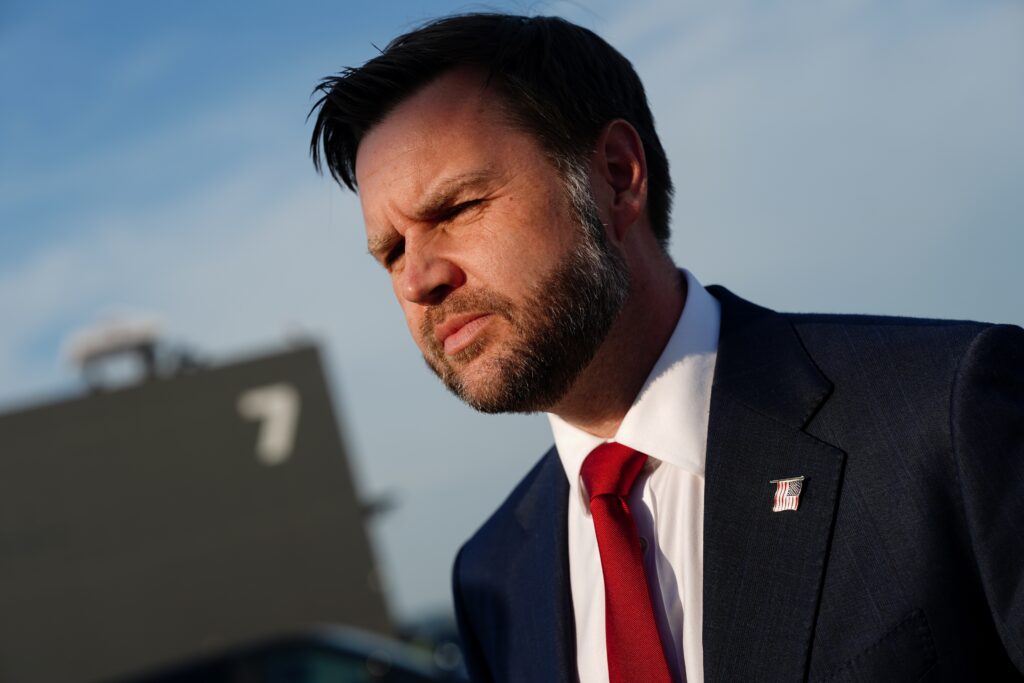
Those wondering why Vice President JD Vance is heading the team negotiating the final peace settlement with Iran should recall how President Donald Trump’s television hit, “The Apprentice,” always ended. Finalists were assigned a complicated task, helped out by a team of former contestants, to complete to the boss’s satisfaction.
Like those TV finalists, Vance might think he’s auditioning for an audience of one. But the job here is trickier than that. Beyond satisfying Trump, the vice president needs to make both GOP primary voters and general-election swing voters happy. Balancing those three very disparate constituencies is going to be tough.
Satisfying Trump might be the easiest part. Trump’s justifications for the Iran war have been all over the map, but he has always been crystal clear on two things: Iran must not be able to develop nuclear weapons, and the Strait of Hormuz must remain open to all. The Iranians might not want to comply with either or both of those conditions. But in that case, if Vance returned empty-handed, it would be for a clear and acceptable reason.
The greater danger arises if Vance and Trump sign off on an agreement that complies only facially with those red lines. Foreign policy experts in both parties have spent decades thinking about Iranian nuclear capabilities. Any deal that fails to satisfy the bulk of them will be loudly attacked, with large and receptive audiences across the political spectrum.
The larger immediate danger for Vance is with the Republican primary electorate that will decide the party’s 2028 presidential nominee. The fight to succeed Trump as the party’s standard-bearer will be fierce. As vice president, Vance has as strong a claim to that mantle as anyone, but there are plenty of others — Secretary of State Marco Rubio, Trump’s son Donald Trump Jr. and Florida Gov. Ron DeSantis follow Vance in early polling — in position to mount a vigorous challenge.
Even today, a recent CBS News poll shows that 40 percent of Republican adults want the war to continue until the Iranian regime gives up more. Many of those Republicans will be drawn to a candidate who offers a hawkish, confrontational approach to Iran and other American enemies. Will Vance be that candidate?
Those hawkish voters punch above their weight in GOP primaries. Polls consistently show a large age differential on foreign policy among Republicans. A late 2025 Pew Research poll reveals this strikingly, with supermajorities of GOP voters over 65 favoring an active U.S. role in the world. Republicans older than 50 also hold very positive views of Israel and think Israeli Prime Minister Benjamin Netanyahu makes good decisions.
Could Vance just rely on a younger support base? Probably not. In the 2024 primaries, voters 65 and older outnumbered those 44 and younger in every state for which we have exit polls. The median age of 2024 presidential GOP primary voters was at least 50. Given current American demographics, expect that to creep up in 2028.
To win the nomination, the 41-year-old Vance will need to get substantial, and probably majority, support from the older, highly pro-Israel and hawkish age cohort within the GOP. Authoring a peace plan credibly attacked by foreign policy experts, Jewish leaders and their Christian allies would complicate his path immensely.
But say he succeeds. After that comes a new test. In a general election, Vance would need to appeal to the small but crucial number of independent swing voters to get to the White House. Swing voters tend to be more moderate and less politically informed than partisans. They also tend to be more interested in economic and quality-of-life issues — think inflation, crime or a general sense of disorder in their communities. That means Vance will need to deliver a deal that credibly addresses those concerns to convince them he’s been successful.
That’s no problem if Hormuz reopens and stays toll-free. In that case, gas prices will surely come down significantly from this year’s peak. Returning to a stable situation in the region also avoids the chaos these voters dislike.
But there’s a catch: Will Iran go along? Already, Tehran is indicating that it intends to control access to the strait after negotiations conclude. If a final deal is ambiguous on this point, Vance could suffer.
Vance will also face problems if Iran tries to wiggle out of whatever deal it signs. If traffic in the strait goes up and down in response to Iranian threats, or if American forces are continually pulled in and out of the region to compel compliance, a Vance-brokered deal will look like it continued the very chaos it was meant to end.
The vice president is often underestimated in the mainstream media. He is intelligent and thoughtful and is also an unusually good communicator. But he can’t sell a pig in a poke, and even a Trump endorsement won’t solve that conundrum. As we often see, Trump has no compunction about withdrawing an endorsement or expanding one to include a person’s primary opponent.
So on the eve of the presidential season, Trump has fashioned a fascinating test for his understudy. Can Vance obtain a peace deal that provides the security and economic benefits that Trump, older Republicans and swing voters want?
Because if he can’t, and he’s tasked with selling a problematic deal, it will significantly increase the likelihood that either Trump or a key voter demographic will utter the two words every aspiring apprentice dreads most: “You’re fired.”
The post The Iran negotiations could make or break Vance’s political future appeared first on Washington Post.