President Trump abruptly canceled his plans to sign a bipartisan bill aimed at improving housing affordability, one that Democrats and Republicans alike had been eager to promote on the campaign trail as evidence they were working to try to bring down costs.
Mr. Trump said in a social media post that he would not sign the bill until Congress passed a law that would impose new restrictions on voter identification and mail-in voting, known as the Save America Act. But Senator John Thune, Republican of South Dakota, has said that Republicans did not have the votes required.
Though the president said he would not sign the housing bill, it can still become law without his signature. If Congress is in session, legislation can generally become law 10 days after a bill is enrolled and presented to the president.
The president’s announcement came at the same moment that the House Republican leadership was championing the legislation during a weekly news conference.
“House Republicans are going to be the party that governs and delivers,” said Representative Tom Emmer of Minnesota, the No 3. House Republican, seemingly unaware of Mr. Trump’s social media post.
Even the White House had said it supported the bill — the first major piece of housing legislation to be adopted in decades — and had shared an equally supportive statement about its components on Tuesday night.
But on Wednesday, Mr. Trump described the bill as “of minor importance compared to lower interest rates,” and called it “Warren centric,” using a racial slur to refer to Senator Elizabeth Warren of Massachusetts, the top Democrat on the Banking, Housing and Urban Affairs Committee.
The White House did not immediately respond to a request for comment.
While Mr. Trump focused on Ms. Warren’s involvement in the bill, the measure cleared both chambers with overwhelming support this week, a rarity in hyperpartisan Washington. It ws the culmination of a long negotiation process involving Ms. Warren and others including Senator Tim Scott, Republican of South Carolina and chair of the Banking Committee, and Representative French Hill, an Arkansas Republican who chairs a similar panel in the House.
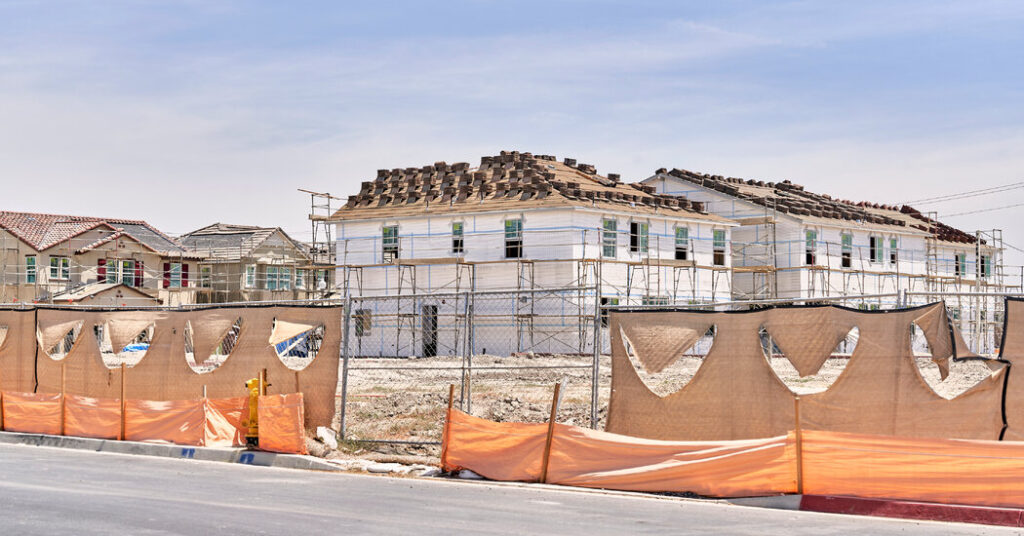
The measure aims to lower housing costs by making it easier and cheaper to construct new homes. Spanning roughly 380 pages, the so-called 21st Century Road to Housing Act reduces a bevy of federal regulations and seeks to incentivize more development at the local level, adopting an approach that generally won broad support among economists and housing experts.
The measure even includes some of Mr. Trump’s own priorities, such as a new prohibition on large investors that snap up single-family homes, which the president tried to tackle in a limited executive order earlier this year.
Both parties had celebrated the bill as a way to make housing more affordable. Senator Chuck Schumer, Democrat of New York and the majority leader, accused Mr. Trump on Wednesday morning of “running away from one of the very few accomplishments that could actually help the American people.”
Mr. Trump at times has been dismissive of the housing package, telling the Washington Examiner at one point in April that he was “looking at other things very strongly.”
Then, and now, Mr. Trump argued that he believed the most important force to lower housing costs would be a reduction in interest rates, which could ultimately help to push down mortgage bills. Rates on a 30-year mortgage have hovered around 6.5 percent, which has deterred some families from buying new homes and priced many out of the market altogether.
Reacting to the news, Ms. Warren sharply criticized Mr. Trump in an appearance on CNBC, saying the decision to cancel the signing “made clear that he isn’t worried about families’ rising expenses.”
“This just doesn’t make any sense, other than whatever it is he wants to do is a complete indifference to the cost squeeze on American families, and to genuine efforts to do something about it,” she added. “You know, he could be over here trying to claim a victory lap, and instead he’s saying no, no, he doesn’t want anything to do with it.”
The post Trump Refuses to Sign Housing Bill Until Unpopular Voting Restrictions Pass Congress appeared first on New York Times.