I was a few months shy of my seventh birthday the first time I saw looting up close. We were living in Nairobi, Kenya, in an apartment complex near the downtown shopping district. All of a sudden, people started streaming back to our building with armloads of brand-new stuff. I watched in awe as a man balanced a small refrigerator on his head, blood pouring out of a gash above his eyes.
“All the shops are open and everything is free,” I declared to my mother. “Can we go?”
We did not go. The shops weren’t open, exactly. A group of disgruntled military officers had attempted to overthrow the Kenyan government, then led by a budding kleptocratic autocrat named Daniel arap Moi. Amid the chaos, some of the Kenyan underclass had decided to pry open the gates of shops across the country and help themselves to the goods inside.
Kenya was, and still is, a highly unequal society, and there seemed little evidence that merit was the distinguishing factor between those who had access to wealth and opportunity and those who toiled in menial jobs and lived in penury. The government did little to improve people’s lives; corruption was rampant. In a perfect world, no one would steal. This was not a perfect world, and if the powerful were engaged in a smash-and-grab, it seemed natural that ordinary people would join in.
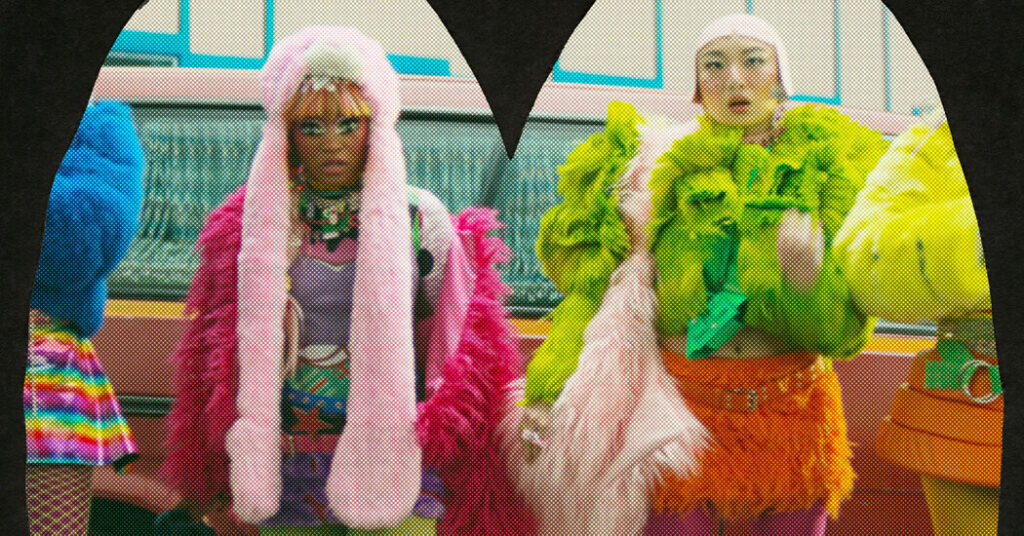
I thought of this childhood memory as I watched the filmmaker Boots Riley’s irresistibly overstuffed, technicolor provocation, “I Love Boosters.” The film, which was released last month, follows a charismatic and very stylish crew of professional shoplifters — boosters, as they are known — who steal high-end clothing from retail stores and resell it to friends and neighbors at a steep discount.
Part anticapitalist satire, part buddy comedy, part heist movie, “I Love Boosters” is a messy, brilliant sendup of the absurd contradictions of our savage era of inequality and political corruption. It asks us: When theft defines a social system, what’s the difference between the individual acts of ordinary people and the collective behavior of the powerful?
The movie’s heroine goes by the nickname Corvette. Played by a luminous Keke Palmer, she lives in an abandoned fried chicken restaurant in Oakland and dreams of becoming a fashion designer; she plasters her makeshift home with her supernatural, candy-colored streetwear creations.
Corvette idolizes a famous, girl-bossy fashion mogul named Christie Smith, played by a delightfully unhinged Demi Moore. Smith sells her clothes at a highly successful chain of stores called Metro Designers, offering flashy, expensive streetwear in a single color at each outlet. Want a different color? Go to another store. Corvette keeps a well-thumbed copy of Smith’s “Lean In”-style manifesto on her night stand, bristling with Post-it notes.
Metro Designers is a favorite target for Corvette and her best friends, Mariah and Sade. The crew, the so-called Velvet Gang, have perfected an ingenious method for their elaborate heists. Corvette, Mariah and Sade, all of them Black women, stuff their oversized outfits with clothes while a pair of large Black men — participants in the scheme — pretend to get into a fistfight. A white woman, another confederate, distracts the salesclerks with feigned hysteria over witnessing Black male violence. In the melee, the Velvet Gang waddle out with their booty.
These thefts are common enough, and bold enough, to catch Smith’s attention. In a television interview, she refers to the Velvet Gang as “low-class, urban bitches” and vows to punish them. In her telling, the members of the Velvet Gang “have no style, they have no ingenuity. They steal it from me.” Smith, it turns out, is a thief on a grander scale. Corvette discovers that Smith’s company copied one of Corvette’s far-out designs, a sculptural jumpsuit festooned with Jurassic scales on its arms and legs.
The thieving doesn’t end there. The crew, having got themselves hired at a Metro Designers store to better case the joint, discover that workers are required to wear current-season Metro Designers clothes. The cost is deducted from their meager paychecks, with a 30 percent employee discount. Lunch breaks are so comically short — 30 seconds — that the peevish store manager sets out starting blocks for workers and times them on a stopwatch. A co-worker tries to persuade Corvette and the gang to join a unionizing effort, but they dismiss the idea in favor of their own scheme: a complicated heist of every Metro Designer store in the area.
Riley, the director, has been a left-wing agitator and activist for a long time. He is a self-described communist, and years ago he released rap albums with titles that made his politics quite plain: “Kill My Landlord,” “Genocide & Juice,” “Pick a Bigger Weapon” and “Steal This Album.” His first feature film, “Sorry to Bother You,” a black comedy about workers at a sinister telemarketing firm, was a modest indie hit, making about $18 million on a budget of just over $3 million. For his follow-up, Riley’s producers nudged him toward a script he had shelved that was in a bankable genre: the heist movie.
I adore heist films. The genre has varied over the decades, but the essential elements create a timeless formula: a motley crew of down-at-heel social outcasts who possess unusual skills that the straight world has failed to reward. Invariably led by a charming antihero — think George Clooney’s suave Danny Ocean from Steven Soderbergh’s “Ocean’s” franchise — they have gifts for things like safecracking, explosives management, reading architectural plans and coming up with creative ways to unload hot merchandise.
Their target is at best morally ambiguous: an odious casino mogul, a faceless bank, a jewelry store packed with trinkets for billionaires. The crimes aren’t victimless, exactly, but no one roots for the plutocrat who gets fleeced. And most important, the crime itself must be executed with dazzling elegance. Heists are an artistic endeavor in which undervalued forms of labor are combined to pull off something akin to poetry or ballet. In the process, viewers almost inevitably end up on the side of the criminals.
The Velvet Gang are in many ways a classic heist crew — misfits on the edge of society with outsize talents for which the world has no use. Expected to take their place at the bottom of the modern economic pyramid, they choose instead to dynamite the whole thing. So far, so heist. But instead of breaking into an art museum or cracking a safe buried beneath layers of elaborate security, they steal clothes from high-end stores. The gang’s central crime threatens to upend the usual distribution of sympathy.
Shoplifting, after all, is regarded as a particularly pernicious crime, as close to pure selfishness as one can get. By stealing items most people simply pay for, shoplifters shift the cost of their greedy unwillingness to follow the rules onto everyone else. This basic violation of the social contract would strike anyone as wrong. In recent years, this moral objection has risen to panic as retailers have claimed that gangs of shoplifters have caused huge losses and forced them to close stores.
In business terms, it isn’t that simple. TJ Maxx was at the center of the shoplifting panic. An analysis of its parent company’s accounts showed that though theft had whittled its margins by about 0.3 percentage points, other costs — including higher spending on shipping and markdowns of unsold merchandise — took away four times as much. In other words, the company’s leaders bought things consumers didn’t want and paid more to ship them.
Despite those missteps, the chief executive of TJX, the parent company of TJ Maxx, saw his pay rise 23 percent, not adjusted for inflation, between 2019 and 2024. Over that period, the company spent more than $11 billion buying back shares of its own stock, a common method of rewarding shareholders and plumping the wallets of executives paid handsomely in company stock. That helped the chief executive make 1,565 times as much as the company’s median employee. To paraphrase Bertolt Brecht, what is the robbing of a retail store compared to the founding of a retail empire?
This is exactly the kind of legal but mind-bending corporate flimflam at which Riley takes aim. In his hands, the heist movie becomes a metaphor for the multilayered heist of contemporary capitalism. There’s the theft of ideas from the street to the high-fashion atelier; the purloined time, wages and dignity of workers; the stolen responsibility, as blame for social and economic problems is shifted from corporations and governments to individuals. In one running gag, supposedly ordinary citizens complain in television interviews about how cheap housing limits their ability to pay more rent and extol the freedom that comes with low pay.
Yet the film’s resonance goes beyond the fun-house mirror of modern capitalism to the heart of power. In Donald Trump’s second term, each week brings some fresh and shocking example of wanton self-dealing by the president and his cronies: shady crypto deals, the Jan. 6 slush fund, his family’s exemption from I.R.S. audits, his flurry of well-timed stock trading, sweetheart no-bid government deals to favored contractors and more. In this heist, it seems, the casino bosses are definitely winning.
Heist movies are all about the thrill of the plan and the skill and camaraderie of the crew sticking it to an unfair system. Hollywood is, after all, part of the system, so heist movies do not always end in triumph for the thieves. In the original “Ocean’s 11,” a seemingly fail-safe plan to hide the stolen cash in the coffin of a crew member who dies of a heart attack goes spectacularly awry when the coffin, booty and all, ends up as ashes in a crematory.
So it is fitting, in a way, that by the end of “I Love Boosters” — stop reading if you don’t want to know — the crew doesn’t have much money to show for their ingenious schemes. The film has a happy ending in another way. Through a convoluted series of events, the crew ends up making common cause with the exploited workers in the Chinese factory who make the garments Metro Designers sells. Their efforts set off a series of global strikes, gumming up companies all across the world.
In the final scene, a cartoonish boulder of overdue bills that has chased Corvette throughout the film shrinks to the size of a golf ball, small enough to fit into her pocket. It turns out that the ultimate boost wasn’t loot after all, but solidarity.
The Times is committed to publishing a diversity of letters to the editor. We’d like to hear what you think about this or any of our articles. Here are some tips. And here’s our email: [email protected].
Follow the New York Times Opinion section on Facebook, Instagram, TikTok, Bluesky, WhatsApp and Threads.
The post This Is the Perfect Film for Our Savage Era appeared first on New York Times.