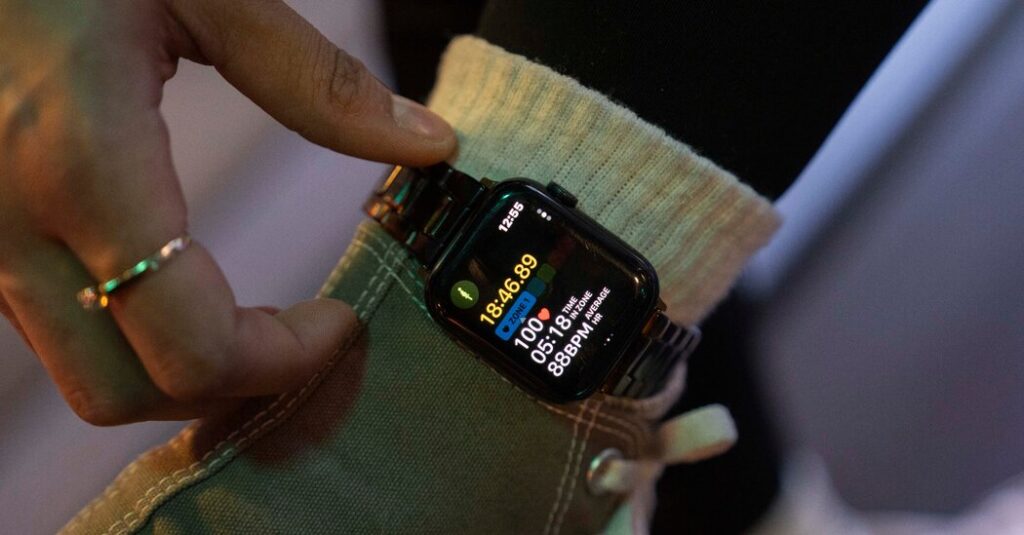
Health Secretary Robert F. Kennedy Jr. has called wearable devices, like smart watches or smart rings, a way for people to “take control over their own health” and “a key” to the Make America Healthy Again agenda.
These devices, often called wearables, can provide a feed of useful data, including your step count, heart rate, sleep quality and calories burned. In the last few years, surveys have found that about 40 percent of Americans were using some type of wearable and that ownership was higher among younger, healthier and more fitness-minded consumers. “My vision is that every American is wearing a wearable within four years,” Mr. Kennedy said in a congressional hearing last year.
But many doctors are more skeptical, saying that only some of the metrics wearables provide are clinically useful, and they are still sorting out which ones and in what context. Dr. Zahi Fayad, director of the BioMedical Engineering and Imaging Institute at Mount Sinai, said the devices can help doctors remotely monitor patients and detect early signs of disease. But for now, he said, many wearable metrics fall short of medical standards, and there is little data to prove that using them improves health outcomes.
Still, some patients, searching for answers, arrive at their doctors’ offices with screenshots of their wearable data or questions about confusing readings. And some companies that sell wearables are starting to allow users to consult with clinicians through their apps.
Which wearable metrics matter to doctors
Certain wearables, like continuous glucose monitors, tend to be prescribed by doctors and are held to medical-grade standards. But with wearables you can buy online, doctors tend to focus on only a few metrics that are medically meaningful or revealing.
For example, some wearable devices can flag atrial fibrillation, a potentially dangerous heart rhythm abnormality, said Dr. Erica Spatz, director of the preventive cardiovascular health program at Yale. In one Apple Watch study, researchers checked irregular pulse notifications against simultaneous readings from a medical-grade electrocardiogram patch and found that the watch alerts corresponded to atrial fibrillation 84 percent of the time.
Other measures, like step counts, can show doctors how active or sedentary you are. Studies have tied getting about 7,000 steps a day to a lower risk of cardiovascular disease, Type 2 diabetes and dementia.
Basic sleep patterns — when you go to bed, when you wake up and how much total sleep you get — can similarly be useful, since both sleep consistency and duration are important, said Dr. Cheri Mah, a California-based sleep physician and adjunct lecturer at the Stanford Sleep Medicine Center. Researchers tested three popular wearables against a gold-standard sleep study and found the devices agreed with the study over 90 percent of the time, in distinguishing sleep from wakefulness.
But some metrics, like blood pressure, blood oxygen and sleep stages, are not measured accurately by wearables, Dr. Spatz said. Others, she added, like VO2 max and heart rate variability, can offer rough measures of fitness and recovery, but are not yet useful for making medical decisions.
Many wearables also offer wellness scores, aggregating multiple streams of data into a simple number, like biological age, stress or sleep quality. Each company calculates these scores differently, using their own proprietary algorithms, said Dr. Jag Singh, a professor at Harvard Medical School and a former chair of cardiology at Massachusetts General Hospital. So doctors can’t tell what these scores are really measuring or whether they correspond to actual health outcomes.
“They can be useful at the individual level for wellness,” Dr. Singh said, “but I don’t think they’re useful to the clinician.”
How to use wearables properly
The best way to use wearables is to look at longer-term trends rather than obsessing over day-to-day swings, Dr. Fayad said. A sudden change can matter when it lines up with symptoms, like palpitations during a heart rate spike. But in general, one unusual reading is less telling than a sustained change over weeks or months. “The value of the wearable is not the number,” he said. “It’s the trajectory.”
The same caution, Dr. Singh said, applies when comparing your data with someone else’s. People vary widely in metrics like heart rate variability or VO2 max, even when they have similar fitness levels. Your own base line is typically more useful than any outside benchmark.
If a wearable motivates you to improve your step count or helps you notice that alcohol worsens your resting heart rate, that can be useful, Dr. Fayad said. But if you compulsively check your data and become worried or frustrated, the wearable might be doing more harm than good. For example, wearables can sometimes worsen sleep, said Dr. Ezekiel J. Emanuel, a health policy expert at the University of Pennsylvania and the author of the book “Eat Your Ice Cream.”
One recent survey found that about 30 percent of the people who tracked their sleep were at risk of orthosomnia, an unhealthy fixation with getting perfect sleep. A better guide, Dr. Emanuel said, is how refreshed you feel in the morning.
If anxiety over wearable data is a problem, one answer might be to just stop tracking the data. Another might be to use a wearable for specific, short-term purposes, like increasing activity levels or sleep consistency, and then to put it away, Dr. Spatz said.
Wearables have made it easier than ever to monitor the inner workings of your body. But it will take more research and better tools to integrate those numbers, put them in context and tell doctors what, if anything, is worth acting on.
“They help to tell a story,” Dr. Spatz said, “but we haven’t yet figured out how to use them.”
The post The Wearable Data Your Doctor Actually Wants appeared first on New York Times.